Plot Explained Spoilers guaranteed!
Plot Explained

Browse by genre

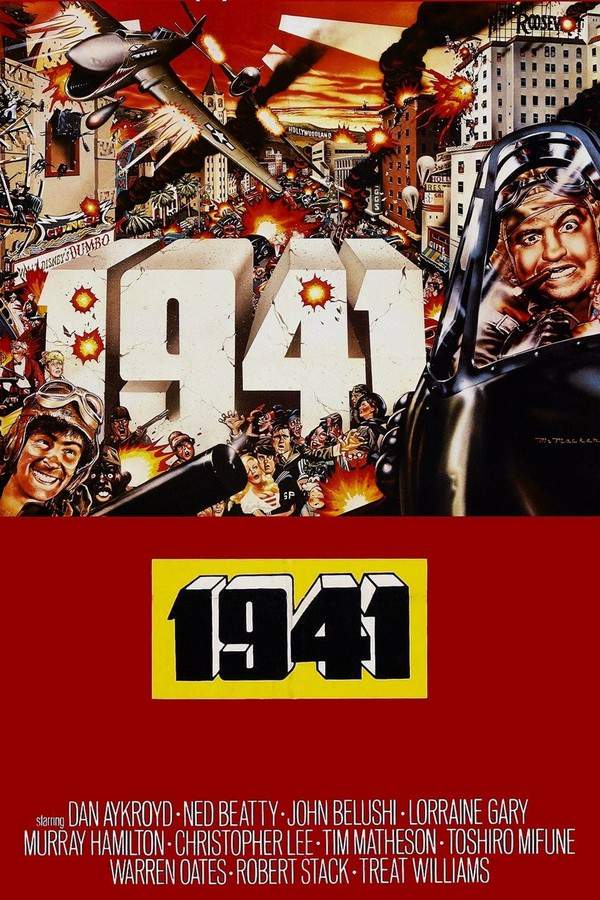
1941 (1979) movie poster

Plot Summary

1941 (1979) Plot Summary Explained

Release, runtime and language
1979 · 118 min · English
JustWatch #3,970 24
Directed by
Steven Spielberg
Starring
Dan Aykroyd, Treat Williams, Nancy Allen, John Belushi, Tim Matheson
Budget
$35M

Following the surprise attack on Pearl Harbor, Los Angeles is thrown into a state of panic and confusion. A ragtag group of soldiers and civilians find themselves caught up in a chaotic series of events as rumors of an imminent Japanese invasion spread. Amidst the escalating hysteria and elaborate special effects, they must navigate a comical and over-the-top situation, ultimately preparing to defend Hollywood's iconic coastline.

On this page (6)
  1. 1 Where to watch
  2. 2 What happens: full plot
  3. 3 Plot questions answered
  4. 4 Movie threads
  5. 5 Movies like 1941
  6. 6 Every angle

Where to watch

Where to Watch 1941 (1979)

Where can you watch 1941? Stream, rent or buy it in the US, including on Fawesome, Amazon Video and Apple TV Store: current JustWatch availability with up-to-date prices.

Streaming availability powered by JustWatch

Full plot summary · contains spoilers

What Happens in 1941: Full Plot Summary

The whole story of 1941 (1979) explained, from the opening scene to the final frame: every key event, every twist and what it all adds up to. Read it as a quick recap before the sequel, to check a scene you missed, or to finally understand what really happened.

On December 13, 1941, mere days after the devastating Japanese attack on Pearl Harbor, a young woman, a member of a daring 'Polar Bear' swim club, takes the exhilarating plunge into the ocean off a beach in northern California, unaware of the peril lurking beneath the surface. As she swims, her adventure takes a startling turn when a Japanese submarine rises from the depths, revealing the I-19 and its commanding officer, Akiro Mitamura, played by the legendary Toshiro Mifune. Accompanying him is a stern German naval captain, Wolfgang von Kleinschmidt, portrayed by Christopher Lee. Mitamura reveals to Von Kleinschmidt their audacious mission to eradicate a symbol of American pride along the West Coast, having evaded spotlight during the week of chaos the Japanese Navy created. The scene escalates as a Japanese crew member spots the girl clinging to the periscope, exclaiming: > "Hollywood! Hollywood!" This pivotal moment signals their intended target as the submarine dives back under the water, leaving the girl to swim to safety.

Meanwhile, in the heart of Los Angeles, the local dishwasher, Wally Stephens, played by Bobby Di Cicco, shares his risky ambition to enter a dance contest with his former love, Betty Douglas, much to the dismay of her strict father. This hopeful endeavor is humorously interrupted by the chaotic presence of Sgt. Frank Tree, exquisitely portrayed by Dan Aykroyd. Alongside his tank crew, including Corporal Sitarski played by Treat Williams, the camaraderie and tension culminate as Sitarski develops a strong animosity toward Wally due to Wally's shady past. In a fit of rage, the situation escalates into a scuffle fueled by misunderstandings linked to Wally's juvenile delinquent history.

Shifting our focus, we find Betty Douglas deep in training with her friend Maxine as taxi dancer trainees gearing up for a USO show amidst a flurry of military activity. Wally, on a shopping spree for the perfect zoot suit to impress Betty, devises an uproarious plan involving an air raid siren to make his escape from a department store, leading to a hilariously theatrical getaway. The farce continues as John Belushi's character, Captain Wild Bill Kelso, a reckless US Army Air Force officer, creates havoc after crash-landing his stolen P-40 to refuel, resulting in explosive consequences.

Back in Los Angeles, Major General Joseph Stilwell, portrayed by Robert Stack, attempts to maintain some semblance of order amid the unfolding chaos. His new secretary, Donna Stratten, played by Nancy Allen, finds herself ensnared in the absurdity when she is pursued by Captain Loomis Birkhead played by Tim Matheson. Birkhead's outlandish attempts to woo Donna are fraught with comedic mishaps, particularly in an airborne adventure gone wrong during a press conference, leading to a bomb dropping incident that sends everyone diving for cover.

Simultaneously, the Douglas family home falls victim to the spiral of madness as they confront the consequences of their past actions, including Wally's criminal misdeeds. The brewing tension reaches a climax as the all-too-determined Corporal Sitarski and the Tank crew attempt to keep peace in the escalating feuds of a community divided. As the ongoing madness ensues with collisions between soldiers and civilians, misunderstandings lead to a riot in which Wally tries to gain Betty's attention while getting embroiled in the chaos.

The night spirals into a whirlwind of ludicrous events with the Japanese submarine gripped in a whirlwind of their own, leading to a series of unforgettable confrontations that play out with the amusement park serving as the battle ground. Amidst the pandemonium, the confluence of characters leads to Wally commandeering a tank in a heroic and disastrous frenzy, aiming to rescue his love and reclaim some semblance of honor.

As morning dawns on December 14, the remnants of the previous night's uproar lay scattered across the coastline. General Stilwell gathers the beleaguered townsfolk to recount their harrowing experiences. The absurdity of the war, personal vendettas, and the community's determination to rise above owning their flaws gives way to a wild, comedic reckoning. Fittingly, Wally's impulsive nature leads to a misshapen decoration spiel underscoring the dark humor amidst a dire moment, illustrating that despite chaos, hope shines bright amid the calamity.

As General Stilwell observes, with fond exasperation, > "It's gonna be a long war," signifying the endless comedic potential that war and folly often unveil.
Last updated: January 18, 2025 at 14:36

Was this helpful?

Plot questions answered

1941 Plot Explained: Your Questions Answered

The questions people ask most about 1941 (1979): what happens in the confusing scenes, why the characters do what they do, the twists, hidden details and what the ending means. Each answer contains spoilers.

Q1

Why did the Japanese submarine aim for Hollywood instead of a military target?

Commander Mitamura explains that they chose Hollywood as their target to strike at a symbol of American pride along the West Coast. The sub had evaded detection during the chaos following Pearl Harbor and selected Hollywood as a high-profile psychological target rather than a strategic military installation.

  • japanese submarine
  • hollywood
  • commander mitamura
  • target
Q2

Why did Corporal Sitarski hate Wally so much?

Sitarski developed strong animosity toward Wally because of Wally's shady past as a juvenile delinquent. When Wally tried to pursue Betty Douglas, Sitarski's hostility was fueled by knowledge of Wally's criminal history, leading to the initial confrontation at the diner.

  • wally stephens
  • sitarski
  • betty douglas
  • juvenile delinquent
Q3

What triggered the civil defense red alert in Los Angeles?

A civil defense radar spotted an unknown aircraft approaching Los Angeles, prompting the red alert. This aircraft was actually Captain Birkhead and Donna Stratten stolen transport plane, which inadvertently attracted enemy fire and escalated the city's panic during the night of chaos.

Foreshadowing: Earlier, Birkhead and Donna stole an old transport plane from Barstow Air Force Base to pursue their airborne adventure.

  • civil defense
  • red alert
  • los angeles
  • aircraft
  • birkhead
Q4

Why did Wally steal a tank to pursue the submarine?

After hearing about the Japanese submarine's position in the area, Wally commandeered a tank out of desperation to confront the threat and prove himself worthy to Betty Douglas. His impulsive nature and desire to reclaim his honor drove him to take this heroic but disastrous action.

Foreshadowing: Wally's desperation to impress Betty had been building throughout the film, as seen in his failed attempts to get a zoot suit and enter the dance contest.

  • wally stephens
  • tank
  • submarine
  • betty douglas
Q5

What happened that got Wally and Dennis fired from the diner?

Wally and Dennis were fired from the diner after persistently trying to secure a night off. This dismissal intensified Wally's desperation to reconnect with Betty and pursue his dream of entering the dance contest, setting up his later increasingly reckless behavior.

  • wally stephens
  • diner
  • fired
  • dennis
Q6

Why did Captain Birkhead and Donna steal a plane?

Captain Birkhead, desperate to impress Donna, convinced her to steal an old transport plane from Barstow Air Force Base. Their lack of flying experience and communication led to their aircraft being mistaken for an enemy threat, inadvertently causing the civil defense panic.

Foreshadowing: Birkhead had been making outlandish attempts to woo Donna throughout the movie, including a disastrous airborne press conference.

  • birkhead
  • donna
  • plane
  • steal
  • barstow
Q7

What happened to the Japanese submarine I-19?

The Japanese submarine I-19 became disoriented when its compass failed. After dispatching a landing party to capture a local timber merchant for directions, the submarine eventually surfaced at the amusement park pier where it confronted Wally, Wild Bill, and their crew in the final chaotic showdown.

Foreshadowing: The compass failure was referenced when the sub crew realized they were lost along the California coast.

  • i-19
  • japanese submarine
  • compass
  • amusement park
Q8

Why did Captain Wild Bill Kelso crash-land his plane at a gas station?

Captain Wild Bill Kelso, portrayed as a reckless US Army Air Force officer, stole a P-40 fighter plane and crash-landed it at a gas station in Death Valley while attempting to refuel. His chaotic attempt to take off again resulted in accidentally blowing up the station in a fiery explosion.

  • wild bill kelso
  • p-40
  • death valley
  • gas station
Q9

Why did the Japanese submarine crew capture a timber merchant?

After their compass failed and they became lost along the California coast, Commander Mitamura dispatched a landing party to capture a local timber merchant. The crew needed the merchant to determine their location and get directions, leading to an unusual exchange that caused unexpected trouble for the captors.

Foreshadowing: Earlier, the submarine crew had discussed becoming disoriented after their compass malfunctioned.

  • timber merchant
  • compass
  • submarine
  • lost
Q10

What started the fight between Wally and the tank crew at the diner?

The fight erupted when Sgt. Frank Tree's tank crew confronted Wally after he shared his ambitions to enter the dance contest with his former love Betty. Tensions rose due to Wally's shady past, and Sitarski's personal animosity toward Wally fueled the scuffle that revealed Wally's juvenile delinquent history.

  • sgt frank tree
  • tank crew
  • diner
  • fight
  • betty
Q11

How did Wally get the zoot suit from the department store?

Wally went on a shopping spree to buy the perfect zoot suit to impress Betty. When trapped by store security, he devised a humorous plan using an air raid siren as a distraction to make his theatrical escape from the department store with the suit.

  • zoot suit
  • department store
  • air raid siren
  • wally
Q12

What happened at the amusement park pier showdown?

The final confrontation took place at the amusement park pier where Wally, his crew, and Wild Bill engaged in a chaotic battle against the Japanese submarine. Misfires and pandemonium ensued as they tried to neutralize the submarine threat while dealing with their own hilarious misadventures, ultimately resolving the immediate invasion threat comedically.

Foreshadowing: The sub had been heading toward the Hollywood coastline since its initial appearance.

  • amusement park pier
  • final battle
  • submarine
  • wild bill

Movie threads

More Movies Like 1941, by Mood & Story

Curated lists built around what makes 1941 tick: the same mood, the same kind of story or the same emotional payoff. Each list explains why these movies belong together.

Wartime Hysteria Comedies like 1941

Stories where mass panic and misunderstandings fuel a chaotic, comedic spectacle. If you liked the chaotic, slapstick portrayal of home-front panic in 1941, you'll enjoy these movies. This thread gathers comedies where historical anxiety, often set during wartime, leads to a frenzy of misunderstandings, brawls, and spectacularly incompetent responses from both civilians and the military.

  • chaotic
  • slapstick
  • zany
  • uproarious
  • frenetic
  • satirical
  • Tone: light, farcical, satirical
  • Pacing: fast, frenetic, non-stop
Why these movies?

The story pattern: The narrative typically begins with a triggering event that sparks widespread, irrational fear. This fear is then amplified through a series of comedic misunderstandings and mishaps, involving an ensemble cast whose separate storylines collide in increasingly absurd ways. The plot is driven by a domino effect of panic rather than a single antagonist, culminating in a large-scale, chaotic finale that resolves the immediate threat but often leaves a hint of ironic reality.

Why they belong together: Movies in this thread share a commitment to turning serious settings into playgrounds for slapstick. They blend high-intensity action and frantic pacing with a consistently light, farcical tone, ensuring the stakes feel comical rather than genuinely threatening. The core similarity is the theme of 'patriotic panic' leading to spectacular, humorous incompetence.

Movies with Ensemble Cast Chaos like 1941

Fast-paced comedies where multiple character arcs collide in a single night of madness. Fans of 1941's huge cast and intersecting storylines will love these picks. This section features fast-paced comedies and action-comedies where a diverse group of characters—soldiers, civilians, rivals—find their paths chaotically crossing, leading to a spectacular, comedic collision of narratives.

  • frenetic
  • ensemble
  • interweaving plots
  • chaotic collisions
  • zany
  • madcap
  • Tone: light, humorous, frantic
  • Pacing: fast, intersecting, non-linear
Why these movies?

The story pattern: The narrative structure follows multiple parallel storylines, often involving romantic rivals, bureaucratic fools, and eager heroes. These threads are woven together by a central, chaotic event that acts as a magnet, pulling every character into the same escalating situation. The plot advances through rapid-fire scene shifts between the different groups, building towards a climax where all storylines converge in a massive, hilarious set piece.

Why they belong together: These films are united by their structural similarity: a large cast, a fast pace that juggles multiple perspectives, and a tone that finds humor in the chaos of crowded, colliding narratives. They prioritize energetic, sprawling antics over deep character study, creating a sense of joyful, unpredictable bedlam.

If you liked this

Movies Like 1941

Similar movies to 1941: the same genre, themes or kind of story. Each one comes with its own plot summary, timeline and ending explained.

Browse all movie summaries

Every angle

1941 (1979) Explained: Plot, Timeline & Characters

Everything about 1941 in one place: what happens in the plot summary, the timeline in chronological order, the characters and meaning and a spoiler-free summary. What's After the Movie adds the cast, box office and post-credit scenes.

Coming soon on iOS and Android

The Plot Explained Movie Summary App

Plot summaries, endings explained and timelines on your phone. Catch up on any movie in minutes, save your favorites and never miss a twist again.

Be the first to know when we launch. Your email stays private, always.

Learn more about the app