





Plot Explained Spoilers guaranteed!
Plot Explained

Browse by genre

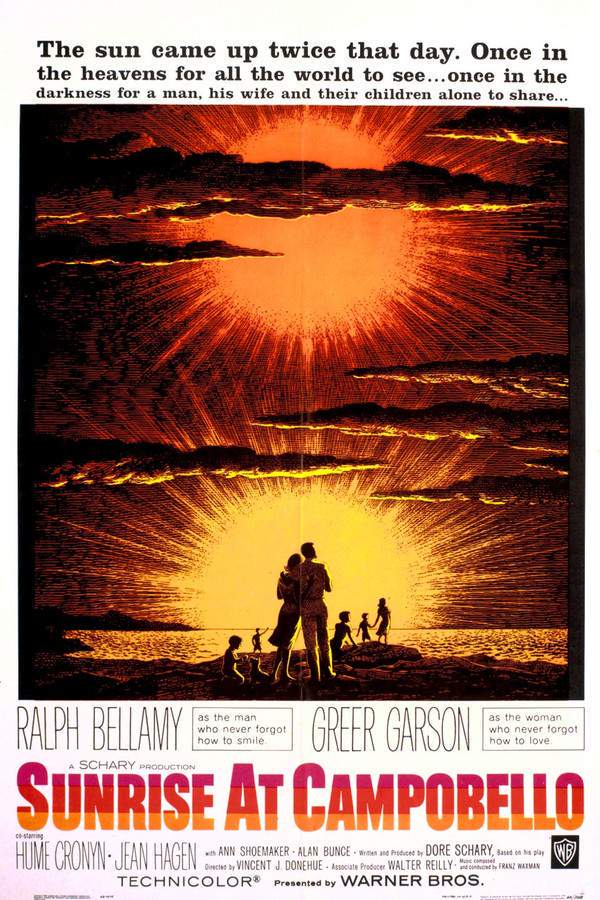
Sunrise at Campobello (1960) movie poster

Timeline

Sunrise at Campobello (1960) Timeline Explained – Every Event in Order

Release, runtime and language
1960 · 144 min · English
Directed by
Vincent J. Donehue
Starring
Hume Cronyn, Ralph Bellamy, Frank Ferguson, Zina Bethune, Jean Hagen, Tim Considine

During a summer on Campobello Island, Vice President Franklin Delano Roosevelt is suddenly struck by a mysterious illness that leaves him paralyzed. Facing a devastating blow to his political ambitions and personal life, he grapples with the challenges of his condition alongside his supportive wife, Eleanor, and the guidance of his trusted advisor, Louis Howe. The experience profoundly shapes his perspective and sets the stage for his future leadership.

On this page (6)
  1. 1 Where to watch
  2. 2 Events in order (15)
  3. 3 Timeline questions answered
  4. 4 Movie threads
  5. 5 Movies like Sunrise at Campobello
  6. 6 Every angle

Where to watch

Where to Watch Sunrise at Campobello (1960)

Where can you watch Sunrise at Campobello? Stream, rent or buy it in the US, including on Amazon Video, Apple TV Store and Fandango At Home: current JustWatch availability with up-to-date prices.

Streaming availability powered by JustWatch

15 events in order · contains spoilers

Sunrise at Campobello Timeline: Events in Chronological Order

Every key event of Sunrise at Campobello (1960) in order, scene by scene, with when and where it takes place. Use it to untangle flashbacks, time jumps and parallel storylines, to refresh your memory before the sequel or to find the exact scene you are thinking of.

  1. Summer Bliss at Campobello Island

    In the summer of 1921, Franklin Delano Roosevelt enjoys peaceful days with his family at their summer home in Campobello Island, Canada. Alongside his wife Eleanor and their five children, he relishes the beauty of the island while envisioning a hopeful future.

    When
    Summer 1921
    Where
    Campobello Island, New Brunswick, Canada
  2. Life-Altering Collapse

    One fateful evening, while watching the sunset, Franklin inexplicably loses strength in his legs and collapses. This incident marks the beginning of a significant transformation in his life as he grapples with his health.

    When
    Evening, Summer 1921
    Where
    Campobello Island, New Brunswick, Canada
  3. Diagnosis of Poliomyelitis

    By the next morning, Franklin experiences another fall, leading to a heartbreaking diagnosis of infantile paralysis, also known as poliomyelitis. This sudden turn brings about emotional turmoil for Franklin and his family, who must now confront the reality of his condition.

    When
    Morning, Summer 1921
    Where
    Campobello Island, New Brunswick, Canada
  4. Arrival of Louis McHenry Howe

    Following the devastating news of Franklin's health, his friend and advisor, Louis McHenry Howe, arrives on the scene. With a strong belief in Franklin's potential political future, Louie offers both guidance and encouragement during this troubled time.

    When
    Weeks after diagnosis
    Where
    Campobello Island, New Brunswick, Canada
  5. Sara Delano's Arrival

    Weeks later, Franklin's overprotective mother, Sara Delano, arrives from overseas, bringing her dominating presence into the already strained family dynamic. While she disapproves of Louie's influence, he serves as a comforting figure for Eleanor, who's now caring for Franklin.

    When
    Weeks after diagnosis
    Where
    Campobello Island, New Brunswick, Canada
  6. Plan to Mislead the Press

    As the summer comes to a close, Louie devises a plan to protect Franklin from prying reporters eager to exploit his weakened condition. The family uses decoys while Franklin, hidden beneath a stretcher, is secretly transported away, showcasing Louie's dedication to safeguarding his friend's reputation.

    When
    End of Summer 1921
    Where
    Campobello Island, New Brunswick, Canada
  7. Life in New York City

    After spending several months in the hospital, Franklin returns to New York City, where he starts using leg braces and devises tools to help with daily activities. Despite his physical challenges, he remains keenly engaged in politics, exchanging letters and supporting peace initiatives.

    When
    Fall 1921
    Where
    New York City, USA
  8. Seeking Independence

    Franklin's determination to regain mobility leads him to teach himself how to crawl, which he perceives as a metaphor for his struggles. During poignant conversations, he shares his feelings of isolation and the importance of viewing his trials as learning experiences.

    When
    Fall 1921
    Where
    New York City, USA
  9. Eleanor as Franklin’s Voice

    As Franklin is considered for a gubernatorial candidacy, he prepares Eleanor to act on his behalf, delivering his speeches with care. Through this partnership, they reinforce their commitment to overcoming obstacles and pursuing public service together.

    When
    Winter 1922
    Where
    New York City, USA
  10. Significant Improvements

    By July 1923, the Roosevelt family gathers in Hyde Park, where Franklin experiences a notable improvement in his condition. Despite still being unable to walk, he joyfully interacts with his sons, crediting Eleanor's public engagement and Louie's support for his renewed spirit.

    When
    July 1923
    Where
    Hyde Park, New York, USA
  11. A Candid Family Discussion

    During a heartfelt conversation, Franklin and Eleanor reflect on their family background and the challenges they have faced together. Their discussion is interrupted by their daughter Anna, leading to a family dialogue that addresses issues of belonging and connection.

    When
    July 1923
    Where
    Hyde Park, New York, USA
  12. Return to New York City

    In January 1924, the family resumes their life in New York City where Eleanor's public speaking skills flourish. Tensions remain with Sara, who insists Franklin abandon his ambitions for leisure, igniting a spirited debate about societal responsibilities.

    When
    January 1924
    Where
    New York City, USA
  13. Preparing for the Democratic Convention

    As the presidential election approaches, Governor Alfred E. Smith considers nominating Franklin for a significant speech at the Democratic Convention. Louie recognizes the moment as a chance for Franklin to reaffirm his political relevance.

    When
    Early 1924
    Where
    New York City, USA
  14. Franklin’s Historic Speech

    On the night of the convention, Franklin prepares to make history by walking to the podium for his speech. In front of an expectant audience, he triumphantly takes his first steps, symbolizing not only his physical progress but also his determination to engage with the public.

    When
    Early 1924
    Where
    New York City, USA
  15. Public Reception

    As Franklin makes his way to the podium, a hush falls over the hall before erupting into cheers when he delivers his speech. This moment marks a critical point in his comeback story, solidifying his place in politics and inspiring those facing their own challenges.

    When
    Early 1924
    Where
    New York City, USA

Last updated: October 25, 2024 at 10:12

Was this helpful?

Timeline questions answered

Sunrise at Campobello Timeline Explained: Your Questions Answered

When does it happen, and why in that order? The questions people ask about the chronology of Sunrise at Campobello (1960): time jumps, flashbacks, cause and effect between scenes and the correct order of events, each answered with spoilers.

Q1

Why did Franklin Roosevelt suddenly collapse at Campobello Island?

In the summer of 1921, Franklin Roosevelt was enjoying a peaceful evening watching the sunset at his Campobello Island home when he suddenly lost strength in his legs and collapsed. The next morning, he experienced another fall, leading to his diagnosis of poliomyelitis (infantile paralysis). The exact cause of the paralysis was the disease itself, which attacks the motor neurons of the spinal cord, leading to temporary or permanent loss of muscle function. This sudden onset is characteristic of polio, which can progress rapidly once the virus reaches the nervous system.

  • franklin roosevelt collapse
  • poliomyelitis onset
  • campobello island 1921
  • fdr paralysis cause
Q2

How did Eleanor Roosevelt become Franklin Roosevelt's political voice after his illness?

After Franklin was paralyzed and confined to his bed, his political career appeared to be over. His advisor Louis Howe recognized that Franklin could still pursue politics if he had someone to represent him publicly. Howe coached Eleanor to deliver Franklin's speeches, acting as his "eyes, ears, and legs" by speaking on his behalf at public events. This arrangement allowed Franklin to maintain his political relevance while his physical condition prevented him from appearing publicly. Eleanor's public engagements grew from this necessity, eventually transforming her into a major political figure in her own right.

Foreshadowing: Earlier, Louie had encouraged Missy Le Hand to maintain faith in Franklin, foreshadowing the support system that would develop around him.

  • eleanor roosevelt political voice
  • fdr speech delivery
  • louis howe political strategy
  • eleanor public speaker
Q3

Why was Franklin Roosevelt's 1924 Democratic Convention speech a turning point?

The 1924 Democratic Convention speech marked Franklin Roosevelt's public return to politics after his polio diagnosis. Governor Alfred E. Smith, a Catholic candidate seeking the Democratic nomination, asked Franklin to deliver the nominating speech. This was a significant test because the speaker needed to stand for at least forty-five minutes. In a dramatic moment, Franklin had his son James wheel his chair close to the stage, then used his leg braces to stand and walk the ten steps to the podium. The crowd erupted in cheers, proving to the nation that Franklin had recovered sufficiently to resume his political career.

Foreshadowing: Louie had been preparing Franklin for this opportunity, pressuring him to streamline his responsibilities and clearly articulate his opinions to the public.

  • 1924 democratic convention
  • fdr nominating speech
  • alfred smith
  • fdr walk to podium
  • political comeback
Q4

Why was Louis Howe so confident about Franklin Roosevelt's political future?

Louis McHenry Howe arrived at Campobello Island shortly after Franklin's diagnosis with an almost mystical conviction that Franklin's political destiny was preordained. Despite Franklin's paralysis, Howe believed that his friend was destined for greater things and refused to accept that his political career was over. Howe dedicated himself to protecting Franklin's public image, devising the plan to mislead the press, and strategically positioning Franklin for future political opportunities. His unwavering belief provided crucial emotional support during Franklin's darkest moments and drove the practical strategies that kept Franklin politically relevant during his recovery.

Foreshadowing: Howe had already been Franklin's trusted advisor before the illness, giving him unique insight into Franklin's capabilities and ambitions.

  • louis howe conviction
  • fdr political destiny
  • louie howe advisor
  • fdr recovery support
Q5

Why did Sara Delano oppose Franklin Roosevelt's return to politics?

Franklin's mother Sara Delano was an intimidating, overprotective widow who believed that wealthy's responsibility to society was through "noblesse oblige" - meaning the wealthy should live leisurely lives and contribute through philanthropy rather than seeking public office. She found Louie's influence distasteful and discouraged any notion that Franklin should engage in public service or pursue ambitious political goals. Sara wanted Franklin to abandon his political ambitions and live a comfortable life at their Hyde Park estate. She argued that his late cousin President Theodore Roosevelt had perished due to ambition from those around him. Franklin passionately rejected this view, countersuggesting that such ideals merely cloaked indifference.

Foreshadowing: From her arrival, Sara disapproved of Louie's influence and systematically opposed his efforts to keep Franklin politically active.

  • sara delano opposition
  • fdr mother conflict
  • noblesse oblige
  • fdr family tension
Q6

How did Louis Howe protect Franklin Roosevelt's reputation from the press?

As summer ended in 1921 and the family typically prepared to return to New York, Franklin was still confined to his bed. The press was clamoring for evidence of his weakened state, which could have ended his political career. Louie devised a clever plan where the departing family acted as decoys to mislead reporters, while Franklin was discreetly transported by stretcher to a separate ferry. Once Franklin was safely away, Louie released an optimistic statement about Franklin's anticipated recovery. This deception successfully protected Franklin's public image during his most vulnerable period and allowed him to rebuild his strength away from public scrutiny.

Foreshadowing: Louie's belief in Franklin's political destiny made him willing to take extraordinary measures to protect his friend's future.

  • press deception
  • fdr reputation protection
  • louie howe plan
  • media cover-up fdr
Q7

What did Franklin Roosevelt mean by the "fire" metaphor during his recovery?

Franklin Roosevelt revealed to Eleanor that he was experiencing recurring nightmares about being trapped in flames. He interpreted the "fire" as a metaphor for his struggles with polio - the intense physical and emotional ordeal he was enduring. Rather than seeing these trials solely as suffering, Franklin believed there was a greater purpose in enduring them. He viewed his challenges as lessons in humility that would ultimately strengthen his character and prepare him for future leadership. This mindset reflected his remarkable psychological resilience in converting his personal tragedy into a source of inner strength.

Foreshadowing: Franklin's private despair about his situation was known to Louie, who worked to provide hope and purpose during this period.

  • fdr fire metaphor
  • fdr nightmares
  • fdr psychological struggle
  • polio recovery mindset
Q8

How did Franklin Roosevelt learn to walk again after polio?

After returning to New York City from the hospital, Franklin used leg braces and invented ingenious gadgets to assist with daily activities. Despite medical expectations that he would never walk again, Franklin nurtured the hope of a full recovery. He taught himself to crawl as an intermediate step, which Eleanor witnessed as a small victory of independence. By July 1923 at Hyde Park, Franklin had improved significantly - still unable to walk unassisted but capable of playful interactions with his sons. He credited his resilience to Eleanor's public engagements, Louie's relentless support, and his written statements that kept him afloat. The dramatic culmination came in early 1924 at the Democratic Convention, where he walked to the podium using his braces.

Foreshadowing: Franklin had been planning a vibrant future despite his condition, refusing to accept the limitations others imposed on him.

  • fdr learn walk
  • fdr leg braces
  • fdr polio recovery
  • fdr crawl stairs
Q9

What political opportunities arose for Franklin Roosevelt after his illness?

After his polio diagnosis, Franklin Roosevelt's political career seemed finished, but Louis Howe kept his name alive in political circles. By winter 1922, the New York Democratic Party began considering Franklin for a gubernatorial candidacy. This opportunity required Eleanor to take on a more public role, delivering carefully crafted speeches that reflected Franklin's positions. The timing was crucial - as the 1924 presidential election approached, Governor Alfred E. Smith needed a reliable speaker who could command respect. Franklin's preparation for the nominating speech at the Democratic Convention represented his pathway back to national politics.

Foreshadowing: Franklin remained politically engaged through correspondence even during his recovery, supporting Woodrow Wilson's peace initiatives.

  • fdr gubernatorial candidate
  • new york democrats
  • fdr political comeback
  • alfred smith nomination
Q10

How did Franklin Roosevelt's illness affect his family relationships?

Franklin's paralysis created significant strain within the family. His mother Sara clashed with Louis Howe, whom she found vulgar and overbearing, while he provided crucial support to Eleanor. Eleanor took on the primary caregiving role while also learning to become Franklin's political voice. Their relationship deepened through this shared challenge - in July 1923, Franklin told Eleanor he felt "sure-footed" thanks to her public engagements, Louie's support, and his written statements. However, their daughter Anna felt excluded from this close partnership, leading to an honest family dialogue about belonging. Franklin and Eleanor also reflected on their originally distant relationship and the opposition they faced when they married, acknowledging how much they had grown together.

Foreshadowing: Early in their marriage, Franklin and Eleanor were described as having distant familial ties, making their collaborative partnership after the illness even more significant.

  • fdr family relationships
  • eleanor roosevelt caregiver
  • sara delano conflict
  • anna roosevelt feelings

Movie threads

More Movies Like Sunrise at Campobello, by Mood & Story

Curated lists built around what makes Sunrise at Campobello tick: the same mood, the same kind of story or the same emotional payoff. Each list explains why these movies belong together.

Movies about overcoming adversity like Sunrise at Campobello

True stories of individuals overcoming immense personal challenges with unwavering spirit. For viewers who appreciated the inspiring journey in Sunrise at Campobello, this section features similar movies. If you like true stories about resilience, disability, and personal triumph against overwhelming odds, you'll find more biographical dramas with hopeful and determined characters here.

  • inspiring
  • resilient
  • emotional
  • determined
  • supportive
  • hopeful
  • Tone: hopeful, determined, inspiring
  • Pacing: steady, character-driven
Why these movies?

The story pattern: Stories in this thread typically follow a linear, character-driven arc. A successful or ambitious individual is struck by a sudden, devastating setback—often a medical condition or physical limitation. The narrative then charts their emotional struggle, acceptance, and the arduous process of redefining their life and goals, culminating in a hard-won victory or a renewed sense of purpose.

Why they belong together: These movies are grouped together because they share a core theme of human resilience. They balance the weight of a serious situation with a fundamentally hopeful and uplifting tone. The pacing is steady, allowing the audience to fully invest in the character's emotional journey, and the endings provide a sense of catharsis and triumph.

Steady historical dramas with strong characters like Sunrise at Campobello

Deliberate narratives that explore pivotal moments in the lives of notable figures. If you liked the character-focused, steady pacing of Sunrise at Campobello, explore these similar historical dramas. This list features movies that offer a thoughtful and in-depth look at the personal lives of famous figures, focusing on their relationships and internal struggles during a key period.

  • reflective
  • historical
  • character-driven
  • earnest
  • steady
  • intimate
  • Tone: reflective, earnest, hopeful
  • Pacing: steady, deliberate
Why these movies?

The story pattern: The narrative pattern involves a focused examination of a specific, transformative period in a famous person's life. The plot is straightforward and chronological, avoiding complex twists in favor of emotional authenticity. The conflict is often internal—a battle of will and spirit—as much as it is external, with the supporting cast playing a crucial role in the protagonist's journey.

Why they belong together: These films share a similar viewing experience: a steady, deliberate pace that allows for deep character immersion. They blend historical context with intimate human drama, resulting in a medium-intensity experience that is more reflective than thrilling. The tone is generally earnest and hopeful, even when dealing with serious subject matter.

If you liked this

Movies Like Sunrise at Campobello

Similar movies to Sunrise at Campobello: the same genre, themes or kind of story. Each one comes with its own plot summary, timeline and ending explained.

Browse all movie summaries

Every angle

Sunrise at Campobello (1960) Explained: Plot, Timeline & Characters

Everything about Sunrise at Campobello in one place: what happens in the plot summary, the timeline in chronological order, the characters and meaning and a spoiler-free summary. What's After the Movie adds the cast, box office and post-credit scenes.

Coming soon on iOS and Android

The Plot Explained Movie Summary App

Plot summaries, endings explained and timelines on your phone. Catch up on any movie in minutes, save your favorites and never miss a twist again.

Be the first to know when we launch. Your email stays private, always.

Learn more about the app