Plot Explained Spoilers guaranteed!
Plot Explained

Browse by genre

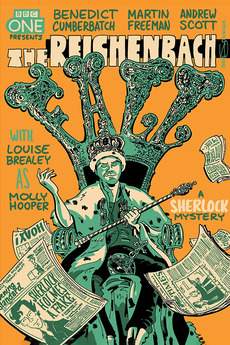
Sherlock: The Reichenbach Fall (1000) movie poster

Plot Summary

Sherlock: The Reichenbach Fall (1000) Plot Summary Explained

Release, runtime and language
1000 · 88 mins · English
Loading streaming availability…
Directed by
Toby Haynes
Starring
Benedict Cumberbatch, Martin Freeman, Mark Gatiss, Douglas Wilmer, Andrew Scott, Vinette Robinson

Jim Moriarty hatches a mad scheme to turn the whole city against Sherlock.

On this page (5)
  1. 1 Where to watch
  2. 2 What happens: full plot
  3. 3 Plot questions answered
  4. 4 Movie threads
  5. 5 Every angle
Loading streaming availability…

Full plot summary · contains spoilers

What Happens in Sherlock: The Reichenbach Fall: Full Plot Summary

The whole story of Sherlock: The Reichenbach Fall (1000) explained, from the opening scene to the final frame: every key event, every twist and what it all adds up to. Read it as a quick recap before the sequel, to check a scene you missed, or to finally understand what really happened.

John Watson, Martin Freeman, sits in his first therapy session in eighteen months, trying to explain why he’s there, and he stumbles toward a devastating confession that frames the entire episode:

> "My best friend, Sherlock Holmes, is dead."

To understand how things spiraled there, the story rewinds to three months earlier, when Benedict Cumberbatch as Sherlock Holmes is riding high on a string of public praise. He has solved dangerous cases, recovered a valuable Turner painting of Reichenbach Falls, and helped Interpol trap a wanted criminal, all while a media circus swirls around him. The director of a project greets him with a wrapped gift, which Sherlock immediately deduces is a pair of diamond cuff-links—though he grumbles that he wears cuffs without buttons. The kidnapped banker’s son presents another wrapped gift, and Sherlock detects a tie pin, though he insists he does not wear ties. For the Interpol case, DI Lestrade offers a deerstalker cap as a present. The gifts feel like trophies and tests, all while Sherlock basks in attention that borders on fame.

Watson senses the danger in Sherlock’s growing notoriety. The press might turn on him, and the private detective’s days of quiet investigation could be over. So Watson counsels a low profile and a modest case to keep the spotlight from becoming overwhelming. Moriarty, ever the puppeteer, teases the edge of the crime world, nearly stealing the Crown Jewels to prove a point, then allows himself to be caught. He even brazenly taunts the security at the Bank of England and the Tower of London by exploiting his iPhone-powered tricks, all while work on the Tower burglary continues. Before smashing the Crown Jewels’ case, he writes the ominous words “Get Sherlock” on the outside to catch the cameras’ gaze, and then surrenders to the police wearing the jewels while sitting on a throne.

The tabloids explode with headlines about a “Crime of the Century,” framing a sequence of break-ins at the Tower, Pentonville Prison, and the Bank of England as the work of a single mastermind. A front door full of reporters and gawkers greets Sherlock and Watson as they head to court, and Kitty Riley, a sharp reporter, slips her business card into Sherlock’s jacket pocket while warning him that the press may soon turn on him and that he’ll need someone on his side.

In court, Sherlock testifies that Moriarty is a criminal genius who has threatened jurors into acquitting him. Moriarty has manipulated the system and the jurors through fear, claiming he can hack any bank, access nuclear launch codes, and wreak havoc—yet Sherlock cannot quite pin down the motive beyond Moriarty’s own desire to observe people and manipulate them for power. Moriarty casually admits that the break-ins were a publicity stunt designed to attract clients, confessing, “I owe you a fall.” A chilling line; the danger isn’t merely wealth or power, but the spectacle.

Meanwhile, Sherlock’s world is unsettled by the growing sense that someone is leaking his personal information. Mycroft, Mark Gatiss, unintentionally reveals details during interrogation with Moriarty, and those disclosures are weaponized to attack Sherlock’s reputation. Sherlock begins to notice a coded pattern—the anti-security code is hidden in the tapping of Moriarty’s fingers—and Moriarty’s aim is to corner him in a public collision.

The plot thickens as the team hunts for the source of the leak. They break into Kitty Riley’s home and discover Moriarty’s fake identity, Richard Brook (a.k.a. “Reichen Bach” in German), a ruse used to present himself as the mastermind behind every crime. With his cover now blown, Sherlock resolves to play a final gambit. He seeks help from Molly Hooper, Louise Brealey, a pathologist at St. Bartholomew’s, and confesses that he respects her and wants her assistance if he is to face Moriarty’s threats. Molly shares personal memories of her father’s death and the way people show happiness when others are nearby, offering Sherlock a rare chance to connect emotionally in the midst of danger.

As investigations pivot, Sherlock and Watson race to prevent further harm to a British ambassador’s children, Rufus Bruhl’s kin being abducted. Sherlock deciphers clues that help the police locate the children, but Moriarty has already manipulated events to mislead them, traumatizing one of the children to make her fear Sherlock herself. Sergeant Donovan, played by Vinette Robinson, grows suspicious, and the chief superintendent pushes Lestrade, Rupert Graves, toward making an arrest—only Sherlock escapes with Watson as a “hostage” during the confrontation. The world’s eyes turn toward the duo as they realize Moriarty’s “Get Sherlock” message has convinced the underworld that Sherlock is compromised and that the password to bypass security might exist.

In a tense pursuit, Sherlock and Watson infiltrate Kitty Riley’s newsroom and uncover Moriarty’s manipulation: the “master criminal” Richard Brook is just a front, and Moriarty has crafted a narrative designed to crash Sherlock’s credibility. With the trap closing in, Sherlock leaves John and seeks Molly’s help once more, admitting he knows someone betrayed him and that he is in grave danger. He also learns that Mycroft inadvertently disclosed sensitive information during earlier interrogations of Moriarty, a revelation that helps explain the public onslaught against him.

The final gambit hinges on Sherlock’s plan to erase the threat and outwit Moriarty once and for all. He arranges a rooftop rendezvous at St. Bartholomew’s Hospital, inviting Moriarty to face him one last time. Moriarty’s ultimatum is brutal: either Sherlock commits suicide, or Moriarty’s hitmen will finish the job for him, targeting John, Mrs. Hudson, and Lestrade. Sherlock, recognizing the deadly trap, feigns acquiescence but refuses to surrender. The two men acknowledge a profound similarity, and Moriarty swears that as long as he lives, Sherlock will be tested by danger. Then Moriarty overwhelms Sherlock with a choice that cannot be undone and ends his own life, saying, “As long as I am alive, you can save your friends.”

The moment of triumph is also a moment of tragedy. Sherlock calls John, explaining that the call was his “note” and leaps from the hospital roof, a decision that leaves John and Mrs. Hudson reeling with fear and grief as Sherlock’s body is carried away. John, stunned and heartbroken, watches as a cyclist knocks him to the ground before he reaches Sherlock’s side. The story returns to the therapy room, where John remains unable to open up fully, and Mycroft stands over The Sun, a tabloid revealing the headline “Suicide of Fake Genius.” Later, John visits Sherlock’s grave with Mrs. Hudson, affirming his faith that Sherlock is not truly gone, and then, in a quiet, haunting final beat, Sherlock is shown watching from a distance before stepping away again, leaving a sense of unresolved absence and the enduring bond between two friends.

The episode ends with the quiet ache of memory and the suggestion that the enigma of Moriarty—the man who could “solve” anything—has finally died with him, but the friendship between Martin Freeman and Benedict Cumberbatch remains, a knot of loyalty, fear, and genius that survives even the darkest hour.
Last updated: October 01, 2025 at 13:03

Was this helpful?

Plot questions answered

Sherlock: The Reichenbach Fall Plot Explained: Your Questions Answered

The questions people ask most about Sherlock: The Reichenbach Fall (1000): what happens in the confusing scenes, why the characters do what they do, the twists, hidden details and what the ending means. Each answer contains spoilers.

Q1

Why did Sherlock jump off the hospital rooftop?

Sherlock jumped to fake his death and protect John, Mrs. Hudson, and Lestrade. Moriarty had set an ultimatum: either Sherlock kills himself, or Moriarty's hitmen would murder his friends. By appearing to die, Sherlock eliminated Moriarty's leverage while ensuring Moriarty's identity as the true mastermind died with him, preventing any possibility of clearing his name publicly. The call to John was his 'note' - a final message before the fall.

  • sherlock holmes death
  • fake suicide
  • moriarty rooftop
  • reichenbach fall
  • john watson
Q2

Who is Richard Brook in Sherlock?

Richard Brook is a fictional identity created by Moriarty to destroy Sherlock's reputation. 'Brook' is an English translation of the German word 'Bach' - making 'Richard Brook' an anagram of 'Reichenbach', the waterfall where Sherlock fakes his death. Moriarty used this fabricated persona to have journalist Kitty Riley publish stories portraying Sherlock as the true criminal mastermind behind all his crimes.

  • richard brook
  • moriarty fake identity
  • reichenbach
  • kitty riley
  • sherlock framed
Q3

Why was Moriarty acquitted in court?

Moriarty was acquitted because he intimidated the jurors by threatening to harm their families. During the trial, he claimed he could hack any bank, access nuclear launch codes, and destroy anyone who opposed him. The terrified jurors voted not guilty, allowing Moriarty to walk free and continue his campaign against Sherlock.

  • moriarty trial
  • juror intimidation
  • old bailey
  • sherlock testifies
Q4

Why did Moriarty break into the Tower of London and Bank of England?

The break-ins were deliberate publicity stunts designed to demonstrate Moriarty's capabilities and attract clients. He orchestrated simultaneous break-ins at the Tower of London, Pentonville Prison, and the Bank of England, then deliberately allowed himself to be caught wearing the Crown Jewels while sitting on a throne. Each crime was meant to prove he could bypass any security system, building his reputation as a criminal mastermind before his confrontation with Sherlock.

  • crown jewels
  • tower of london
  • bank of england
  • moriarty crimes
  • pentonville prison
Q5

Why did Moriarty kill himself on the rooftop?

Moriarty killed himself to force Sherlock into an impossible choice. By shooting himself, he denied Sherlock the option to save him and removed the leverage Moriarty had over Sherlock's friends. His final words - 'As long as I am alive, you can save your friends' - meant that with his death, Sherlock could no longer save anyone, making Sherlock's suicide the only way to stop the hitmen. It was Moriarty's final test and psychological manipulation.

  • moriarty suicide
  • moriarty death
  • rooftop scene
  • sherlock choice
Q6

How did Mycroft accidentally help Moriarty?

Mycroft inadvertently leaked Sherlock's personal information during his interrogation of Moriarty. While questioning Moriarty, Mycroft revealed sensitive details about Sherlock that Moriarty later weaponized in his campaign to destroy Sherlock's reputation. This leak contributed to the public turning against Sherlock and the spread of the Richard Brook narrative.

  • mycroft
  • moriarty interrogation
  • information leak
  • sherlock betrayed
Q7

What was the anti-security code Moriarty mentioned?

The anti-security code was a psychological trap. Moriarty hinted that there was a special code that could bypass all security systems, which Sherlock desperately tried to decode throughout the episode. In reality, the code did not exist - it was part of Moriarty's plan to make Sherlock appear paranoid and obsessive while creating the illusion of a solution just out of reach. The tapping pattern Moriarty made was meant to taunt Sherlock rather than provide real information.

  • anti-security code
  • moriarty cipher
  • sherlock deduction
  • security hack
Q8

Did Sherlock really die in The Reichenbach Fall?

No, Sherlock faked his death. While John and the public believed Sherlock jumped to his death, the final scenes reveal Sherlock is actually alive and watching from a distance as John visits his grave. This sets up the premise for Sherlock's return in subsequent episodes. John remains unaware of the truth throughout the episode, which is why he attends therapy to cope with his grief.

  • sherlock alive
  • sherlock fake death
  • sherlock returns
  • john watson grief
Q9

What was Moriarty's real motive against Sherlock?

Moriarty's motive was not money or power - it was intellectual satisfaction. He explicitly states he enjoys observing people and manipulating them for his own amusement. Sherlock represented the ultimate challenge, a worthy opponent whose destruction would prove Moriarty's superiority. Moriarty wanted to 'solve' Sherlock the way one solves a puzzle, culminating in forcing Sherlock to choose between his own death or his friends' deaths.

  • moriarty motivation
  • moriarty personality
  • sherlock enemy
  • criminal mastermind
Q10

What was Kitty Riley's role in Moriarty's plan?

Kitty Riley was a journalist whom Moriarty used as a mouthpiece to spread his false narrative. She published stories presenting Richard Brook as the criminal mastermind whom Sherlock had secretly employed to commit all his cases. Sherlock and Watson later broke into her home and discovered the truth, but by then the damage to Sherlock's public reputation was already done. She warned Sherlock earlier that the press would turn on him.

  • kitty riley
  • journalist
  • richard brook story
  • sherlock reputation
Q11

What does the title The Reichenbach Fall mean?

The title references Reichenbach Falls in Switzerland, the location where Sherlock Holmes creator Arthur Conan Doyle originally 'killed' the detective in 1893. The German word 'Fall' means 'case' or 'fall' (as in downfall), while Richard Brook is an anagram of 'Reichenbach'. The title connects Moriarty’s manufactured identity to the location of Sherlock's fake death, blending the episode's plot with the original Sherlock Holmes mythology.

  • reichenbach falls
  • sherlock holmes history
  • title meaning
  • arthur conan doyle
Q12

What was the meaning of 'Get Sherlock' written on the Crown Jewels case?

Moriarty deliberately wrote 'Get Sherlock' on the Crown Jewels case before smashing it, knowing the security cameras would capture the message. This was a calculated move to directly implicate Sherlock in the crime and plant suspicion in the public mind, setting up his broader campaign to destroy Sherlock's reputation and credibility.

  • get sherlock
  • crown jewels
  • moriarty message
  • frame sherlock

Movie threads

More Movies Like Sherlock: The Reichenbach Fall, by Mood & Story

Curated lists built around what makes Sherlock: The Reichenbach Fall tick: the same mood, the same kind of story or the same emotional payoff. Each list explains why these movies belong together.

Mastermind Psychological Battles Like Sherlock: The Reichenbach Fall

Brilliant minds face off in high-stakes psychological warfare where intellect is the ultimate weapon. For viewers who enjoyed the cerebral showdown in Sherlock: The Reichenbach Fall, this section highlights movies and shows featuring genius protagonists pitted against equally brilliant antagonists. If you like tense, psychologically complex stories of intellectual warfare and manipulation, you'll find similar thrilling experiences here.

  • cerebral
  • tense
  • suspenseful
  • psychological
  • mind-bending
  • strategic
  • Tone: tense, cerebral
  • Pacing: fast, driven by plot twists
Why these movies?

The story pattern: The narrative typically revolves around a strategic game of cat and mouse, where the antagonist designs an elaborate scheme to destroy the protagonist's reputation, sanity, or life. The protagonist must decipher complex puzzles and psychological traps under immense pressure, leading to a climax that hinges on outthinking the opponent rather than brute force.

Why they belong together: These movies are grouped together because they share a core focus on intellectual conflict, high-stakes mind games, and the intense psychological pressure faced by brilliant characters. The similarity lies in the specific type of tension generated by two masterminds trying to anticipate each other's every move.

Movies About Sacrificial Friendship Like Sherlock: The Reichenbach Fall

Heart-wrenching stories where profound friendship is tested by a necessary, devastating sacrifice. If the emotional weight of sacrifice and loyalty in Sherlock: The Reichenbach Fall resonated with you, this section collects stories with similar themes. Discover movies and shows where deep friendships are central to a narrative involving tragic choices, profound loss, and a bittersweet aftermath.

  • tragic
  • melancholic
  • bittersweet
  • emotional
  • grief
  • loyalty
  • Tone: tragic, melancholic, bittersweet
  • Pacing: fast build-up, poignant resolution
Why these movies?

The story pattern: The emotional journey follows a deeply bonded pair, often a duo, where one character feels compelled to make a huge personal sacrifice—sometimes faking their death or enduring great suffering—to protect the other or a greater good. The aftermath focuses on the surviving character's grief and the complex, often hidden, truth behind the sacrifice, creating a poignant mix of tragedy and unwavering loyalty.

Why they belong together: These films are united by their exploration of sacrificial love within powerful friendships. They share a heavy emotional weight, a bittersweet or tragic ending feel, and a core theme that true loyalty can endure even the most devastating deception or loss.

Every angle

Sherlock: The Reichenbach Fall (1000) Explained: Plot, Timeline & Characters

Everything about Sherlock: The Reichenbach Fall in one place: what happens in the plot summary, the timeline in chronological order, the characters and meaning and a spoiler-free summary. What's After the Movie adds the cast, box office and post-credit scenes.

Coming soon on iOS and Android

The Plot Explained Movie Summary App

Plot summaries, endings explained and timelines on your phone. Catch up on any movie in minutes, save your favorites and never miss a twist again.

Be the first to know when we launch. Your email stays private, always.

Learn more about the app