Plot Explained Spoilers guaranteed!
Plot Explained

Browse by genre

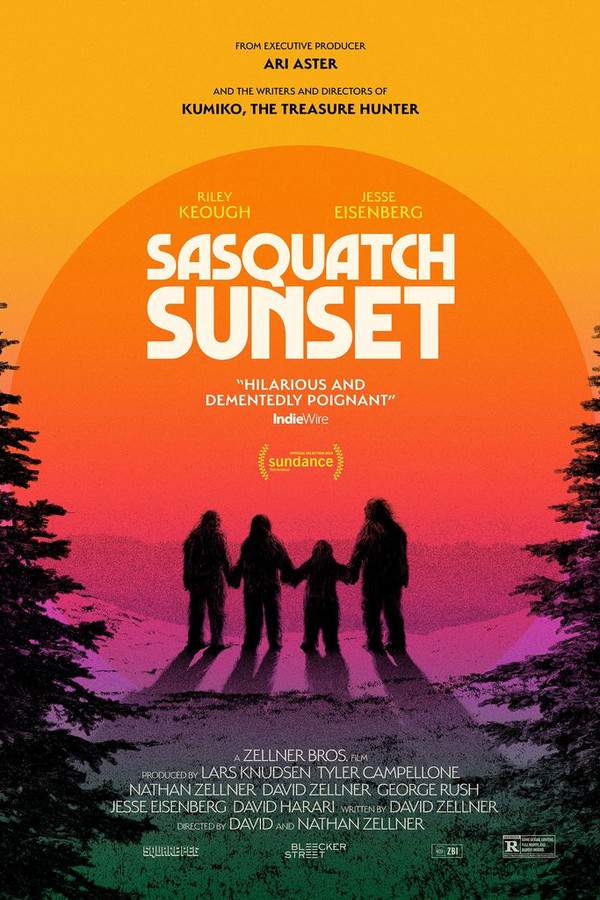
Sasquatch Sunset (2024) movie poster

Plot Summary

Sasquatch Sunset (2024) Plot Summary & Ending Explained

Release, runtime and language
2024 · 1 h 29 m · English
Echo score 77
Directed by
David Zellner
Starring
Jesse Eisenberg, Riley Keough, Nathan Zellner, Christophe Zajac-Denek

A family of Sasquatches, their existence precarious, undertakes a humorous and action-packed journey across a single year in the heart of North America. Facing an ever-changing world and the challenges of survival, they confront questions about identity and what it means to be human.

On this page (7)
  1. 1 Where to watch
  2. 2 What happens: full plot
  3. 3 Plot questions answered
  4. 4 How it ends
  5. 5 Movie threads
  6. 6 Movies like Sasquatch Sunset
  7. 7 Every angle

Where to watch

Where to Watch Sasquatch Sunset (2024)

Where can you watch Sasquatch Sunset? Stream, rent or buy it in the US, including on Hoopla, Kanopy and Fandango at Home Free: current JustWatch availability with up-to-date prices.

Streaming availability powered by JustWatch

Full plot summary · contains spoilers

What Happens in Sasquatch Sunset: Full Plot Summary

The whole story of Sasquatch Sunset (2024) explained, from the opening scene to the final frame: every key event, every twist and what it all adds up to. Read it as a quick recap before the sequel, to check a scene you missed, or to finally understand what really happened.

In the untamed wilderness of Northern California, a family of four nomadic Sasquatches struggles to survive. This group consists of a rugged alpha male, his devoted mate, their young offspring, and another adult male. Their daily lives revolve around roaming through the terrain, foraging for food, and engaging in mystical rituals, using branch drums to create sounds that resonate with the land in the hopes of contacting others of their kind.

As spring approaches, the alpha's attempts to mate are met with rejection from the female, igniting a whirlwind of frustration. In his anger, he steals an essential beam from their shelter, searching for comfort in a misguided connection with an inanimate object. This leads to a confrontation with the rest of the group, resulting in his exclusion. Consumed by despair, he accidentally ingests a poisonous mushroom, which leaves him incapacitated. In a delusional state, he tries to connect with a mountain lion but tragically meets his doom the following day. His companions, forced to grapple with sorrow, hold a solemn burial for their fallen leader.

As summer unfolds, new complications arise with the female's noticeable pregnancy, evoking the lone male's primitive urges. Despite his attempts at mating rituals, she repeatedly denies him, triggering a flight response when the family stumbles across marked trees and roads. Instinctively, they leave their own markings out of caution. Their journey turns dire when they encounter a floating log. In a reckless move, the male ascends the log, only to meet a watery fate, leaving his family in a state of helpless despair as they witness his tragic drowning.

With the arrival of fall, the female and her child invade a human campsite, taking out their pent-up emotions by vandalizing the area while a boombox blasts "Love to Hate You." In a playful moment, the child throws a frisbee, triggering a dramatic series of events that lead to the mother going into labor. They hastily escape the chaos as she gives birth to a new baby, whose placenta unexpectedly becomes a protective diversion from a prowling mountain lion.

In the unforgiving winter, survival means resorting to stealing a penned chicken and outsmarting traps, narrowly avoiding disaster as the baby almost suffocates in sleep but is saved by its vigilant mother. Their journey eventually brings them to Willow Creek, where they encounter the stark reality of a forest fire and the unsettling remnants of clear-cutting. As they traverse this altered landscape, they approach a local museum, linearly connecting with a Sasquatch statue in a poignant reflection of their far-reaching desires that remain unfulfilled, echoing their lost heritage amidst the devastation.

Last updated: November 17, 2024 at 15:51

Was this helpful?

Plot questions answered

Sasquatch Sunset Plot Explained: Your Questions Answered

The questions people ask most about Sasquatch Sunset (2024): what happens in the confusing scenes, why the characters do what they do, the twists, hidden details and what the ending means. Each answer contains spoilers.

Q1

Why does the alpha male get kicked out of the family?

The alpha male is rejected and excluded after he steals a vital beam from the family's shelter in a moment of frustration. His attempts to mate with the female have been repeatedly rejected, and in his anger and desperation, he takes the beam in a misguided attempt to find comfort through connection with an inanimate object. This betrayal of the family's resources leads the others to drive him out.
  • alpha male
  • exile
  • shelter beam
  • mating rejection
  • familial conflict
Q2

How does the alpha male die in the forest?

After being excluded from the family, the alpha male consumes a poisonous mushroom in his depressed state, which leaves him incapacitated and hallucinating. In his delusional condition, he attempts to connect with a mountain lion as if it were another Sasquatch. The following day, he is killed by the mountain lion, fulfilling his tragic attempt at connection.

Foreshadowing: Earlier in spring, the family uses branch drums in rituals hoping to contact others of their kind, establishing their desperate need for connection.
  • alpha death
  • mountain lion
  • poisonous mushroom
  • hallucination
  • tragic connection
Q3

Why does the female reject the lone male during her pregnancy?

The female Sasquatch continues to reject the lone male's mating attempts despite her pregnancy because she is already carrying another family member's child. Her loyalty and attachment remain with the deceased alpha, and her pregnancy represents the continuation of his lineage rather than a new bond with the surviving male.

  • pregnancy
  • female rejection
  • mating rituals
  • loyalty
  • alpha lineage
Q4

Why do the Sasquatches mark trees and roads during their journey?

The Sasquatches mark trees and roads as an instinctual response to encountering human-made markings in the wilderness. This is a territorial behavior, they leave their own scent and scratch marks to establish their presence and warn other creatures (or Sasquatches) away from their territory, reflecting their animalistic survival instincts.

  • marking territory
  • instinct
  • survival
  • wilderness
  • communication
Q5

What triggers the mother to go into labor at the human campsite?

The mother's labor is triggered during the chaotic moment when her child throws a frisbee at the campsite, causing dramatic upheaval. The combination of physical exertion from the vandalism, stress, and likely the emotional intensity of the moment induces premature labor, leading to an unexpected birth amidst the chaos.

  • labor
  • birth
  • campsite
  • frisbee
  • chaos
  • emotional stress
Q6

How does the placenta protect the newborn from the mountain lion?

After the mother gives birth at the campsite, the placenta is discarded but becomes a crucial diversion. When a mountain lion approaches, the placenta's scent or the mother's quick use of it distracts the predator, buying time for the family to escape. The placenta literally becomes a protective shield in their moment of greatest vulnerability.

  • placenta
  • mountain lion
  • protection
  • birth
  • escape
  • survival
Q7

Why does the family visit the museum at the end of the movie?

The family approaches a local museum as they travel through the devastated landscape around Willow Creek. Drawn by the Sasquatch statue displayed there, they seek connection to their lost heritage and identity. The museum represents the human world's attempt to memorialize or understand creatures like them, while the family longs for acknowledgment of their existence.

  • museum
  • Sasquatch statue
  • heritage
  • identity
  • Willow Creek
  • human world
Q8

What does the Sasquatch statue represent in the ending?

The Sasquatch statue at the museum represents the family's unfulfilled desire for connection and recognition. It serves as a haunting mirror showing what their kind has become, a symbol, a curiosity, a relic, while the real Sasquatches remain hidden and dwindling. The statue reflects both their longing for belonging and the extinction of their living heritage.

  • statue
  • heritage
  • extinction
  • identity
  • belonging
  • symbolism
Q9

Why is the movie's ending considered bittersweet?

The ending is bittersweet because the family survives and gains a new member (the baby), offering hope for continuation. However, they witness the destruction of their habitat through forest fires and clear-cutting, and their encounter with the museum statue reveals their lost heritage and unfulfilled desire for connection with others of their kind. They endure but remain fundamentally alone.

  • bittersweet ending
  • survival
  • habitat destruction
  • heritage loss
  • hope
  • grief
Q10

What is the purpose of the Sasquatches' branch drum rituals?

The branch drum rituals are mystical practices the family uses in an attempt to contact others of their kind. By creating resonant sounds that echo through the land, they hope to signal any remaining Sasquatches in the wilderness. These rituals underscore their deep loneliness and desperate need for connection with their own species.

  • branch drums
  • ritual
  • communication
  • Sasquatch connection
  • loneliness
  • hope

Ending explained

What Happens at the End of Sasquatch Sunset?

How Sasquatch Sunset (2024) ends, in short: the final scene, the last twist and what it means for the characters. The full ending explained, with every spoiler, lives on its own page.

Read the full ending explained

Sasquatch Sunset presents a haunting reflection on the possible disappearance of the legendary creatures known as sasquatches, set against the backdrop of a wilderness gradually encroached upon by humans. Throughout the film, we observe a simple, natural life cycle of a small sasquatch family—an alpha male, a female, and a child—whose existence is marked by primal behaviors and struggles. As the seasons change, the story reveals the increasing difficulty they face: the alpha male’s aggression, his inappropriate pursuit of the female, and his tragic death in a river, which signifies the loss of a dominant figure. The female and child are left to continue their existence, navigating the wilderness and encounters with human objects and signs of civilization, like a campsite and a tape recorder playing synth-pop music, which disturb their natural harmony.

The pivotal moment comes when the female female’s water breaks at the campsite, leading to the birth of a baby. This act symbolizes new life amidst the ongoing decay of their world. However, the scene is intense and visceral, emphasizing the rawness of their existence and the toll of their environment. As winter sets in, survival becomes even harder—resources are scarce, and they face dangers like traps and predators, yet the female repeatedly sacrifices herself to protect the baby.

Continue reading the ending (1 more paragraphs)

The film’s ending is tinged with a sense of melancholy and loss. The sasquatches follow smoke to what appears to be a human establishment, such as a museum with a bigfoot statue. They are curious, but their attempt to communicate or connect with this symbol of humans fails utterly, leaving them in a place that is clearly outside their natural habitat. The final scene, with the female and the child gazing at the statue in silence, suggests that these creatures are no longer part of the world—perhaps extinct or simply mythologized. Their look conveys a mixture of sadness, confusion, and resignation, expressing that what once roamed the forest freely has now vanished, replaced by human development. The film implies that the myth of sasquatches lives on only as a memory or a relic of a lost wilderness, overshadowed by mankind’s relentless encroachment. It’s a contemplative and eerie reflection on how nature’s legends fade away when faced with civilization’s relentless advance.

Sasquatch Sunset ending explained in full

Movie threads

More Movies Like Sasquatch Sunset, by Mood & Story

Curated lists built around what makes Sasquatch Sunset tick: the same mood, the same kind of story or the same emotional payoff. Each list explains why these movies belong together.

Primal survival tales like Sasquatch Sunset

Raw, contemplative journeys through nature, blending survival struggles with absurdist comedy. For viewers who enjoyed the raw, nature-centric journey in Sasquatch Sunset, this collection highlights movies like it that explore primal survival, animal instincts, and the bittersweet humor found in the struggle for existence. Discover similar stories of family, loss, and connection to the natural world.

  • primal
  • survivalist
  • tragicomic
  • contemplative
  • raw
  • isolated
  • Tone: melancholic, tragicomic
  • Pacing: steady, episodic
Why these movies?

The story pattern: Narratives in this thread often follow a group or individual's fight for existence in a wild, unforgiving setting. The journey is structured around the passage of time and seasons, punctuated by both tragic setbacks and moments of levity that arise from an inherently non-human or primal viewpoint, leading to a contemplative reflection on life and legacy.

Why they belong together: These films are grouped by their unique tonal blend of melancholic survivalism and tragicomedy. They share a focus on primal perspectives, a steady pace that mirrors natural cycles, and a medium emotional weight that balances the gravity of loss with the absurdity of existence.

Isolated group journeys like in Sasquatch Sunset

Stories of isolated groups facing a changing world, yearning for meaning and community. If you liked the story of the Sasquatch family's isolated journey in Sasquatch Sunset, this selection features similar movies about small groups or families grappling with their place in a changing world. Find films with a bittersweet feel, exploring themes of isolation, loss, and the search for connection.

  • isolated
  • longing
  • contemplative
  • bittersweet
  • melancholic
  • hopeful
  • Tone: melancholic, bittersweet, contemplative
  • Pacing: steady, character-driven
Why these movies?

The story pattern: These narratives typically follow a tight-knit, isolated unit through a linear journey of adaptation and survival. The plot is driven by external pressures and internal dynamics, leading to significant emotional losses and a climax that offers a bittersweet resolution—survival is achieved, but often at the cost of innocence or with an unfulfilled yearning for a deeper connection to the world beyond their isolation.

Why they belong together: Movies in this thread share a specific emotional mix: a melancholic and contemplative mood, a steady pacing that allows for emotional absorption, and a bittersweet ending feel. They are united by themes of family, isolation, and the existential search for purpose in a vast, often indifferent world.

If you liked this

Movies Like Sasquatch Sunset

Similar movies to Sasquatch Sunset: the same genre, themes or kind of story. Each one comes with its own plot summary, timeline and ending explained.

Browse all movie summaries

Every angle

Sasquatch Sunset (2024) Explained: Plot, Ending, Timeline & Characters

Everything about Sasquatch Sunset in one place: what happens in the plot summary, the timeline in chronological order, the characters and meaning, the ending explained and a spoiler-free summary. What's After the Movie adds the cast, box office and post-credit scenes.

Coming soon on iOS and Android

The Plot Explained Movie Summary App

Plot summaries, endings explained and timelines on your phone. Catch up on any movie in minutes, save your favorites and never miss a twist again.

Be the first to know when we launch. Your email stays private, always.

Learn more about the app