








Plot Explained Spoilers guaranteed!
Plot Explained

Browse by genre

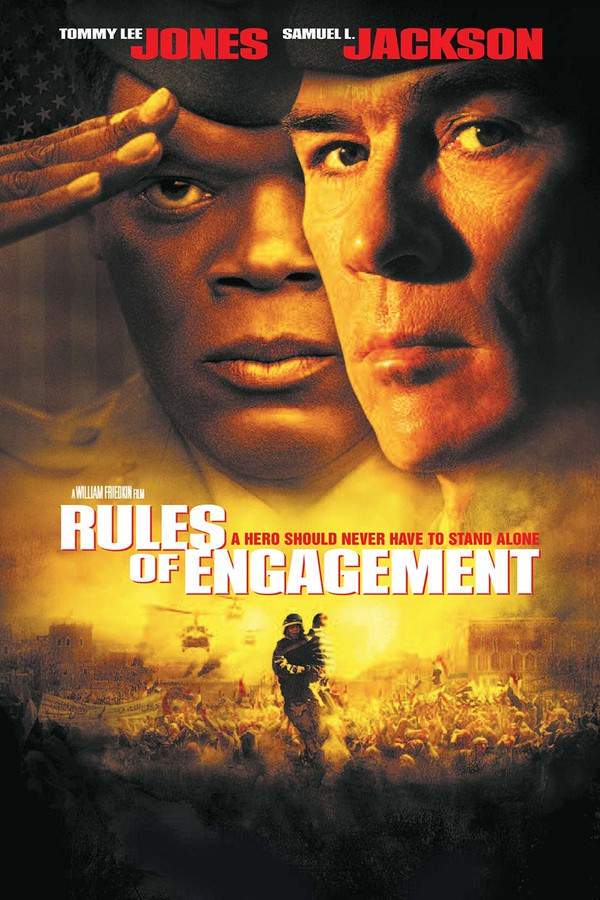
Rules of Engagement (2000) movie poster

Timeline

Rules of Engagement (2000) Timeline Explained – Every Event in Order

Release, runtime and language
2000 · 128 min · English
Directed by
William Friedkin
Starring
Samuel L. Jackson, Tommy Lee Jones
Budget
$60M

Facing legal repercussions after a disastrous rescue operation, decorated war hero Colonel Terry Childers seeks the assistance of Colonel Hays Hodges, a seasoned lawyer and trusted friend. Together, they navigate a complex legal battle, forcing Childers to confront the difficult truths of war, the weight of his actions, and the true cost of patriotism. The film explores themes of loyalty, sacrifice, and the blurred lines between duty and justice.

On this page (6)
  1. 1 Where to watch
  2. 2 Events in order (15)
  3. 3 Timeline questions answered
  4. 4 Movie threads
  5. 5 Movies like Rules of Engagement
  6. 6 Every angle

Where to watch

Where to Watch Rules of Engagement (2000)

Where can you watch Rules of Engagement? Stream, rent or buy it in the US, including on Hoopla, Kanopy and Amazon Video: current JustWatch availability with up-to-date prices.

Streaming availability powered by JustWatch

15 events in order · contains spoilers

Rules of Engagement Timeline: Events in Chronological Order

Every key event of Rules of Engagement (2000) in order, scene by scene, with when and where it takes place. Use it to untangle flashbacks, time jumps and parallel storylines, to refresh your memory before the sequel or to find the exact scene you are thinking of.

  1. Execution of Unarmed Prisoner

    In 1968, Lieutenant Terry Childers makes a controversial and drastic decision during the Vietnam War by executing an unarmed prisoner. His intention is to intimidate a North Vietnamese army officer to prevent a potential ambush, ultimately impacting the lives of U.S. Marines.

    When
    1968
    Where
    Vietnam
  2. Consequences of the Decision

    Despite Childers' actions saving Lieutenant Hayes Hodges, a group of Hodges' men tragically perish in the subsequent conflict. The incident leaves a significant mark on Hodges, shaping his future and perspective on military ethics.

    When
    1968
    Where
    Vietnam
  3. Hodges Reflects on His Past

    Fast forward to 1996, Colonel Hayes Hodges, now a distinguished officer on the verge of retirement, reflects on his transition from combat after being injured during Operation Kingfisher. This pivotal moment in his life prompted Hodges to pursue law school and begin a new path as a JAG officer.

    When
    1996
    Where
    United States
  4. Reunion with Colonel Childers

    At a gathering honoring his military service, Hodges reunites with Colonel Terry Childers, who currently leads a Marine Expeditionary Unit. Their reunion is a poignant reminder of their previous wartime experiences and the bonds formed under duress.

    When
    1996
    Where
    United States
  5. Evacuation in Yemen

    Col. Childers and his Marine Expeditionary Unit are deployed to Southwest Asia amidst growing civil unrest. Their mission is to evacuate the U.S. Ambassador to Yemen, but what starts as a routine operation swiftly devolves into chaos.

    When
    1996
    Where
    Yemen
  6. Return for the American Flag

    After successfully escorting the Ambassador to safety, Childers makes a fateful decision to go back for the American flag. This choice leads to the troops engaging a densely packed crowd, resulting in a tragic and lethal outcome.

    When
    1996
    Where
    Yemen
  7. Civilian Casualties

    The decision to engage the crowd leads to the deaths of 83 civilians and injuries to over 100 people. This disastrous consequence sends shockwaves throughout the military and government, igniting a national controversy.

    When
    1996
    Where
    Yemen
  8. Court-Martial Decision

    In the aftermath, U.S. National Security Advisor Bill Sokal calls for a court-martial to place the blame on Childers. This decision is motivated by a desire to restore the image of the U.S. military, further complicating Childers' situation.

    When
    1996
    Where
    United States
  9. Hodges Takes the Case

    Childers seeks legal representation from Hodges despite initial hesitations due to Hodges' mixed record as a JAG officer. The urgency of the matter pushes Hodges to accept the challenging case, as he must defend his old friend.

    When
    1996
    Where
    United States
  10. Journey to Yemen

    Hodges travels to Yemen to gather evidence and complete key interviews for the trial. He faces obstructions from government officials and challenging witness testimonies as he tries to piece together Childers’ defense.

    When
    1996
    Where
    Yemen
  11. Evidence Against Childers

    As the trial progresses, Hodges discovers that the evidence heavily favors the prosecution, with witnesses unable to confirm gunfire came from the crowd. This lack of corroboration increases the difficulty of mounting a solid defense for Childers.

    When
    1996
    Where
    United States
  12. Destruction of Evidence

    In a shocking turn, Bill Sokal destroys critical security footage that could support Childers' defense. This act of sabotage reveals the lengths to which the prosecution is willing to go to secure a conviction against Childers.

    When
    1996
    Where
    United States
  13. The Trial Heats Up

    During the trial, Hodges uncovers evidence of the destruction of exculpatory evidence, adding complexity to the courtroom drama. When Captain Lee is cross-examined, doubts about Childers’ actions are inadvertently raised, intensifying the proceedings.

    When
    1996
    Where
    United States
  14. Childers Takes the Stand

    In a dramatic courtroom moment, Childers takes the witness stand, passionately defending his actions. He confronts Major Biggs as audio evidence of his orders is presented, highlighting the moral dilemmas faced by military leaders.

    When
    1996
    Where
    United States
  15. Verdict and Aftermath

    The trial concludes with Childers being found guilty of only a minor infraction while being acquitted of murder and conduct unbecoming. The case raises questions about military ethics and the manipulation of truths, ultimately leading to Childers retiring honorably.

    When
    1996
    Where
    United States

Last updated: November 02, 2024 at 12:33

Was this helpful?

Timeline questions answered

Rules of Engagement Timeline Explained: Your Questions Answered

When does it happen, and why in that order? The questions people ask about the chronology of Rules of Engagement (2000): time jumps, flashbacks, cause and effect between scenes and the correct order of events, each answered with spoilers.

Q1

Why did Lieutenant Childers execute an unarmed prisoner during the Vietnam War?

Childers executed the unarmed prisoner to intimidate a North Vietnamese army officer and prevent an ambush that would have killed U.S. Marines under his command. This drastic decision, while controversial, was made under extreme wartime pressure with the intention of saving his men's lives.

Foreshadowing: The film opens with this incident, establishing Childers' willingness to make hard decisions under fire.

  • terry childers
  • vietnam war
  • execution
  • ambush
  • intimidation
Q2

Why did Colonel Childers risk his troops by returning for the American flag?

After successfully evacuating Ambassador Mourain and his family, Childers made the decision to return for the American flag as a symbolic act of honor and respect. This choice, however, led to engaging the crowd and resulted in the deaths of 83 civilians.

Foreshadowing: Earlier scenes establish Childers' deep sense of military honor and symbolism.

  • american flag
  • yemen
  • childers
  • civilian casualties
  • decision
Q3

Why was National Security Advisor Sokal so determined to convict Childers?

Sokal wanted to shift blame onto Childers to restore the American public image after the Yemen incident. A court-martial would provide a scapegoat for the government, protecting higher-level officials from accountability for the disaster.

Foreshadowing: Sokal's political motivations are hinted at early when he discusses managing public perception.

  • bill sokal
  • conviction
  • political cover-up
  • national security
Q4

How did the destruction of evidence affect Childers' defense?

Bill Sokal destroyed critical security footage that could have supported Childers' claim that the crowd fired first. This act of sabotage severely weakened the defense's case, forcing Hodges to rely on witness testimony and cross-examination strategies.

Foreshadowing: The film hints at Sokal's willingness to manipulate evidence when he meets with officials early in the investigation.

  • evidence
  • security footage
  • trial
  • childers defense
  • sabotage
Q5

What was the outcome of Childers' court-martial?

Childers was found guilty only of a minor infraction for breach of peace and acquitted of the serious charges of murder and conduct unbecoming an officer. He ultimately retired honorably from the Marine Corps, while Sokal and Mourain faced consequences for their manipulation of evidence and perjury.

Foreshadowing: Throughout the trial, the prosecution struggles to prove their more serious accusations.

  • verdict
  • acquitted
  • conviction
  • court-martial
  • retirement
Q6

Why did Hodges agree to defend Childers despite his hesitation?

Hodges initially hesitated due to his mixed record as a JAG officer, but the urgency of the situation and his personal history with Childers compelled him to accept. He felt that Childers, as a battle-hardened veteran who saved his life in Vietnam, deserved a lawyer who understood military combat ethics.

Foreshadowing: The 1996 reunion scene establishes the deep bond between Childers and Hodges from their Vietnam service.

  • hayes hodges
  • defense lawyer
  • jag officer
  • military
  • loyalty
Q7

Why did Ambassador Mourain agree to provide false testimony against Childers?

Mourain was blackmailed by Sokal, who used some form of leverage to force him into providing false testimony that would incriminate Childers. This manipulation was part of Sokal's broader scheme to ensure a conviction and protect the government's interests.

Foreshadowing: The film reveals Sokal's unethical tactics early through his discussions with prosecutors.

  • ambassador mourain
  • false testimony
  • blackmail
  • sokal
  • perjury
Q8

How did the Vietnam execution incident impact the court-martial?

The prosecution used Childers' Vietnam actions to portray him as having a pattern of reckless behavior. Colonel Cao, a Vietnamese officer who witnessed the 1968 execution, was brought to testify against Childers. However, Hodges successfully challenged this narrative by getting Cao to admit he would have done the same thing under similar circumstances.

Foreshadowing: The dual-timeline structure connects Childers' past decisions to his present legal battle.

  • vietnam
  • colonel cao
  • execution
  • trial
  • cross-examination
Q9

What caused the civilian casualties during the Yemen evacuation?

After retrieving the flag, Childers ordered his troops to engage the densely packed crowd, resulting in 83 deaths and over 100 injuries. The key dispute in the trial was whether the crowd fired first or if Childers' troops initiated the violence, with no team members able to confirm gunfire originated from the crowd.

Foreshadowing: The chaos of the Yemen scene establishes the confusion around who fired first.

  • yemen
  • civilian casualties
  • firefight
  • crowd
  • 83 deaths
Q10

Why was Childers acquitted of murder despite the civilian deaths?

The court could not prove beyond reasonable doubt that Childers ordered the shooting or that his actions directly constituted murder. While the incident was tragic, the legal standard for murder in a military context required clear evidence of intent and direct orders to fire, which the prosecution failed to establish definitively.

Foreshadowing: The trial highlights the difficulty of proving command responsibility in chaotic combat situations.

  • murder charge
  • acquitted
  • military law
  • command responsibility

Movie threads

More Movies Like Rules of Engagement, by Mood & Story

Curated lists built around what makes Rules of Engagement tick: the same mood, the same kind of story or the same emotional payoff. Each list explains why these movies belong together.

Military Courtroom Thrillers like Rules of Engagement

When soldiers face court-martial, their duty and honor go on trial. If you enjoyed the tense legal battle and wartime flashbacks of Rules of Engagement, explore more movies like it. This collection features gripping military legal dramas where soldiers must defend their actions in court, often leading to intense moral examinations and high-stakes verdicts.

  • tense
  • gripping
  • procedural
  • somber
  • thought-provoking
  • urgent
  • Tone: tense, somber
  • Pacing: variable, procedural
Why these movies?

The story pattern: Stories typically unfold through a dual-timeline structure, juxtaposing past combat missions with their present-day legal repercussions. The central conflict involves a military professional, often an officer, defending their conduct and their honor against accusations of misconduct, exploring the vast gray area between the rules of engagement and the reality of war.

Why they belong together: Movies are grouped here for their shared high-stakes atmosphere, blending the procedural nature of a legal thriller with the visceral impact of a war film. They share a tense tone, focus on themes of loyalty and duty, and often end with a verdict that carries a bittersweet weight.
Movies about Moral Command Choices like Rules of Engagement

Stories about leaders facing impossible choices and living with the consequences. For viewers who appreciated the deep ethical conflict in Rules of Engagement, this list features similar films about the heavy burdens of leadership. Discover stories where characters in positions of authority must make impossible decisions, facing severe consequences and a crisis of conscience.

  • thought-provoking
  • somber
  • gripping
  • psychological
  • anxious
  • heavy
  • Tone: somber, thought-provoking
  • Pacing: variable, character-driven
Why these movies?

The story pattern: The narrative pattern centers on a protagonist in a leadership role, often military or similar high-pressure environments, forced to make a split-second decision with far-reaching, often tragic, consequences. The story then follows their journey of justification, defense, and personal reckoning with the moral fallout of their actions.

Why they belong together: These films are united by their heavy emotional weight and focus on the moral complexity of leadership. They create a gripping, thought-provoking experience by forcing the audience to confront difficult ethical questions alongside the characters, often leading to a somber and bittersweet resolution.

If you liked this

Movies Like Rules of Engagement

Similar movies to Rules of Engagement: the same genre, themes or kind of story. Each one comes with its own plot summary, timeline and ending explained.

Browse all movie summaries

Every angle

Rules of Engagement (2000) Explained: Plot, Timeline & Characters

Everything about Rules of Engagement in one place: what happens in the plot summary, the timeline in chronological order, the characters and meaning and a spoiler-free summary. What's After the Movie adds the cast, box office and post-credit scenes.

Coming soon on iOS and Android

The Plot Explained Movie Summary App

Plot summaries, endings explained and timelines on your phone. Catch up on any movie in minutes, save your favorites and never miss a twist again.

Be the first to know when we launch. Your email stays private, always.

Learn more about the app