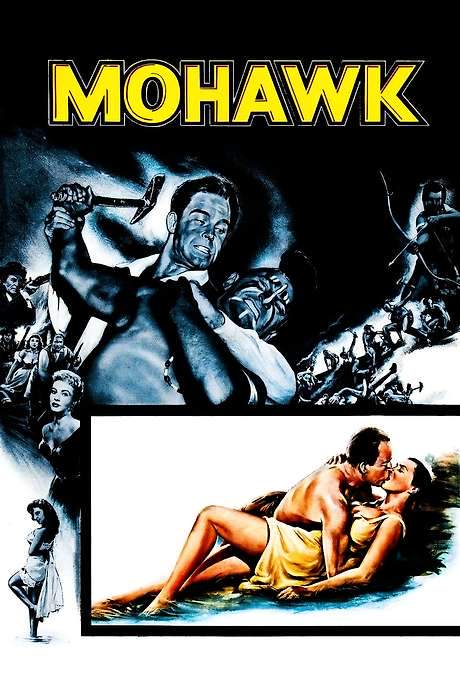
Year: 1956
Runtime: 79 mins
Language: English
Director: Kurt Neumann
In a distant frontier outpost, an artist stationed with the army finds his heart divided among three women: the storekeeper’s daughter, his newly arrived eastern fiancée, and the chief’s daughter. When a resentful settler manipulates tensions, he pits the soldiers against the Native warriors, thrusting the artist into a perilous struggle between love and war.
Warning: spoilers below!
Haven’t seen Mohawk yet? This summary contains major spoilers. Bookmark the page, watch the movie, and come back for the full breakdown. If you're ready, scroll on and relive the story!
Read the complete plot breakdown of Mohawk (1956), including all key story events, major twists, and the ending explained in detail. Discover what really happened—and what it all means.
In late 18th-century upstate New York, Cynthia Stanhope, Lori Nelson, a society lady from Boston, travels with her Aunt Agatha, Barbara Jo Allen, to Fort Alden to surprise her fiancé, the artist Jonathan Adams, Scott Brady. Adams is away at the fort painting the local barmaid Greta Jones, Allison Hayes, with whom he shares more than a professional relationship. The fort sits at the edge of a tense frontier, where old resentments simmer beneath the surface of white settlement and Native presence.
A descendant of the first white family in the Mohawk Valley, Butler, John Hoyt, despises both the white settlers in “his” valley and the local Indians. He seeks out the Iroquois chief Kowanen, Ted de Corsia, to warn him about a party of armed white settlers. Kowanen shows little concern, but his teenage son Keoga, Tommy Cook, and the brave Rokhawah, Neville Brand, feel differently and hatch a plan to raid the fort to seize the settlers’ muskets. With help from Keoga’s sister Onida, Rita Gam, they slip into the fort through a tunnel dug by the garrison, but as they are leaving with the muskets they are discovered and several are killed. Onida is trapped inside the fort and is later found by Adams hiding in his quarters.
Adams helps her escape in his wagon the next morning, and as he escorts her back toward her people, a quiet, growing attraction develops between them. At the village, the unarmed Adams defeats knife-wielding Rokhawah in a tense exchange, earning the respect of Kowanen and the admiration of Keoga. Adams also offers to paint Kowanen’s portrait to show the whites a glimpse of how the Indians live, a gesture meant to bridge misunderstanding through art and empathy.
When Adams fails to return to the fort by sunset, as was required of all settlers, Butler urges Captain Langley, John Hudson, to attack the fort, but Langley refuses the rash move. After further agitation by Butler, Langley travels to the village and explains to Adams and Kowanen that Butler has stoked the conflict. Kowanen, seeking a path to peace, proposes that Keoga accompany Langley and Adams back to the fort as a sign of goodwill.
Langley returns to the fort with Adams and Keoga following later in the wagon. En route they are ambushed by Butler, who shoots and kills Keoga, leaving Adams stunned by the loss. Adams does not see who fired the shot. He retrieves Keoga’s body and returns it to his tribe, while Kowanen contemplates the possibility of renewed war. At Rokhawah’s suggestion, they even contemplate burning Adams at the stake, but Onida intervenes, helping him escape and killing Rokhawah in the process.
Adams finally reaches the fort, with the Indians in close pursuit. As the settlers retreat, the Indians burn homes and crops, escalating the sense that war might erupt at any moment. A troop is sent for reinforcements, and Butler makes a last attempt to slip back into the fort, but Adams confronts him and exposes his role in fanning the flames of violence. In the ensuing assault, Butler is cast out of the besieged fort and is killed by an arrow in his back when he pleads to be let back inside. After a series of fierce clashes, the Indians break the defenses, but reinforcements arrive just in time to prevent a complete catastrophe.
In the aftermath, Adams convinces Kowanen that Butler was responsible for inciting the war, and a fragile truce is declared. Cynthia eventually heads back to Boston with the paintings, while Adams stays behind to continue his work and his life with Onida, choosing a future that begins to heal decades of mistrust through art, courage, and reluctant reconciliation.
Last Updated: October 09, 2025 at 14:04
Discover curated groups of movies connected by mood, themes, and story style. Browse collections built around emotion, atmosphere, and narrative focus to easily find films that match what you feel like watching right now.
Where personal love and political duty clash on a dangerous frontier.If you enjoyed the tense romantic and political conflicts in Mohawk, you'll find similar stories here. This collection features movies like Mohawk where characters are torn between love and duty on a dangerous frontier, exploring themes of forbidden romance, cultural clash, and the high-stakes choices that define a life.
The narrative pattern follows a protagonist, often an outsider or mediator, whose personal relationships span conflicting groups. As external tensions escalate, their loyalties are tested, forcing difficult choices that often lead to sacrifice and a redefined sense of belonging.
Movies in this thread are grouped by their shared focus on the intense personal cost of cultural conflict. They blend high-stakes frontier settings with complex character studies, creating a powerful mix of romance, political tension, and moral ambiguity.
Stories where fragile hope is earned through painful sacrifice.For viewers who appreciated the bittersweet resolution and themes of reconciliation in Mohawk, this thread gathers similar movies. Discover stories like Mohawk about peacemakers and bridge-builders whose efforts lead to a fragile peace, blending high drama with emotionally resonant, bittersweet conclusions.
The narrative arc involves a mediator or idealist attempting to prevent or resolve a larger conflict. Their journey is marked by setbacks, betrayal, and personal loss, culminating in an ending that acknowledges the tragedy of the conflict while leaving a glimmer of hope for the future.
These movies share a specific emotional trajectory: they build tension towards violent confrontation but ultimately focus on the fragile possibility of peace. The shared mood is a sober, atmospheric blend of danger and hope, resulting in a poignant, bittersweet feeling.
Don't stop at just watching — explore Mohawk in full detail. From the complete plot summary and scene-by-scene timeline to character breakdowns, thematic analysis, and a deep dive into the ending — every page helps you truly understand what Mohawk is all about. Plus, discover what's next after the movie.
Track the full timeline of Mohawk with every major event arranged chronologically. Perfect for decoding non-linear storytelling, flashbacks, or parallel narratives with a clear scene-by-scene breakdown.
Discover the characters, locations, and core themes that shape Mohawk. Get insights into symbolic elements, setting significance, and deeper narrative meaning — ideal for thematic analysis and movie breakdowns.
Get a quick, spoiler-free overview of Mohawk that covers the main plot points and key details without revealing any major twists or spoilers. Perfect for those who want to know what to expect before diving in.
Visit What's After the Movie to explore more about Mohawk: box office results, cast and crew info, production details, post-credit scenes, and external links — all in one place for movie fans and researchers.