Plot Explained Spoilers guaranteed!
Plot Explained

Browse by genre

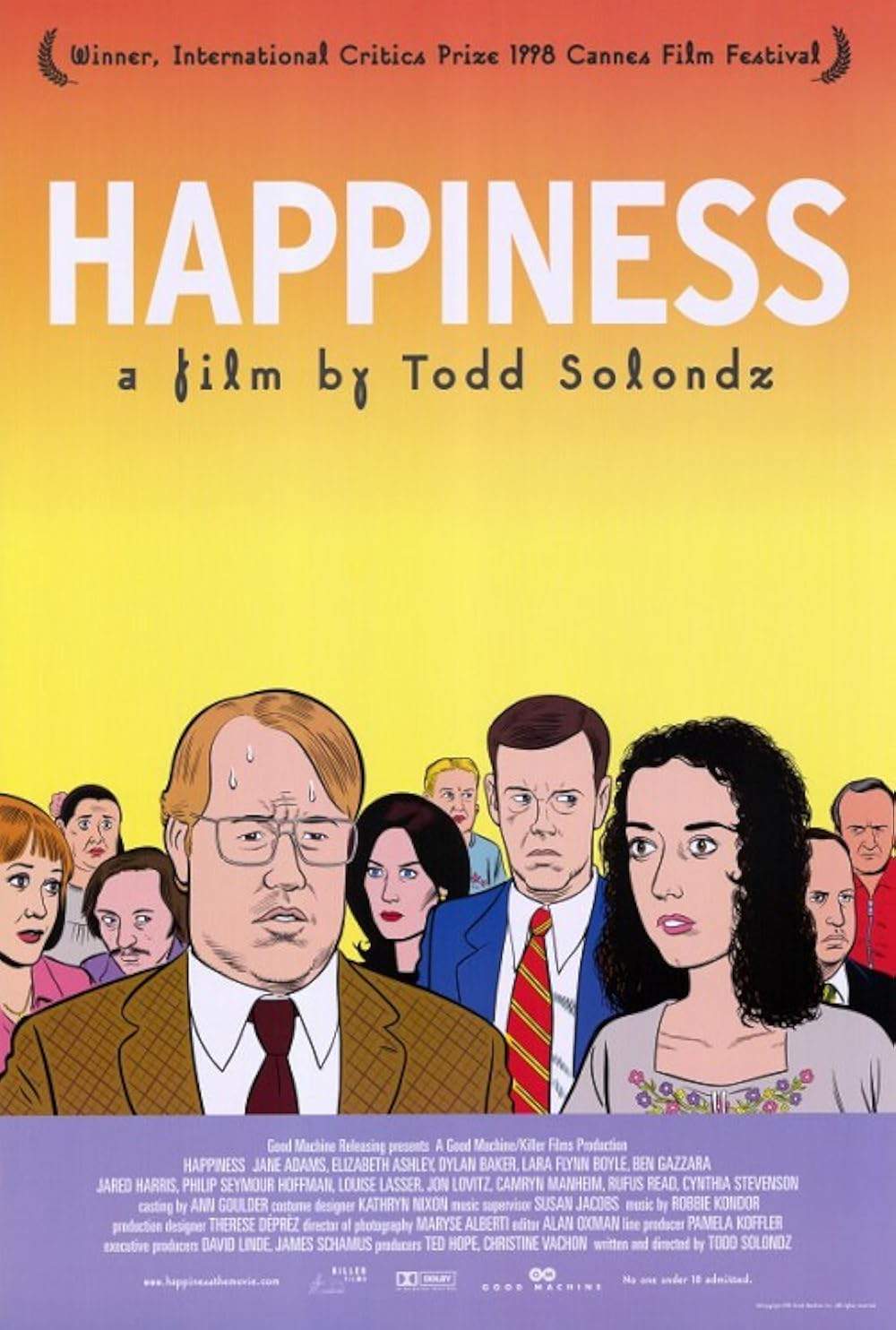
Happiness (1998) movie poster

Timeline

Happiness (1998) Timeline Explained – Every Event in Order

Release, runtime and language
1998 · 134 min · Russian
Directed by
Todd Solondz
Starring
Philip Seymour Hoffman, Jane Adams, Jon Lovitz

Several disparate individuals, each grappling with loneliness and unusual desires, find their lives unexpectedly intertwined. Their individual journeys to find connection and belonging lead to both humorous and heartbreaking encounters, revealing the blurry boundaries between love, eccentricity, and the search for genuine human connection. The film explores the complexities of relationships and the sometimes-unconventional paths people take in their quest for happiness.

On this page (5)
  1. 1 Events in order (15)
  2. 2 Timeline questions answered
  3. 3 Movie threads
  4. 4 Movies like Happiness
  5. 5 Every angle

15 events in order · contains spoilers

Happiness Timeline: Events in Chronological Order

Every key event of Happiness (1998) in order, scene by scene, with when and where it takes place. Use it to untangle flashbacks, time jumps and parallel storylines, to refresh your memory before the sequel or to find the exact scene you are thinking of.

  1. Joy Ends Toxic Relationship

    Joy, the youngest sister, decides to end a harmful relationship, seeking a new beginning in her life. This crucial decision sets off a chain of events that significantly impacts her journey and the lives of those around her.

  2. Ex's Tragic Decision

    Following the breakup, Joy's ex-boyfriend experiences a devastating emotional response. Just days later, he makes the tragic choice to take his own life, leaving Joy in shock and grappling with guilt.

  3. Joy's New Job

    In an attempt to find purpose, Joy takes a position at a refugee education center. This new job is meant to help her contribute positively to society, but it soon leads to unexpected challenges.

    Where
    Refugee Education Center
  4. Conflict with Students

    Joy faces immediate backlash from her students, who resent her for crossing the picket line during a teachers' strike. This conflict intensifies her feelings of alienation and frustration in her new role.

    Where
    Refugee Education Center
  5. Betrayal by a Student

    One student initially shows kindness to Joy, only to betray her trust later. This student seduces Joy and then robs her, demanding $1,000, illustrating the harsh realities of Joy's new environment.

  6. Trish's Facade

    Trish, Joy’s middle sister, appears to lead a perfect life as a married housewife. However, her dismissive remarks towards Joy reveal the family's low expectations and adds a layer of tension to their relationship.

  7. Bill's Troubling Behavior

    Trish's husband, Bill, a therapist, displays deeply troubling urges and instructs their son on inappropriate subjects. His unsettling behavior raises alarms about his moral integrity and sets him on a dark path.

    Where
    Family Home
  8. Horrific Act at Sleepover

    Bill's obsession culminates during a sleepover when he drugs the family of his son's friend, Johnny. This horrific action leads to dire consequences and reveals the depth of Bill's depravity.

    Where
    Sleepover Location
  9. Helen's Superficiality

    Helen, the eldest sister, embodies self-absorption as an author grappling with the superficiality of her work. Her hunger for a true understanding of sexual violence leads her into complex emotional territory.

  10. Awkward Encounter with Allen

    Helen encounters her neighbor Allen, who struggles with inappropriate behavior including making obscene phone calls. Their awkward interaction underscores both characters' isolation and discomfort.

    Where
    Apartment Complex
  11. Kristina's Dark Past

    On a date with Allen, Kristina shares her traumatic history of assault and her violent retribution against her attacker. This unsettling revelation adds complexity to her character and reflects themes of trauma.

  12. Parents' Discontent

    Joy's parents are portrayed as emotionally discontented, with her father attempting infidelity. This highlights the familial dysfunction that permeates the sisters' lives and complicates their relationships.

    Where
    Family Home
  13. Tense Family Dinner

    The film reaches a climax during a tense family dinner where Joy faces sustained condescension from her family. This moment symbolizes the overarching struggles she faces for acceptance and love.

    Where
    Family Home
  14. Trish's Son's Achievement

    In a surprising turn, Trish's son celebrates his personal success on the balcony during the family dinner. His jubilant shout of 'I came!' juxtaposes the heavier themes of the film and introduces a moment of unexpected joy.

    Where
    Family Home Balcony
  15. Thematic Tapestry of Dysfunction

    Through intertwined narratives, *Happiness* reveals a vivid tapestry of despair and longing for connection. Each sister's story showcases the deep dysfunction of their family, exploring the complexities of human relationships.

Last updated: November 03, 2024 at 22:49

Was this helpful?

Timeline questions answered

Happiness Timeline Explained: Your Questions Answered

When does it happen, and why in that order? The questions people ask about the chronology of Happiness (1998): time jumps, flashbacks, cause and effect between scenes and the correct order of events, each answered with spoilers.

Q1

Why did Joy's ex-boyfriend kill himself after the breakup?

Joy's ex-boyfriend responded to the breakup with extreme emotional instability. The text describes it as a 'malicious outburst' followed by his tragic decision just days later. This suggests he was psychologically unstable and unable to cope with rejection, viewing the ending of the relationship as unbearable rather than a manageable life event.

  • ex-boyfriend suicide
  • breakup response
  • emotional instability
Q2

Why did the student betray and rob Joy?

The student who showed Joy kindness was motivated by the broader conflict at the refugee education center. Joy had crossed the picket line during a teachers' strike, making her a target of resentment from students who saw her as a strikebreaker. The betrayal, seducing her and then demanding $1,000, appears to be both a personal act of exploitation and a statement against her crossing the picket line.

  • student betrayal
  • teachers strike
  • rob
Q3

What did Bill do to Johnny's family at the sleepover?

Bill, a therapist and the husband of Joy's sister Trish, drugged Johnny's family during a sleepover at their house. The summary indicates this 'horrific act' and 'dire consequences' occurred, revealing Bill's deep psychological depravity. The film depicts him as having pedophilic fantasies and fixating on Johnny, his son's friend.

  • bill
  • johnny
  • sleepover
  • drugs
  • assault
Q4

Why does Joy's family treat her with condescension?

Joy's family, particularly her sisters Trish and Helen, display condescension toward her that reflects the family's low expectations. Trish makes dismissive remarks about Joy's prospects, and the family dinner scene shows this dynamic at its peak, Joy faces sustained condescension from all family members. This suggests a pattern of emotional neglect and dismissal of Joy's worth compared to her older sisters.

  • family dinner
  • condescension
  • sisters
  • joy
Q5

Why does Helen want to understand sexual violence?

Helen, the eldest sister and a self-absorbed author, recognizes the superficiality of her literary work. Her hunger for 'a visceral understanding of sexual violence' stems from a desire to create meaningful, authentic art rather than shallow content. She wants to experience or comprehend something genuinely impactful rather than continue producing work she knows lacks substance.

  • helen
  • author
  • sexual violence
  • superficiality
Q6

What is the significance of Trish's son shouting 'I came!' on the balcony?

This moment occurs during the tense family dinner as a shocking juxtaposition. Trish's son achieves some personal success, implied to be a sexual climax, and rushes inside to announce it jubilantly. This darkly comic moment contrasts sharply with the heavy themes of dysfunction and despair, symbolizing how each character seeks validation and 'happiness' through their own distorted means, however small or inappropriate.

  • trish son
  • balcony
  • i came
  • ending
Q7

Why does Allen make obscene phone calls?

Allen is Helen's neighbor who struggles with inappropriate behavior, specifically making obscene phone calls. This action reflects his profound isolation and inability to connect with others in healthy ways. His peculiar penchant represents one of the film's explorations of unconventional, destructive attempts to bridge human loneliness.

  • allen
  • obscene calls
  • neighbor
  • isolation
Q8

Why does Kristina share her assault story on the date?

During her date with Allen, Kristina reveals her traumatic past involving a violent assault. Her unsettling delivery of this dark history, detailing her violent retribution against her attacker, serves to expose her own brokenness and the lengths trauma survivors may go to in processing their experiences. It also reflects the film's theme of people sharing their deepest wounds in attempt to connect.

  • kristina
  • assault
  • date
  • trauma
Q9

Why does Joy's father attempt infidelity?

Joy's father is depicted as emotionally discontent within his marriage, leading him to seek connection outside his relationship. However, he finds himself 'emotionally detached' even in this attempt, suggesting his dysfunction extends beyond the marriage itself, he is incapable of genuine emotional intimacy regardless of the circumstance.

  • father
  • infidelity
  • parents
  • discontent
Q10

Why is Bill fixated on Johnny?

Bill, a therapist with deeply troubling urges, becomes obsessed with Johnny, his son's friend, because he harbors pedophilic fantasies. His professional position as a therapist makes his behavior even more disturbing, as he exploits trust. His fixation culminates in the drugged sleepover scenario, revealing the depth of his psychological depravity.

  • bill
  • johnny
  • obsession
  • pedophilia
Q11

What happens at the family dinner in Happiness?

The family dinner serves as the film's climax where Joy faces sustained condescension from all family members, her parents, Trish, and Helen. This dinner exposes the deep dysfunction in their relationships and represents Joy's ongoing struggle for acceptance and love. The meal becomes a battleground where her family's contempt reaches its peak.

  • family dinner
  • climax
  • joy
  • sisters
Q12

Why does Joy take a job at the refugee education center?

After ending her toxic relationship and dealing with guilt over her ex-boyfriend's suicide, Joy seeks purpose and a way to contribute positively to society. She takes the job at the refugee education center specifically to find meaning and make a difference, though this decision leads to further hardship when her students resent her for crossing the picket line.

  • joy
  • refugee center
  • job
  • purpose

Movie threads

More Movies Like Happiness, by Mood & Story

Curated lists built around what makes Happiness tick: the same mood, the same kind of story or the same emotional payoff. Each list explains why these movies belong together.

Interwoven ensemble dramas like Happiness

Stories where separate, troubled lives collide in unsettling ways. Movies like Happiness that feature multiple interconnected character arcs. If you enjoyed the complex web of relationships and the way disparate stories of loneliness and desire collided, explore similar dramas that masterfully weave individual tragedies into a cohesive whole.

  • dysfunctional
  • interconnected
  • lonely
  • somber
  • unsettling
  • anxious
  • Tone: bleak, unsettling, somber
  • Pacing: steady, deliberate
Why these movies?

The story pattern: These films often employ a fragmented narrative structure, introducing characters separately before revealing the subtle or dramatic ways their lives are linked. The plot unfolds through parallel journeys, with pivotal moments of intersection that amplify the thematic weight about societal alienation or the difficulty of genuine connection.

Why they belong together: Movies are grouped here for their shared structural approach to storytelling—using an ensemble cast and interlocking plots—and their thematic focus on the isolation and dysfunction that can exist beneath the surface of everyday life.


Dark satirical comedies with disturbing themes like Happiness

Bleak comedies that find unsettling humor in profound human failings. If you appreciated the darkly humorous and satirical edge of Happiness, these films offer a similar blend of comedy and profound discomfort. They tackle taboo subjects with a sharp, unflinching wit that challenges the viewer.

  • darkly humorous
  • unsettling
  • satirical
  • painful
  • bleak
  • transgressive
  • Tone: dark, satirical, bleak
  • Pacing: steady, methodical
Why these movies?

The story pattern: The narrative journey in these films often follows characters as they rationalize or engage in morally reprehensible behavior. The humor arises from the absurdity of their justifications and the uncomfortable juxtaposition of comic moments with deeply serious, often horrific, themes, leading to ambiguous or bleak conclusions.

Why they belong together: These movies are united by their distinct tonal blend: a DARK tone that uses satirical humor not for levity, but to heighten the unsettling nature of their themes. They share a high intensity and heavy emotional weight derived from engaging with taboo topics.

If you liked this

Movies Like Happiness

Similar movies to Happiness: the same genre, themes or kind of story. Each one comes with its own plot summary, timeline and ending explained.

Browse all movie summaries

Every angle

Happiness (1998) Explained: Plot, Timeline & Characters

Everything about Happiness in one place: what happens in the plot summary, the timeline in chronological order, the characters and meaning and a spoiler-free summary. What's After the Movie adds the cast, box office and post-credit scenes.

Coming soon on iOS and Android

The Plot Explained Movie Summary App

Plot summaries, endings explained and timelines on your phone. Catch up on any movie in minutes, save your favorites and never miss a twist again.

Be the first to know when we launch. Your email stays private, always.

Learn more about the app