Plot Explained Spoilers guaranteed!
Plot Explained

Browse by genre

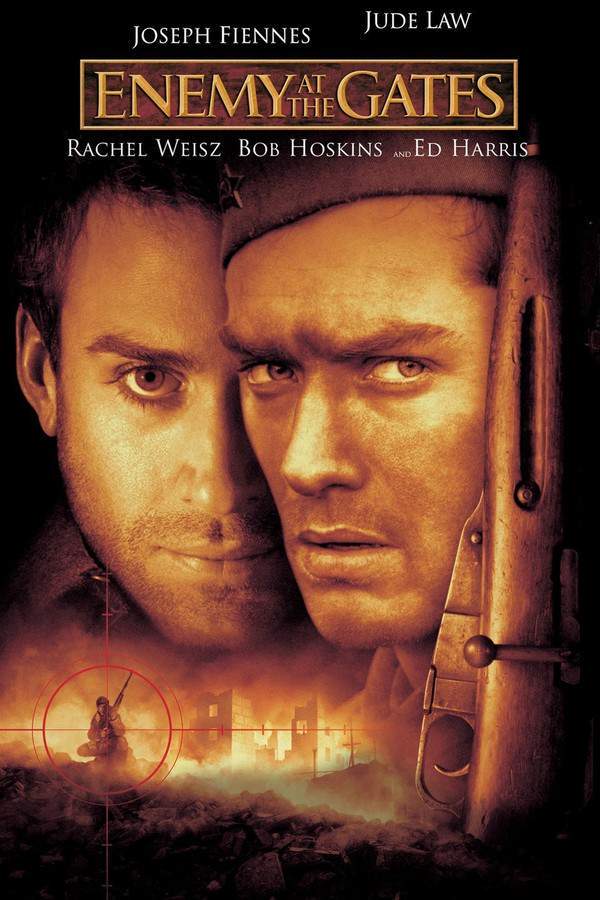
Enemy at the Gates (2001) movie poster

Plot Summary

Enemy at the Gates (2001) Plot Summary Explained

Release, runtime and language
2001 · 131 min · English
JustWatch #1,320 12
Directed by
Jean-Jacques Annaud
Starring
Jude Law, Ed Harris, Joseph Fiennes
Budget
$68M

Amidst the brutal Battle of Stalingrad, the legendary Russian sniper Vassili Zaitsev becomes a symbol of hope for the outnumbered Soviet forces. His remarkable skill attracts the attention of Erwin Konig, a ruthless and equally talented German sniper. A deadly game of cat and mouse ensues, as the two men engage in a personal duel of skill and survival within the larger conflict, each seeking to outwit and eliminate the other.

On this page (6)
  1. 1 Where to watch
  2. 2 What happens: full plot
  3. 3 Plot questions answered
  4. 4 Movie threads
  5. 5 Movies like Enemy at the Gates
  6. 6 Every angle

Where to watch

Where to Watch Enemy at the Gates (2001)

Where can you watch Enemy at the Gates? Stream, rent or buy it in the US, including on MGM Plus, Hoopla and Amazon Video: current JustWatch availability with up-to-date prices.

Streaming availability powered by JustWatch

Full plot summary · contains spoilers

What Happens in Enemy at the Gates: Full Plot Summary

The whole story of Enemy at the Gates (2001) explained, from the opening scene to the final frame: every key event, every twist and what it all adds up to. Read it as a quick recap before the sequel, to check a scene you missed, or to finally understand what really happened.

In the tumultuous year of 1942, Vassili Zaitsev, portrayed by Jude Law, embarks on a harrowing journey as a soldier in the Red Army during the Battle of Stalingrad. Initially a humble shepherd from the Ural Mountains, Vassili showcases his extraordinary marksmanship skills — honed by lessons from his grandfather — while heroically saving himself and his comrade, Commissar Danilov, played by Joseph Fiennes, during a reckless charge against the encroaching German forces.

As the dire situation escalates, Nikita Khrushchev (played by Bob Hoskins) arrives in the city to boost the waning morale of the defenders and seeks innovative ideas. Joseph Fiennes, now elevated to the rank of Senior Lieutenant, proposes that the people require heroes to inspire them. He begins publishing thrilling accounts of Vassili's heroic deeds in the army's newspaper, which frame him as a national icon and propaganda symbol. Consequently, Vassili is reassigned to the sniper division, and he fosters a close friendship with Danilov. Both men become infatuated with Tania, a local citizen of Stalingrad, who has joined the militia as a Private. Danilov ensures her transfer to an intelligence unit to keep her away from the front lines.

With Vassili's growing reputation as a sniper, the German command deploys Major Erwin König, portrayed by Ed Harris, to hunt him down, aiming to extinguish Soviet morale. As a distinguished marksman and chief of the German Army sniper school, König devises a trap that claims the lives of two of Vassili's fellow snipers. Yet, Vassili narrowly evades disaster. As the Red Army learns of König's mission, they dispatch Koulikov (played by Ron Perlman), one of König's former students, to assist Vassili in vanquishing his adversary. However, König cunningly deceives Koulikov into disclosing his location and swiftly eliminates him, dealing a blow to Vassili's spirit. Under increasing pressure from Khrushchev, Danilov realizes he must bring the escalating sniper duel to a swift conclusion.

Upon Tania's request to join the sniper division, Danilov implores Vassili to dissuade her. Yet, Vassili concedes when Tania shares her heartbreaking story about her Jewish parents who fell victim to the Germans. In a strategic move, Danilov recruits young Sacha Fillipov (portrayed by Gabriel Thomson), an impressionable local boy who idolizes Vassili. Sacha, tasked with passing misleading information about Vassili's whereabouts to König, finds himself in peril as the plan unfolds.

In an intense showdown, Vassili manages to injure König but suffers a setback when he falls asleep after a prolonged wait during another ambush. A German soldier loots his sniper log, which the German command mistakenly interprets as confirmation of Vassili's death. For König, however, doubt lingers, and he sets a deadly trap by killing Sacha and using his body to lure Vassili. Vassili, consumed by vengeance, prepares for the inevitable confrontation while organizing the evacuation of Sacha's mother, but tragedy strikes as Tania suffers a serious injury during the chaos.

Amidst despair, Danilov’s jealousy disrupts his loyalty to the cause. In a selfless act, he sacrifices himself to reveal König’s position, ultimately leading to his demise. Believing he has vanquished Vassili, König unknowingly walks into Vassili's line of fire, where he meets his end.

Months later, as Stalingrad stands liberated and the German forces capitulate, Vassili finds solace while reuniting with Tania, who is recuperating in a field hospital, rekindling their love amidst the scars of war.
Last updated: November 03, 2024 at 11:10

Was this helpful?

Plot questions answered

Enemy at the Gates Plot Explained: Your Questions Answered

The questions people ask most about Enemy at the Gates (2001): what happens in the confusing scenes, why the characters do what they do, the twists, hidden details and what the ending means. Each answer contains spoilers.

Q1

Why did Danilov turn Vassili into a propaganda hero?

Danilov recognized that the Soviet troops and civilians needed morale boosters during the desperate Battle of Stalingrad. As a Senior Lieutenant, he proposed to Khrushchev that people required heroes to inspire them, so he began publishing exaggerated accounts of Vassili's deeds in the army newspaper. This transformed Vassili into a national icon and propaganda symbol, which also allowed Danilov to keep Vassili close to him and away from the front lines where he could die.

Foreshadowing: Danilov's early proposal to Khrushchev about creating heroes sets the stage for his later manipulation of Vassili's reputation.

  • propaganda
  • danilov
  • soviet morale
  • hero creation
  • stalingrad
Q2

Why did Germany send Major König to kill Vassili?

After Vassili gained fame as a deadly sniper who killed numerous German soldiers, the German command recognized the threat to their morale. They deployed Major Erwin König, the chief of the German Army sniper school and a highly skilled marksman, specifically to eliminate Vassili and crush Soviet morale. König was chosen because his reputation and skills matched or exceeded Vassili's.

Foreshadowing: The German command's decision to send their top sniper directly reflects how dangerous Vassili had become to their forces.

  • konig
  • german command
  • sniper school
  • counter-sniper
  • elimination
Q3

How did König kill Koulikov?

Koulikov was a former student of König who was sent by the Red Army to assist Vassili. König cunningly deceived Koulikov into disclosing Vassili's location, then killed him. This was a significant blow to Vassili's spirit and demonstrated König's psychological manipulation skills, as he used his former student's trust against him.

Foreshadowing: König's ability to exploit his former student's trust foreshadows his later manipulation using Sacha.

  • koulikov
  • konig former student
  • deception
  • sniper skills
Q4

Why did Vassili fall asleep during the ambush?

Vassili had been waiting in ambush for König for an extremely long time during a cold Stalingrad winter. Exhaustion from the prolonged wait, the freezing conditions, and the psychological toll of the sniper game caused him to fall asleep. This careless mistake allowed a German soldier to discover his sniper log, leading the Germans to falsely believe Vassili was dead.

Foreshadowing: This moment shows how the psychological warfare was draining Vassili, making him vulnerable to human error.

  • exhaustion
  • cold
  • ambush mistake
  • sniper log
  • discovery
Q5

Why did König kill Sacha to lure Vassili?

After König learned from the sniper log that Vassili was actually alive, he needed a way to draw him out. König murdered Sacha, the young boy who had been passing false information about Vassili's whereabouts, and used his body as bait to lure Vassili into an ambush. This was a cruel psychological tactic to exploit Vassili's emotional attachment to the boy who idolized him.

Foreshadowing: König's willingness to use a child demonstrates his complete willingness to exploit any weakness, following the pattern established when he manipulated Koulikov.

  • sacha
  • child bait
  • luring tactic
  • psychological warfare
  • revenge
Q6

Why did Danilov sacrifice himself to reveal König's position?

Danilov's jealousy over Tania had been building throughout the film, causing him to resent Vassili. However, when the moment came, he overcame his personal feelings and selflessy sacrificed himself to reveal König's hidden position. By running into the open and exposing himself as a decoy, Danilov allowed Vassili to locate König, leading to his own death but enabling the final confrontation.

Foreshadowing: Danilov's jealousy had been foreshadowed since he ensured Tania's transfer to an intelligence unit to keep her away from the front lines.

  • danilov sacrifice
  • decoy
  • konig position
  • heroic death
  • redemption
Q7

What happened to Tania at the end of the movie?

Tania was seriously injured during the chaos of the battle while König was using Sacha's body as bait to lure Vassili. She was shot and left in critical condition. However, months later after Stalingrad was liberated, Vassili visited her in a field hospital where she was recovering. Their love was rekindled despite the scars of war, providing a bittersweet reunion.

Foreshadowing: Tania's injury occurs during the climactic battle, underscoring the personal costs of the conflict.

  • tania injury
  • field hospital
  • reunion
  • recovery
  • bittersweet ending
Q8

How did Vassili finally defeat König?

After Danilov's sacrifice revealed König's location, Vassili set up a final confrontation. König, believing Vassili was already dead, walked unknowingly into Vassili's line of fire. Vassili took the shot and killed König, ending the deadly duel. This victory marked a significant moment in the Battle of Stalingrad, boosting Soviet morale.

Foreshadowing: The entire film builds toward this confrontation, with both snipers trying to outmaneuver each other throughout the movie.

  • final confrontation
  • konig death
  • sniper duel
  • victory
  • line of fire
Q9

Why did Tania's backstory about her parents matter?

Tania revealed to Vassili that her Jewish parents had fallen victim to the Germans, which explained her deep motivation to fight against the occupation. This heartbreaking story convinced Vassili to allow her to join the sniper division, despite Danilov's pleas to keep her safe. It added personal stakes to the war and connected Tania's personal loss to the larger conflict.

Foreshadowing: Tania's personal loss foreshadows the brutal realities faced by civilians under German occupation.

  • tania parents
  • jewish
  • genocide
  • motivation to fight
  • personal loss
Q10

Why did Danilov transfer Tania to the intelligence unit?

Both Danilov and Vassili became infatuated with Tania, a local citizen who joined the militia as a Private. Danilov, hoping to protect her and keep her close, used his influence to ensure her transfer to an intelligence unit, which kept her away from the dangerous front lines. This decision also reflected Danilov's personal interests beyond just keeping her safe.

Foreshadowing: Danilov's protective action reveals his romantic feelings for Tania, which would later contribute to his jealousy and eventual sacrifice.

  • tania transfer
  • intelligence unit
  • danilov feelings
  • protection
  • front lines
Q11

Why was the sniper log significant in the story?

Vassili kept a sniper log documenting his kills and position details. When he fell asleep during the ambush and a German soldier found the log, the Germans mistakenly believed Vassili was dead based on the information inside. König, however, remained skeptical. The log became a plot device that created a false sense of victory for the Germans while enabling König's later trap using Sacha.

Foreshadowing: The log's discovery leads to the false death report, which sets up König's later realization that Vassili was still alive.

  • sniper log
  • kills documentation
  • german discovery
  • false death report
Q12

Why was Khrushchev looking for heroes to inspire the troops?

Khrushchev arrived in Stalingrad to boost the waning morale of the defenders during one of the most desperate phases of World War II. The Soviet forces were outnumbered and facing brutal German advances. He believed that heroes like Vassili could rally both soldiers and civilians, providing psychological motivation to continue fighting against overwhelming odds.

Foreshadowing: Khrushchev's search for morale boosters directly leads to Danilov's proposal to create a hero from Vassili.

  • khrushchev
  • morale boost
  • soviet troops
  • propaganda strategy
  • stalingrad defense

Movie threads

More Movies Like Enemy at the Gates, by Mood & Story

Curated lists built around what makes Enemy at the Gates tick: the same mood, the same kind of story or the same emotional payoff. Each list explains why these movies belong together.

Sniper duel thrillers like Enemy at the Gates

Two expert marksmen engage in a lethal, tension-filled game of cat and mouse. If you were captivated by the tense sniper showdown in Enemy at the Gates, this list features similar movies with high-stakes duels and psychological warfare. These films focus on expert marksmen in a deadly game of cat and mouse, delivering suspenseful and gritty stories of survival and rivalry against a backdrop of war or conflict.

  • tense
  • suspenseful
  • gritty
  • psychological
  • harrowing
  • brutal
  • Tone: tense, dark
  • Pacing: variable, with slow builds and fast action
Why these movies?

The story pattern: These narratives typically pit a protagonist against a villain of equal or superior skill in a focused, personal conflict that mirrors a larger war or struggle. The plot unfolds through a series of strategic moves and counter-moves, emphasizing patience, intelligence, and survival instincts over brute force. The emotional journey is one of immense pressure, isolation, and the psychological toll of a hunt where the hunter can also become the prey.

Why they belong together: Movies in this thread are united by their central premise of a specialized, one-on-one confrontation. They share a tense, gritty mood, high intensity, and a focus on the psychological dimension of combat. The pacing often varies between slow, deliberate buildup and sudden, explosive action, creating a gripping and harrowing viewing experience.

Grim war survival stories like Enemy at the Gates

Stories of ordinary people enduring the brutal, dehumanizing reality of warfare. For viewers who appreciated the harrowing depiction of Stalingrad in Enemy at the Gates, this collection highlights similar movies about grim survival in war. These films portray the brutal reality of combat, the desperation of soldiers and civilians, and the heavy emotional weight of enduring unimaginable hardship and sacrifice.

  • gritty
  • harrowing
  • brutal
  • desperate
  • solemn
  • claustrophobic
  • Tone: dark, solemn, bittersweet
  • Pacing: variable, tense and chaotic
Why these movies?

The story pattern: The narrative pattern follows individuals or groups simply trying to stay alive against overwhelming odds within a massive, destructive conflict. Character arcs often involve the erosion of idealism, the forging of bonds under extreme duress, and the trauma of loss. The stories are straightforward, aiming for emotional impact through stark realism rather than complex plotting, often culminating in a bittersweet or bleak resolution that underscores the cost of war.
Why they belong together: These films are grouped together by their shared commitment to portraying the grim, authentic feel of warfare. They possess a heavy emotional weight, a dark and solemn tone, and often feature variable pacing that mirrors the rhythm of combat—long periods of tension punctuated by bursts of violence. The dominant mood is one of desperation, sacrifice, and solemn reflection.

If you liked this

Movies Like Enemy at the Gates

Similar movies to Enemy at the Gates: the same genre, themes or kind of story. Each one comes with its own plot summary, timeline and ending explained.

Browse all movie summaries

Every angle

Enemy at the Gates (2001) Explained: Plot, Timeline & Characters

Everything about Enemy at the Gates in one place: what happens in the plot summary, the timeline in chronological order, the characters and meaning and a spoiler-free summary. What's After the Movie adds the cast, box office and post-credit scenes.

Coming soon on iOS and Android

The Plot Explained Movie Summary App

Plot summaries, endings explained and timelines on your phone. Catch up on any movie in minutes, save your favorites and never miss a twist again.

Be the first to know when we launch. Your email stays private, always.

Learn more about the app