





Plot Explained Spoilers guaranteed!
Plot Explained

Browse by genre

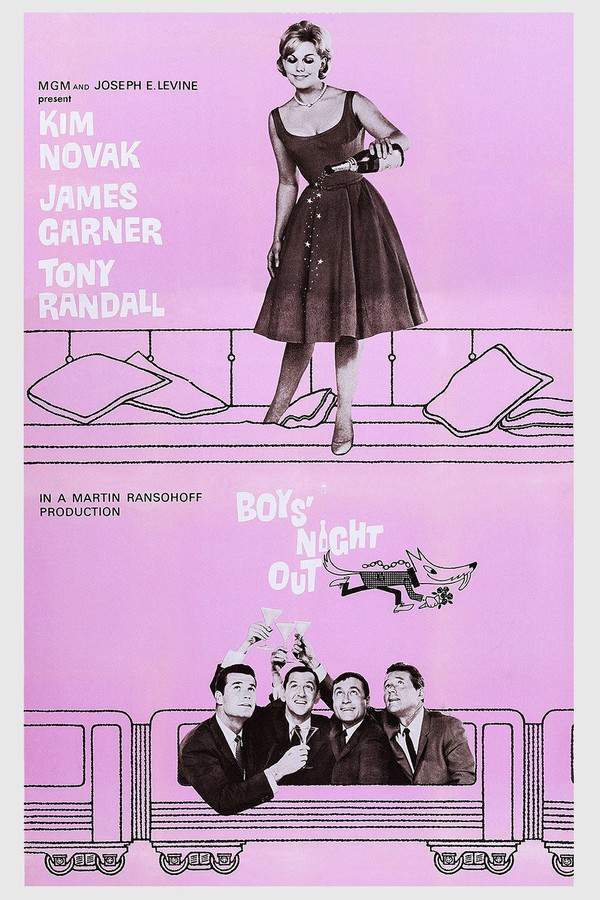
Boys' Night Out (1962) movie poster

Plot Summary

Boys' Night Out (1962) Plot Summary Explained

Release, runtime and language
1962 · 115 min · English
Directed by
Michael Gordon
Starring
James Garner, Kim Novak, Oskar Homolka, Howard Duff, Janet Blair, Howard Morris

Four friends, frustrated with their demanding boss, decide to rent a lavish bachelor apartment to escape their daily grind. Their plans for relaxation take an unexpected turn when they hire a beautiful housekeeper, played by Kim Novak, to attend to their needs. However, the friends soon discover that she has her own agenda, and their carefree weekend is about to become far more complicated than they anticipated, filled with surprising twists and humorous situations.

On this page (6)
  1. 1 Where to watch
  2. 2 What happens: full plot
  3. 3 Plot questions answered
  4. 4 Movie threads
  5. 5 Movies like Boys' Night Out
  6. 6 Every angle

Where to watch

Where to Watch Boys' Night Out (1962)

Where can you watch Boys' Night Out? Stream, rent or buy it in the US, including on Amazon Video, Apple TV Store and Fandango At Home: current JustWatch availability with up-to-date prices.

Streaming availability powered by JustWatch

Full plot summary · contains spoilers

What Happens in Boys' Night Out: Full Plot Summary

The whole story of Boys' Night Out (1962) explained, from the opening scene to the final frame: every key event, every twist and what it all adds up to. Read it as a quick recap before the sequel, to check a scene you missed, or to finally understand what really happened.

As the daily commuter train makes its way from Greenwich, Connecticut, to New York City, three married men—George, Doug, and Howie—along with their divorcé friend, Fred, forge a bond of friendship. Their camaraderie is ignited by witnessing the antics of Mr. Bingham, who is famously unfaithful to his wife. In a lighthearted attempt to create their own escape, the group hatches a plan to rent an apartment in the city as a secret love nest. They set Fred on a humorous task to locate both an incredibly cheap place to stay and an alluring "companion" to accompany them.

Fred’s search brings him to Peter Bowers, who is eager to rent out his upscale apartment, notorious for being the site of a high-profile murder case. Serendipitously, a stunning blonde named Cathy responds to the ad. However, he discovers the apartment has already been claimed. Still, Fred convinces Cathy to take on the role of a beautiful "housekeeper" to meet his friends' needs. Each man justifies his adventures in the city by claiming they're enrolled in a course at The New School for Social Research to expand their minds.

Little do they know, Cathy is a sociology graduate student who is conducting research on the "adolescent fantasies of the adult suburban male." Her skeptical professor, Dr. Prokosch, questions her approach, warning her about the complexities of her study. Unfazed, she boldly states, “This is what a nice girl has learned best.” Cathy cleverly records the men's candid conversations during their meetings, causing them to inadvertently disclose their deepest yearnings and fears.

Cathy skillfully navigates the situation, fending off any romantic advances while allowing each man to feel as if they've had personal encounters with her. Howie seeks more taste than what his diet-conscious wife permits, Doug wishes to fix his belongings without facing his status-obsessed spouse’s judgment, and George craves the attention he lacks as his wife constantly interrupts him. Fred, however, feels a genuine connection with Cathy, resisting the urge to indulge in his friends' tall tales.

As tensions build, the wives begin sensing that their husbands may be hiding something. Driven by suspicion, they consult Ethel, Fred's astute mother, who offers them keen insights. Her advice leads them to hire Ernest Bohannon, a distinguished private investigator, to unveil the truth. The findings he presents stir a confrontation between the husbands and their wives, blending anxiety and indignation.

At first, the men categorically deny any foul play, feigning innocence to calm their spouses. Yet, the underlying truth about Cathy's role in this turmoil starts to surface, leading to moments of shock that transform into a path towards reconciliation and understanding.

Ultimately, Fred and Cathy’s relationship blooms into a romantic connection, signaling the end of their previous escapades. The four couples, who once stood apart, now come together in unity, enriched by their experiences of trust, acceptance, and love.

Last updated: November 17, 2024 at 21:42

Was this helpful?

Plot questions answered

Boys' Night Out Plot Explained: Your Questions Answered

The questions people ask most about Boys' Night Out (1962): what happens in the confusing scenes, why the characters do what they do, the twists, hidden details and what the ending means. Each answer contains spoilers.

Q1

Why do the four friends decide to rent a secret apartment in the city?

The men are frustrated with their demanding daily lives and their marriages. After observing Mr. Bingham on the train, an older man who openly has affairs, they decide they want their own escape from domesticity. The apartment serves as their "love nest" where they can briefly break free from their wives and experience adventure, though they justify it by claiming they're attending courses at The New School for Social Research.

Foreshadowing: Their observation of Mr. Bingham's infidelities on the train directly inspires their own plan.

  • motivation
  • escape
  • bachelor apartment
  • suburbia
  • frustration
Q2

What is Cathy's real identity and why does she take the job as housekeeper?

Cathy is a sociology graduate student conducting research on the "adolescent fantasies of the adult suburban male." She responds to the apartment ad and agrees to become the men's housekeeper specifically to study them. Her professor, Dr. Prokosch, warns her about the complexities of her approach, but she proceeds anyway, seeing it as an opportunity to observe male fantasies up close.

Foreshadowing: Cathy tells her professor, "This is what a nice girl has learned best," foreshadowing her clever manipulation of the men.

  • sociology
  • research
  • graduate student
  • Cathy
  • study
  • deception
Q3

Why does Cathy record the men's conversations during their meetings?

As part of her sociology research, Cathy uses the opportunity to document the men's candid discussions. She strategically allows each man to believe they had personal encounters with her while actually gathering evidence about their deepest yearnings, fears, and insecurities for her academic study.

  • recording
  • evidence
  • research
  • sociology
  • conversations
Q4

How do the wives discover their husbands' secret apartment?

The wives grow suspicious of their husbands' frequent late-night absences and consult Ethel, Fred's perceptive mother. Ethel advises them to hire a private investigator. Ernest Bohannon is subsequently hired and uncovers the men's secretive meetings with Cathy, providing the wives with concrete evidence of the affair.

Foreshadowing: Ethel's sharp observations and advice to the wives sets the investigation in motion.

  • wives
  • suspicion
  • investigator
  • Ernest Bohannon
  • Ethel
  • discovery
Q5

Why does Fred develop genuine feelings for Cathy while his friends do not?

Unlike his friends who become absorbed in their fantasies and tall tales, Fred remains more grounded and resistant to the group's more deceptive behaviors. He senses authenticity in Cathy beyond her role as a housekeeper, and this genuine connection eventually blossoms into a real romantic relationship that outlasts the study.

Foreshadowing: Fred is described as resisting the urge to indulge in his friends' tall tales, distinguishing him from the others.

  • Fred
  • Cathy
  • romance
  • genuine connection
  • feelings
Q6

What happens when the husbands are confronted with the investigator's findings?

When presented with Ernest Bohannon's findings, the men initially deny any wrongdoing and feign innocence to appease their wives. However, the truth about Cathy's role and their secretive meetings gradually surfaces, leading to heated confrontations that ultimately force both sides to confront the reality of their marriages.

Foreshadowing: The investigator's findings directly trigger the confrontation scene.

  • confrontation
  • denial
  • wives
  • husbands
  • truth
  • marriage
Q7

How do the couples manage to reconcile after the truth is revealed?

After the initial shock and tension of revelation, the couples undergo transformative conversations that help them understand each other's perspectives and unmet needs. The experience forces honest communication about what each partner lacks in their marriage, leading to reconciliation. Fred and Cathy's genuine romantic relationship also signals a shift from deception to authenticity.

Foreshadowing: The tension reaches a boiling point before transforming into understanding.

  • reconciliation
  • couples
  • understanding
  • resolution
  • trust
Q8

How does Cathy handle the romantic advances from each of the men?

Cathy skillfully navigates the situation by fending off any actual romantic encounters while making each man feel as if they've had personal experiences with her. She maintains her research objectivity while providing the emotional validation the men seek, effectively keeping them engaged in their fantasies without compromising herself.

  • Cathy
  • advances
  • manipulation
  • men
  • evasion

Movie threads

More Movies Like Boys' Night Out, by Mood & Story

Curated lists built around what makes Boys' Night Out tick: the same mood, the same kind of story or the same emotional payoff. Each list explains why these movies belong together.

Comedies with playful deceptions like Boys' Night Out

Stories where clever schemes and hidden agendas lead to humorous outcomes. If you liked the clever twists and humorous misunderstandings in Boys' Night Out, you'll enjoy these movies. This section features lighthearted comedies where characters engage in playful schemes and deceptions that lead to funny and satisfying resolutions, exploring themes of fantasy and self-discovery in a similar witty style.

  • mischievous
  • deceptive
  • whimsical
  • lighthearted
  • satirical
  • playful
  • Tone: light, whimsical, humorous
  • Pacing: steady, building comedic tension
Why these movies?

The story pattern: Stories in this thread often begin with a character or group concocting a seemingly harmless plan based on a fantasy or misconception. This initial deception sets off a chain of increasingly comical misunderstandings and near-discoveries. The narrative arc typically follows the scheme's successful execution, its eventual unraveling, and a final reconciliation where characters learn a gentle lesson, leading to a positive outcome for all involved.

Why they belong together: These movies are grouped together because they share a core narrative engine of deception used for comedic and sometimes satirical effect. They maintain a light tone where the stakes are primarily emotional or social, avoiding genuine danger. The focus is on witty dialogue, clever plot turns, and a ultimately hopeful view of human nature, making them a cohesive and enjoyable viewing experience.

Satirical comedies about suburban life like Boys' Night Out

Comedies that gently poke fun at middle-class life and its secret desires. Fans of Boys' Night Out will appreciate these movies that similarly explore male fantasies and suburban angst with a satirical edge. Discover films that humorously critique social norms and marital dynamics, where characters' attempts to break free from their daily grind lead to comedic self-discovery and a lighthearted, understanding resolution.

  • satirical
  • sociological
  • whimsical
  • humorous
  • suburban
  • fantasy
  • Tone: satirical, light, humorous
  • Pacing: steady, character-driven
Why these movies?

The story pattern: The narrative pattern involves characters who feel constrained by their comfortable but predictable lives. They embark on a quest—often a misguided one—to recapture excitement or fulfill a fantasy, which inevitably clashes with their real-world responsibilities. The comedy arises from this clash, leading to a series of humorous incidents that force the characters to re-evaluate their desires and often find a deeper appreciation for what they already have.

Why they belong together: These films are united by their thematic focus on using comedy as a lens to examine societal expectations, particularly around gender roles, marriage, and the pursuit of the 'ideal' life. They share a specific mood that is both humorous and thoughtfully observant, blending slapstick with sharper social commentary without becoming cynical or heavy-handed, resulting in a uniquely insightful and entertaining vibe.

If you liked this

Movies Like Boys' Night Out

Similar movies to Boys' Night Out: the same genre, themes or kind of story. Each one comes with its own plot summary, timeline and ending explained.

Browse all movie summaries

Every angle

Boys' Night Out (1962) Explained: Plot, Timeline & Characters

Everything about Boys' Night Out in one place: what happens in the plot summary, the timeline in chronological order, the characters and meaning and a spoiler-free summary. What's After the Movie adds the cast, box office and post-credit scenes.

Coming soon on iOS and Android

The Plot Explained Movie Summary App

Plot summaries, endings explained and timelines on your phone. Catch up on any movie in minutes, save your favorites and never miss a twist again.

Be the first to know when we launch. Your email stays private, always.

Learn more about the app