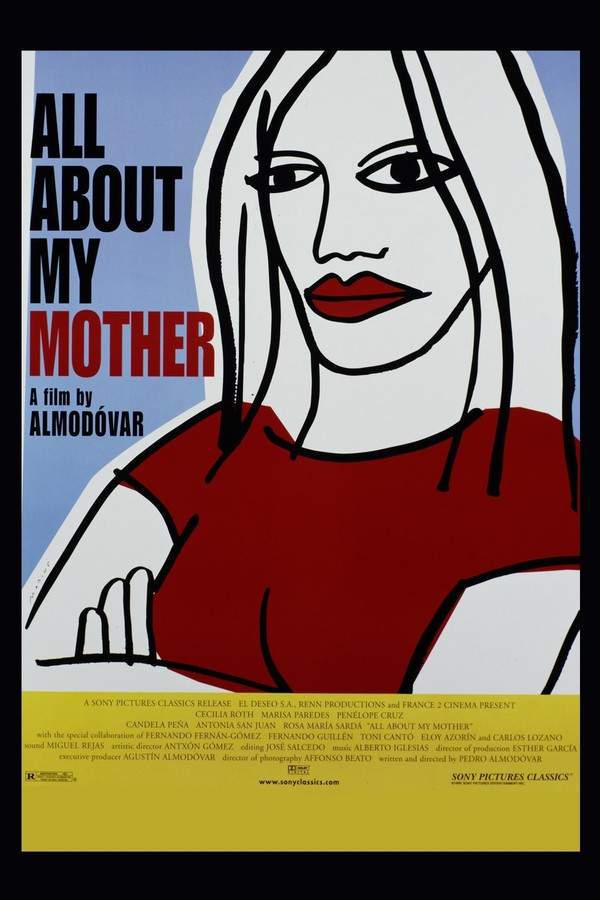
Manuela is an Argentine nurse who oversees donor organ transplants at Ramón y Cajal Hospital in Madrid. She is also a single mother to Esteban, a thoughtful teenager with dreams of becoming a writer. Her life unfolds with quiet resolve, balancing work, motherhood, and the ache of keeping parts of her past private.
On the night of Esteban’s 17th birthday, tragedy strikes when he is hit by a car while chasing after his favorite actress, Huma Rojo, for a autograph after a performance of A Streetcar Named Desire, where Huma embodies Blanche DuBois. In the wake of grief, Manuela makes a harrowing choice: she allows Esteban’s heart to be transplanted to a man in A Coruña. After locating the recipient, she resigns from her job and travels to Barcelona in search of Esteban’s other mother, Lola—a transgender woman whom Manuela had kept secret from her son, just as she had hidden Lola from Esteban.
In Barcelona, Manuela rekindles an old friendship with Agrado, a warm and witty transgender sex worker, and she gradually builds bonds with Huma and her co-star and former lover Nina Cruz, who struggles with heroin addiction. She also meets Rosa, a HIV-positive nun who works in a shelter for battered sex workers and is pregnant with Lola’s child. Manuela’s life becomes woven into the circle around these women as she takes on roles beyond nurse and mother: caring for Rosa during her pregnancy, serving as Huma’s personal assistant, and stepping in as an understudy for Nina during one of her drug-fueled crises.
The journey brings Manuela to a park where Rosa asks the taxi to stop. There, Rosa spots her father’s dog Sapic and encounters her father himself, who suffers from Alzheimer’s and barely recognizes his daughter, yet Sapic clearly recognizes Rosa. Rosa dies in childbirth, delivering a healthy boy, and at her funeral Manuela finally reunites with Lola. Lola, who was once Esteban’s other parent, is dying from AIDS and speaks of her long-held wish to have a son. Manuela recounts the existence of Esteban, sharing a photo to help Lola understand the life they built.
Faced with the fragile moment, Manuela chooses to bring Rosa’s child into Lola’s world by adopting Rosa’s son, Esteban, and caring for him at Rosa’s parents’ home. The father remains bewildered, and Rosa’s mother arrives with a sharp disapproval, insisting that Lola not be allowed near the child. Manuela explains Lola’s true connection to Esteban, but Rosa’s mother, fearing transmission and blame, rejects the arrangement. The family tension underscores the persistence of secrecy and the courage required to redefine family boundaries.
With heavy heart but a steadfast spirit, Manuela leaves Rosa’s household and returns to Madrid with Esteban, writing a letter to Huma and Agrado to apologize for not saying goodbye in the manner she once anticipated. Two years pass, and Manuela reappears in Barcelona with Esteban, who has grown healthy and AIDS-free. At an AIDS convention, she reconnects with Huma and Agrado, who now run a stage show together, and shares that she plans to stay with Esteban’s grandparents. In a final note about Nina, Agrado reveals that Nina left Huma, returned to her hometown, married, and is now a mother herself—an echo of the lives these women have built beyond the shadows of their past.