Plot Explained Spoilers guaranteed!
Plot Explained

Browse by genre

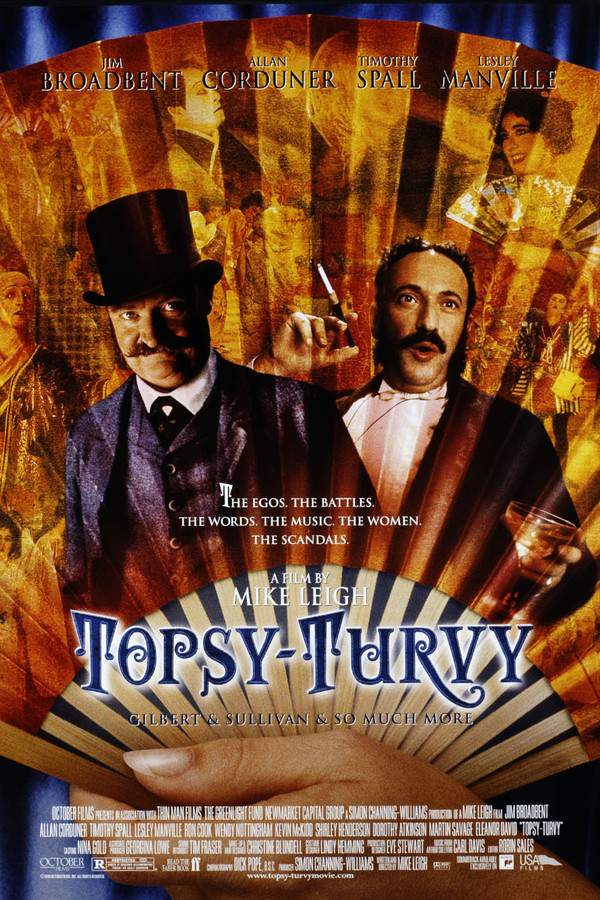
Topsy-Turvy (1999) movie poster

Plot Summary

Topsy-Turvy (1999) Plot Summary Explained

Release, runtime and language
1999 · 160 min · English
Loading streaming availability…
Directed by
Mike Leigh
Starring
Jim Broadbent, Allan Corduner

During the Victorian era, the celebrated duo Gilbert and Sullivan face numerous challenges while creating their operetta, "The Mikado." In 1884, artistic differences and personal struggles threaten to disrupt the collaborative process as they strive to produce a memorable and spectacular performance. The film explores the complexities of their creative partnership and the pressures of bringing a grand production to life.

On this page (6)
  1. 1 Where to watch
  2. 2 What happens: full plot
  3. 3 Plot questions answered
  4. 4 Movie threads
  5. 5 Movies like Topsy-Turvy
  6. 6 Every angle
Loading streaming availability…

Full plot summary · contains spoilers

What Happens in Topsy-Turvy: Full Plot Summary

The whole story of Topsy-Turvy (1999) explained, from the opening scene to the final frame: every key event, every twist and what it all adds up to. Read it as a quick recap before the sequel, to check a scene you missed, or to finally understand what really happened.

On the opening night of Princess Ida at the Savoy Theatre in January 1884, the renowned composer Sir Arthur Sullivan (Jim Broadbent), who is suffering from kidney disease, struggles to reach the theatre in time to conduct. Hoping that taking a holiday on the continent will benefit his health, Sullivan takes some time off. However, during his absence, the sales of tickets and attendance at the Savoy Theatre dwindle under the oppressive summer heat. Producer Richard D'Oyly Carte finds himself in a difficult position, having called upon both Sullivan and dramatist W. S. Gilbert to create a new production for the Savoy, but unfortunately, their new work is not ready when Ida concludes. As a temporary solution, Carte decides to revive an earlier work by Gilbert and Sullivan, The Sorcerer.

As Gilbert begins crafting ideas for their next opera, he proposes a magical lozenge that transforms its users. Yet, Sullivan feels this idea is overly reminiscent of the magic potion and various other supernatural elements utilized in their previous operas, making it feel mechanical. Constrained by the expectations of the British music establishment to produce more serious compositions, Sullivan yearns for something "probable," focusing on "human interest" and eschewing the reliance on magic. Gilbert, however, believes his libretto is sound and stubbornly refuses to create a new one, leading to a creative impasse.

The friction is finally resolved after Gilbert and his wife attend a popular exhibition of Japanese arts and crafts in Knightsbridge, London. A moment of inspiration strikes when a katana sword he acquires unexpectedly tumbles from the wall of his study. This incident sparks his imagination, leading him to craft a libretto set in exotic Japan. Sullivan embraces this fresh concept and eagerly agrees to compose the accompanying music.

The trio of Gilbert, Sullivan, and Carte immerse themselves in the preparations to ensure The Mikado becomes a triumph. A flurry of activity ensues as scenes of rehearsals and behind-the-scenes stresses unfold: cast members enjoy lunch together while attempting to negotiate their salaries. Gilbert seeks assistance from Japanese girls at the exhibition to coach the ladies' chorus in authentic movements and fan techniques. The main cast undergoes costume fittings, created by the talented C. Wilhelm. Tension rises when the cast disputes Gilbert's intended cut of the titular character's Act Two solo, “A more humane Mikado,” ultimately persuading him to restore it.

As the long-awaited premiere approaches, the actors experience first-night nerves in their dressing rooms. Finally, after much anticipation, The Mikado is set to open. True to form, Gilbert's nerves get the best of him, causing him to pace outside instead of watching the performance. After a nerve-wracking wait, he returns to the theatre to discover that the new opera is a resounding success.
Last updated: November 16, 2024 at 16:57

Was this helpful?

Plot questions answered

Topsy-Turvy Plot Explained: Your Questions Answered

The questions people ask most about Topsy-Turvy (1999): what happens in the confusing scenes, why the characters do what they do, the twists, hidden details and what the ending means. Each answer contains spoilers.

Q1

Why was Sullivan struggling to reach the theatre on opening night?

Sir Arthur Sullivan was suffering from kidney disease, which made it difficult for him to travel and arrive at the Savoy Theatre in time to conduct Princess Ida on its opening night in January 1884.

  • sullivan kidney disease princess ida opening night Savoy Theatre
Q2

Why did ticket sales drop after Sullivan took a holiday?

When Sullivan left for the continent to recover his health, the box office suffered because audiences associated the Savoy Theatre's success with his music. Without him present, ticket sales and attendance declined significantly during the oppressive summer heat.

  • ticket sales drop Sullivan holiday Savoy Theatre attendance
Q3

Why did Sullivan reject Gilbert's magical lozenge concept?

Sullivan felt the magical lozenge idea was too similar to the magic potions and supernatural elements used in their previous operas, making it feel mechanical. He wanted something probable with human interest rather than relying on magic, as he faced pressure from the British music establishment to compose more serious works.

  • sullivan rejects magical lozenge gilbert creative differences human interest
Q4

What inspired Gilbert to set the opera in Japan?

Gilbert and his wife attended a Japanese arts and crafts exhibition in Knightsbridge, London. While in his study, a katana sword he purchased unexpectedly fell from the wall, sparking his imagination and leading him to create a libretto set in exotic Japan.

  • katana sword falls gilbert inspiration japanese mikado knightsbridge exhibition
Q5

Why was there a dispute over the Mikado's Act Two solo?

The cast objected when Gilbert wanted to cut the titular character's Act Two solo, 'A more humane Mikado.' After tension and discussion, Gilbert ultimately agreed to restore the solo, keeping it in the production just before the premiere.

  • mikado solo dispute act two cut restoration gilbert cast
Q6

Why did Gilbert pace outside instead of watching the premiere?

Gilbert suffered from severe first-night nerves, a familiar pattern for him during high-stress premieres. Rather than watch the performance, he paced anxiously outside the theatre until he returned to learn that The Mikado had become a resounding success.
  • gilbert first night nerves pacing mikado premiere success
Q7

Why did Carte revive The Sorcerer instead of waiting for a new opera?

With Sullivan on holiday and Gilbert's new work not ready when Princess Ida concluded, producer Richard D'Oyly Carte faced a gap in programming. He revived the earlier Gilbert and Sullivan collaboration The Sorcerer as a temporary solution to keep the theatre running.

  • revive the sorcerer richard doyle carte princess ida gap temporary production
Q8

Why did Gilbert enlist Japanese girls to coach the chorus?

To ensure authenticity for the Japanese setting, Gilbert recruited Japanese girls from the exhibition to teach the ladies' chorus proper movements and fan techniques. This cultural coaching added realism to the production's visual presentation.

  • japanese girls chorus coaching authenticity movements fan techniques
Q9

What role did C. Wilhelm play in The Mikado's production?

C. Wilhelm was the talented costume designer who created the elaborate costumes for the main cast. These extraordinary costumes were crucial in bringing the Japanese setting and characters to life on stage.

  • c wilhelm costume designs mikado japanese setting elaborate costumes

Movie threads

More Movies Like Topsy-Turvy, by Mood & Story

Curated lists built around what makes Topsy-Turvy tick: the same mood, the same kind of story or the same emotional payoff. Each list explains why these movies belong together.

Creative backstage dramas like Topsy-Turvy

Immersive journeys into the challenges and triumphs of artistic collaboration. If you enjoyed the behind-the-scenes look at Gilbert and Sullivan in Topsy-Turvy, you'll appreciate these movies about artistic collaboration. This section highlights films that delve into the creative process of theatre, music, and art, focusing on partnership and the journey to opening night.

  • backstage
  • collaborative
  • process oriented
  • hopeful
  • detailed
  • triumphant
  • Tone: hopeful, detailed, process-oriented
  • Pacing: steady, deliberate
Why these movies?

The story pattern: Stories in this thread typically follow a creative team or partnership through the trials of producing a work of art. The narrative often hinges on overcoming obstacles—be they interpersonal conflicts, artistic blocks, or logistical nightmares—culminating in the triumphant (or sometimes bittersweet) unveiling of their creation.

Why they belong together: These films are grouped by their shared focus on the creative process itself. They share a detailed, process-oriented approach, a hopeful tone that finds reward in hard work, and a deep appreciation for the collaborative spirit that drives artistic endeavors.

Hopeful period dramas about artists like Topsy-Turvy

Historical stories where passion for art overcomes personal and professional hurdles. Fans of Topsy-Turvy who loved its Victorian setting and focus on artistic passion will find similar stories here. Discover movies like Topsy-Turvy that combine historical detail with inspiring narratives about creators overcoming obstacles to leave their mark on the world.

  • period setting
  • artistic passion
  • inspirational
  • hopeful
  • detailed
  • rejuvenating
  • Tone: hopeful, inspirational, detailed
  • Pacing: steady, character-driven
Why these movies?

The story pattern: The narrative pattern follows a talented individual or duo in a historical context, facing both era-specific challenges and universal creative blocks. The journey is one of rejuvenation and inspiration, where the protagonist(s) rediscover their passion, leading to a fulfilling and happy conclusion centered on their artistic achievement.

Why they belong together: These movies share a cohesive vibe defined by a specific time period, a central focus on artistic creation, and a fundamentally hopeful and rewarding emotional arc. The combination of historical immersion and inspirational storytelling creates a distinct and satisfying experience.

If you liked this

Movies Like Topsy-Turvy

Similar movies to Topsy-Turvy: the same genre, themes or kind of story. Each one comes with its own plot summary, timeline and ending explained.

Browse all movie summaries

Every angle

Topsy-Turvy (1999) Explained: Plot, Timeline & Characters

Everything about Topsy-Turvy in one place: what happens in the plot summary, the timeline in chronological order, the characters and meaning and a spoiler-free summary. What's After the Movie adds the cast, box office and post-credit scenes.

Coming soon on iOS and Android

The Plot Explained Movie Summary App

Plot summaries, endings explained and timelines on your phone. Catch up on any movie in minutes, save your favorites and never miss a twist again.

Be the first to know when we launch. Your email stays private, always.

Learn more about the app