Plot Explained Spoilers guaranteed!
Plot Explained

Browse by genre

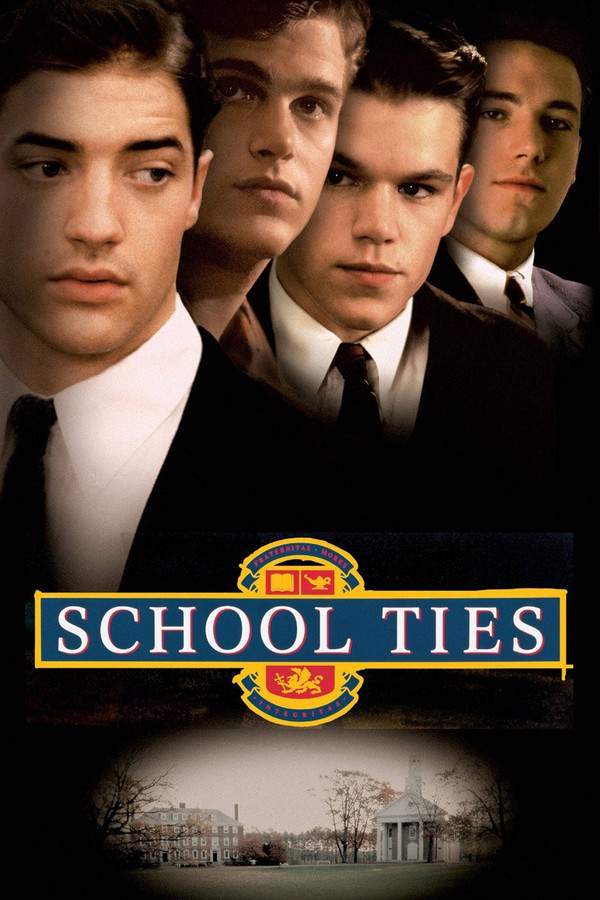
School Ties (1992) movie poster

Plot Summary

School Ties (1992) Plot Summary Explained

Release, runtime and language
1992 · 106 min · English
JustWatch #9,577 27
Directed by
Robert Mandel
Starring
Matt Damon, Brendan Fraser

Set in a prestigious 1950s prep school, the story follows David Greene, a talented football player whose arrival disrupts the established social order. As he gains popularity and excels on the field, his Jewish background is unexpectedly revealed, creating a crisis of acceptance. This discovery challenges the bonds of friendship and exposes the underlying prejudices within the school, forcing David and his peers to confront difficult truths about identity and belonging.

On this page (6)
  1. 1 Where to watch
  2. 2 What happens: full plot
  3. 3 Plot questions answered
  4. 4 Movie threads
  5. 5 Movies like School Ties
  6. 6 Every angle

Where to watch

Where to Watch School Ties (1992)

Where can you watch School Ties? Stream, rent or buy it in the US, including on fuboTV, Paramount Plus Essential and Paramount Plus Premium: current JustWatch availability with up-to-date prices.

Streaming availability powered by JustWatch

Full plot summary · contains spoilers

What Happens in School Ties: Full Plot Summary

The whole story of School Ties (1992) explained, from the opening scene to the final frame: every key event, every twist and what it all adds up to. Read it as a quick recap before the sequel, to check a scene you missed, or to finally understand what really happened.

David Greene, portrayed by Brendan Fraser, is a Jewish teenager from Scranton, Pennsylvania, navigating the challenges of the 1950s. His life takes a dramatic turn when he receives an unusual football scholarship to play as the starting quarterback at St. Matthew's, an exclusive Protestant prep school in Massachusetts. This coming-of-age story delves deep into the themes of prejudice and identity, as David's Jewish roots are met with hostility right from the start.

In a hometown bar, David's heritage is insulted, prompting his father to remind him that he "can't fight his way through life like this." This scholarship is seen as his golden opportunity to get into Harvard, a dream overshadowed by the prejudice he faces daily at St. Matt's. Upon arrival, Coach McDevitt awkwardly inquires about David's "dietary" needs, revealing the school's pervasive bias. Meeting his new peers, including the alpha boys—Charlie Dillon, Jack Connors, Rip Van Kelt, and his roommate Chris Reece—David quickly realizes the undercurrents of anti-Semitism when overhearing disparaging remarks about a team member.

David's faith and commitment are tested when he's torn between attending temple for Rosh Hashanah at his father's request and playing in a crucial football game. Ultimately, he chooses to play, showcasing his skills as he throws a pivotal touchdown pass that leads to a victory, while later paying homage to his culture through prayers in the chapel.

The film goes beyond mere religious tensions, exploring social inequalities and the abuse of power among students. The academic struggles of his peers, particularly McGivern's hurdles in French class, highlight the challenges facing those who flourish in different ways. Dillon expresses envy toward David, realizing his friend’s struggle for acceptance is intertwined with his own expectations as a Dillon.

As Quinn’s character develops, Dillon finds himself threatened by David's success both on the field and off, resulting in a heated clash where David's Jewish identity is weaponized against him. A heartbreaking scene sees him ostracized following Dillon’s cruel jokes, escalating the social divide within their athletic circle. The persistence of this intolerance unfolds as David faces both rejection and harassment from his classmates, culminating in a horrific sign displayed above his bed, twisted with hate.

The tension peaks when Dillon is caught cheating, igniting a debate that forces classmates to confront their biases and loyalty. David, witnessing the betrayal of their friendship, stands firm against the prevailing injustice. Accusations fly as the class grapples with the honor code, reflecting a critical turning point where David's integrity comes into question.

In the end, David’s courage to reveal the truth leads to Dillon’s expulsion, but not without a chilling confrontation where Dillon's anti-Semitic tendencies culminate in taunts about their differing futures. As David walks away, he leaves behind a powerful reminder that this experience will forever shape their identities, a bitter yet resolute assertion that resonates long after the credits roll.
Last updated: October 28, 2024 at 17:36

Was this helpful?

Plot questions answered

School Ties Plot Explained: Your Questions Answered

The questions people ask most about School Ties (1992): what happens in the confusing scenes, why the characters do what they do, the twists, hidden details and what the ending means. Each answer contains spoilers.

Q1

Why does David choose to play football instead of attending Rosh Hashanah?

David chooses football because he feels enormous pressure to prove himself at St. Matthew's. The scholarship is his only path to Harvard, and skipping the game would let down his teammates and coaches who depend on him as quarterback. However, he still honors his faith by praying in the chapel after the game, showing he tried to balance both obligations but prioritized the immediate competitive commitment.

Foreshadowing: Earlier, David's father warned him that he "can't fight his way through life," hinting at the compromises David will make to survive in this environment.

  • rosh hashanah
  • football game
  • david greene
  • scholarship
  • harvard
Q2

Why does Charlie Dillon become hostile toward David?

Dillon feels threatened by David's success both on and off the field. As the school's star athlete, Dillon enjoyed unchallenged status until David arrived and quickly became popular. Dillon also realizes that David's struggle for acceptance mirrors his own internal pressure to maintain his family's prestigious reputation, making David's presence a mirror he resents.

Foreshadowing: The timeline notes Dillon's envy develops early, with the film showing him watching David's growing popularity with increasing resentment.

  • charlie dillon
  • rivalry
  • anti-semitism
  • popularity
  • football
Q3

Why does David decide to report Dillon for cheating?

David decides to report Dillon because he refuses to let his integrity be questioned while knowing the truth. When classmates pressure him to defend Dillon or stay silent, David chooses to stand by his principles rather than protect someone who had consistently humiliated him. The cheating revelation becomes a moment where David must choose between loyalty to his tormentor and his own moral code.

Foreshadowing: The buildup to this moment includes David's earlier choice to pray in chapel despite playing football, showing his ongoing commitment to his values.

  • dillon cheating
  • honor code
  • expulsion
  • integrity
  • david greene
Q4

What is the significance of the hateful sign displayed above David's bed?

The sign represents the climax of the social harassment David faces at St. Matthew's. It transforms private prejudice into explicit, physical hostility targeting his Jewish identity. This moment shocks even some of his peers and marks the point where the discrimination moves from verbal taunts to tangible threats, forcing David to confront how deep the school's anti-Semitism truly runs.

Foreshadowing: Earlier, David overhears disparaging remarks about Jewish team members, establishing that the prejudice is woven into the school's culture.

  • hateful sign
  • anti-semitism
  • harassment
  • david greene
  • roommates
Q5

Why is Coach McDevitt's question about David's dietary needs significant?

Coach McDevitt's awkward inquiry about David's "dietary needs" upon arrival reveals the school's baked-in anti-Semitism. Rather than welcoming David as a student-athlete, the first interaction frames him through the lens of religious difference. This subtle discrimination sets the tone for David's experience, showing that prejudice exists even in seemingly polite, institutional interactions.

  • coach mcdevitt
  • dietary needs
  • anti-semitism
  • arrival
  • st matthews
Q6

What causes David's classmates to turn against him?

David's classmates turn against him primarily because Dillon weaponizes David's Jewish identity. When Dillon starts making cruel jokes about David's heritage, the social pressure to choose sides forces other students to either defend David or maintain their position in the popular group. Many choose conformity over courage, allowing the ostracization to spread through the athletic circle.

Foreshadowing: David overhears anti-Semitic remarks early on, but it's Dillon's personal attacks that escalate this private bias into public exclusion.

  • ostracization
  • classmates
  • dillon
  • social pressure
  • peer pressure
Q7

What leads to Dillon's expulsion from St. Matthew's?

Dillon is expelled when he is caught cheating and David testifies against him, revealing the truth about the academic dishonesty. This forces the school to enforce its honor code, despite Dillon's family's influence and status. David's decision to tell the truth rather than protect Dillon becomes the final rupture between them and results in Dillon being removed from the school.

Foreshadowing: The timeline shows this as a critical turning point where David's integrity comes into direct conflict with Dillon's dishonesty.

  • dillon expulsion
  • honor code
  • cheating
  • testifies
  • consequences
Q8

Why does David remain at St. Matthew's despite facing constant prejudice?

David stays because the football scholarship represents his only realistic path to Harvard and a better life. Coming from Scranton with limited opportunities, leaving would mean giving up the future his father sacrificed for. Staying becomes an act of resilience, David refuses to let bigots drive him out of the opportunity he earned through his talent.

  • staying
  • prejudice
  • harvard
  • scholarship
  • resilience
Q9

What is the significance of the final confrontation between David and Dillon?

The final confrontation crystallizes the film's themes of identity and lasting prejudice. Dillon's taunt about their "differing futures" underscores that despite Dillon's expulsion, the systemic privilege that enabled his behavior remains intact. David's response, that this experience will forever shape their identities, acknowledges that while Dillon faces immediate consequences, the deeper battle against prejudice is far from over.

  • final confrontation
  • identity
  • futures
  • dillon
  • david greene
Q10

How does Dillon use David's Jewish identity against him?

Dillon weaponizes David's Jewish identity by making cruel jokes and taunts that expose the anti-Semitism he'd previously kept more subtle. This escalation from private remarks to public attacks transforms David's religious background into a social liability, turning his peers against him by making his faith the source of ridicule rather than just a difference to be tolerated.

Foreshadowing: Earlier, David hears disparaging remarks about Jewish team members, showing Dillon had always held these biases but needed David's success to ignite their expression.

  • jewish identity
  • taunts
  • dillon
  • anti-semitism
  • social divide

Movie threads

More Movies Like School Ties, by Mood & Story

Curated lists built around what makes School Ties tick: the same mood, the same kind of story or the same emotional payoff. Each list explains why these movies belong together.

Movies about bigotry in isolated worlds like School Ties

Dramas where an enclosed setting becomes a pressure cooker for prejudice. If you liked the pressure-cooker atmosphere of prejudice in School Ties, this list features similar dramas. Discover movies where isolated settings like schools or communities force a confrontation with deep-seated bigotry, featuring themes of identity, betrayal, and moral courage.

  • tense
  • oppressive
  • uneasy
  • melancholic
  • somber
  • unsettling
  • Tone: dark, tense, sobering
  • Pacing: steady, methodical build
Why these movies?

The story pattern: The narrative pattern involves a protagonist entering or existing within a rigid, enclosed community. Their difference—be it race, religion, or belief—is discovered or emphasized, triggering a violent backlash from the group. The story charts the escalating tension as the protagonist fights for acceptance and integrity, often leading to a painful but morally clarifying conclusion.

Why they belong together: Movies are grouped here for their shared focus on exposing prejudice within a confined, high-stakes setting, creating an intense and often uncomfortable viewing experience. They share a dark tone, heavy emotional weight, and a steady pacing that builds tension methodically toward a dramatic moral crisis.

Movies about secret identities exposed like in School Ties

Stories where a hidden identity is revealed, shattering relationships and safety. Fans of the identity crisis and betrayal in School Ties will appreciate these films. Explore stories where a character's hidden truth is revealed, leading to public scrutiny, shattered alliances, and a difficult journey toward self-worth in the face of prejudice.

  • anxious
  • tense
  • somber
  • melancholic
  • unsettling
  • betrayal
  • Tone: dark, anxious, bittersweet
  • Pacing: steady, crisis-driven
Why these movies?

The story pattern: The narrative follows a character who has achieved success or acceptance by concealing a core aspect of their identity. When the truth comes out, often through betrayal, their world unravels. The story focuses on the fallout: the loss of trust, the confrontation with bigotry, and the protagonist's struggle to reclaim their dignity on their own terms.

Why they belong together: These films are linked by the powerful narrative device of a secret identity being forcibly revealed. They share a bittersweet or somber ending feel, a heavy emotional weight from the themes of betrayal and societal rejection, and a tense, anxious mood as the protagonist's safety net is ripped away.

If you liked this

Movies Like School Ties

Similar movies to School Ties: the same genre, themes or kind of story. Each one comes with its own plot summary, timeline and ending explained.

Browse all movie summaries

Every angle

School Ties (1992) Explained: Plot, Timeline & Characters

Everything about School Ties in one place: what happens in the plot summary, the timeline in chronological order, the characters and meaning and a spoiler-free summary. What's After the Movie adds the cast, box office and post-credit scenes.

Coming soon on iOS and Android

The Plot Explained Movie Summary App

Plot summaries, endings explained and timelines on your phone. Catch up on any movie in minutes, save your favorites and never miss a twist again.

Be the first to know when we launch. Your email stays private, always.

Learn more about the app