Plot Explained Spoilers guaranteed!
Plot Explained

Browse by genre

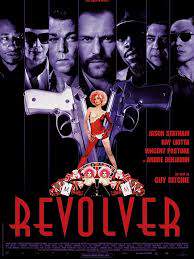
Revolver (2007) movie poster

Plot Summary

Revolver (2007) Plot Summary Explained

Release, runtime and language
2007 · 115 min · English
JustWatch #5,745 1
Directed by
Guy Ritchie
Starring
Jason Statham, Ray Liotta

After serving seven years in prison, Jake Green, a skilled gambler, seeks revenge on those who wronged him. He publicly humiliates his enemy, Dorothy Macha, but soon finds himself targeted by her dangerous associates. With the help of mysterious figures Zach and Avi, Jake navigates a perilous underworld where he must use his wits and gambling skills to survive a deadly game.

On this page (6)
  1. 1 Where to watch
  2. 2 What happens: full plot
  3. 3 Plot questions answered
  4. 4 Movie threads
  5. 5 Movies like Revolver
  6. 6 Every angle

Where to watch

Where to Watch Revolver (2007)

Where can you watch Revolver? Stream, rent or buy it in the US, including on Tubi TV, Amazon Video and Apple TV Store: current JustWatch availability with up-to-date prices.

Streaming availability powered by JustWatch

Full plot summary · contains spoilers

What Happens in Revolver: Full Plot Summary

The whole story of Revolver (2007) explained, from the opening scene to the final frame: every key event, every twist and what it all adds up to. Read it as a quick recap before the sequel, to check a scene you missed, or to finally understand what really happened.

Jake Green, portrayed by Jason Statham, spends seven long years in solitary confinement, contemplating the meaning of life alongside two enigmatic cellmates: a con man and a chess master. Through written exchanges hidden within shared books, they share insights on chess strategies and the art of deception. Although Jake learns essential techniques of the con, it isn't until much later that he understands their true significance in his life.

When a daring jailbreak plan is hatched by his cellmates, they escape, leaving Jake in a state of betrayal and abandonment. While Jake remains incarcerated, the duo makes off with a substantial sum of his hidden money, trusting him with their formula for a perfect con, only to leave behind a chilling reminder: > "The first rule of any game - YOU CAN ONLY GET SMARTER BY PLAYING A SMARTER OPPONENT." Fast forward two years, Jake surfaces from prison penniless but wiser, ready to apply the lessons learned from his time in confinement.

With his renewed skills, Jake takes the gambling world by storm, but quickly becomes entangled with the ruthless Dorothy Macha, played by Ray Liotta. As he makes his way into Macha's casino, Jake is painfully aware of his claustrophobia, a psychological wound still fresh from solitary. After triumphing over Macha in a game, Jake sets off a chain of events that leads to Macha wanting revenge by placing a hit on him.

A mysterious stranger, Zach, appears to aid Jake, providing cryptic advice which he chooses to ignore in favor of descending the stairs, ultimately resulting in a fainting spell that lands him in the hospital. As Jake grapples with his newfound reality, he learns that he is physically deteriorating and only has days to live. Desperation ensues when Macha's hired gun, Sorter, is dispatched to eliminate Jake, which sets off a psychological game for survival that forces Jake to confront his inner demons.

As the story unfolds, Jake unwittingly becomes a pawn in a complex game orchestrated by the ghosts of his past. Avi and Zach, who turn out to be closer than he realizes, push Jake into moral dilemmas that challenge his very essence. These two enigmatic figures manipulate Jake's financial success, dictating his every move while undermining Macha's dealings with the notorious Sam Gold.

The plot thickens as Jake faces the challenging proposition of taking a life, but he defies their orders. This critical moment marks the turning point when he discovers that Sam Gold represents not an external foe, but the very fears and ego inside himself, an adversary he must overcome to truly break free.

In a final showdown, Jake resolves to confront Macha directly. By relinquishing his remaining wealth to charity, a symbolic act that defies his inner adversary, Jake gains an understanding of the true nature of fear and ego, finding a profound freedom that transcends his previous imprisonments.

Ultimately, this story illustrates that true liberation comes from within. The perception of an external enemy is merely a reflection of one's internal struggles. It’s a poignant reminder that the greatest battles we fight are against the fears that dwell within, and that recognition of this battle is the first step toward mastery over one’s own psyche.
Last updated: November 03, 2024 at 20:34

Was this helpful?

Plot questions answered

Revolver Plot Explained: Your Questions Answered

The questions people ask most about Revolver (2007): what happens in the confusing scenes, why the characters do what they do, the twists, hidden details and what the ending means. Each answer contains spoilers.

Q1

Why did Jake's cellmates leave him behind during the jailbreak?

Jake's cellmates escaped without him because they needed a decoy to distract the guards while they made their escape. They took Jake's hidden money with them, leaving him with nothing but the written formula for the perfect con. The betrayal was deliberate, they used Jake as a pawn in their escape plan while keeping his money for themselves.
Foreshadowing: Early in their cell conversations, the con man warns Jake about trusting partners in any game.

  • jake green
  • cellmates
  • jailbreak
  • betrayal
  • prison escape
Q2

What did Jake learn during his seven years in solitary?

Jake learned the art of deception, psychological manipulation, and strategic thinking from two cellmates, a con man and a chess master. They communicated through hidden notes in books, teaching him chess strategies and the principles of running long cons. These skills proved essential when Jake entered the gambling world, though he didn't fully understand their significance until much later in his journey.

Foreshadowing: The cellmates repeatedly emphasize that success comes from playing smarter opponents, not just skilled ones.

  • solitary confinement
  • chess
  • deception
  • con man
  • skills learned
Q3

Why did Dorothy Macha want Jake dead?

After Jake defeated Macha in a high-stakes poker game and publicly humiliated her, she placed a hit on him. However, the deeper reason was that Macha's business dealings with Sam Gold were being undermined by Jake's sudden success, which was secretly orchestrated by Avi and Zach. Macha saw Jake as a threat to her empire and wanted him eliminated to protect her interests.

Foreshadowing: Jake's winning streak immediately after release raises suspicion about who truly orchestrated his success.

  • dorothy macha
  • revenge
  • casino
  • hitman
  • sorter
Q4

Who are Zach and Avi and what do they want from Jake?

Zach and Avi are actually the con man and chess master from Jake's prison cell, they faked their identities to manipulate him. They orchestrate Jake's rise in the gambling world to use him as a pawn against Sam Gold, their rival. Their goal was to have Jake eliminate Sam Gold, but when Jake refuses to kill, they reveal the truth: they pushed Jake into the game to fight their battle for them.

Foreshadowing: Zach appears mysteriously right after Jake's release and offers cryptic guidance that always serves a larger agenda.

  • zach
  • avi
  • con man
  • chess master
  • manipulation
Q5

What does Sam Gold represent in the story?

Sam Gold is not a real person but a psychological construct representing Jake's own ego and fear. Throughout the film, Sam Gold appears as the ultimate external enemy, someone Jake is told he must destroy to win. When Jake finally faces him, he realizes Sam Gold is his own reflection, the embodiment of his fears and ego that he must overcome to achieve true freedom.

Foreshadowing: Jake is repeatedly told that defeating Sam Gold will give him everything, yet no one can clearly explain who Sam Gold actually is.

  • sam gold
  • ego
  • fear
  • internal enemy
  • psychological symbol
Q6

Why did Jake give away his money at the end?

Jake gave away his remaining fortune to charity as a symbolic act of releasing his attachment to wealth and power. By relinquishing everything, he demonstrated that he had conquered his internal adversary, his ego and fear. This act of self-sacrifice represented his ultimate con: defeating the greatest opponent he'd ever faced, which was himself.

Foreshadowing: Throughout the film, Jake is obsessed with accumulating wealth and power as measures of success.

  • charity
  • wealth
  • freedom
  • sacrifice
  • ego
Q7

Why did Jake faint after his gambling victory?

Jake's fainting spell was triggered by his severe claustrophobia, a psychological wound from seven years in solitary confinement. When he descended the stairs after his victory, the confined space triggered a panic attack that caused him to collapse. This incident also revealed his deteriorating physical condition, adding urgency to his situation.

Foreshadowing: Jake's discomfort in enclosed spaces is shown earlier when he enters Macha's casino, where he appears visibly agitated.

  • claustrophobia
  • fainting
  • panic attack
  • hospital
  • health
Q8

What was the con formula Jake's cellmates left him?

The formula is a set of psychological principles for executing the perfect con: you can only get smarter by playing a smarter opponent. The cellmates left Jake with this knowledge instead of money, believing it was more valuable. The formula teaches that the key to winning any game is understanding your opponent's psychology and using their own ego against them.

Foreshadowing: This principle echoes throughout the film, especially in how Jake is manipulated by Avi and Zach.

  • con formula
  • deception
  • psychology
  • chess strategy
  • formula
Q9

Was Jake actually dying or was his illness psychological?

The film presents Jake's terminal diagnosis as real, he is told he has only days to live due to his deteriorating condition. However, this terminal prognosis creates the psychological pressure that forces Jake to confront his mortality and inner demons. The threat of death drives him to finally break free from the game and his internal adversaries.

Foreshadowing: The fainting spell in the hospital foreshadows the serious nature of his condition.

  • dying
  • terminal illness
  • hospital
  • health
  • mortality
Q10

Why did Jake's cellmates take his hidden money?

Jake's cellmates stole his hidden money because they needed capital to start fresh after their escape. They knew Jake had accumulated a substantial sum through gambling before his imprisonment and took it for themselves. However, they left Jake with their knowledge and the formula for the perfect con, believing psychological insight was more valuable than cash.

Foreshadowing: Jake mentions his hidden money early in the prison scenes, establishing what was at stake.

  • money
  • theft
  • betrayal
  • prison
  • cellmates
Q11

Why did Jake refuse to kill Sam Gold when ordered?

Jake refused to kill Sam Gold because he realized that killing an external enemy would not give him the victory he sought. When faced with taking a life, he recognized that Sam Gold represented something internal, not someone to be murdered but rather a part of himself to be understood and overcome. This refusal marked his turning point toward true liberation.

Foreshadowing: Jake's moral dilemmas appear throughout as Avi and Zach push him toward violence.

  • refusal to kill
  • moral dilemma
  • sam gold
  • internal battle
  • principles
Q12

What does the first rule of the game mean?

The first rule, 'you can only get smarter by playing a smarter opponent', means that personal growth comes from facing greater challenges, not easier ones. In the context of the film, this explains why Jake's cellmates targeted the most powerful criminals (Sam Gold), why Jake had to face his fears to grow, and why true victory required confronting an adversary smarter than himself: his own ego.

Foreshadowing: This quote appears as a written note left behind after the escape, setting the film's central theme.

  • first rule
  • chess
  • opponent
  • growth
  • strategy

Movie threads

More Movies Like Revolver, by Mood & Story

Curated lists built around what makes Revolver tick: the same mood, the same kind of story or the same emotional payoff. Each list explains why these movies belong together.

Movies about psychological self-confrontation like Revolver

Stories where the true enemy is the protagonist's own mind and ego. If you enjoyed the cerebral dread and mind-bending self-confrontation in Revolver, you'll appreciate these movies. They focus on characters trapped in psychological games where the ultimate battle is internal, blending thriller elements with deep philosophical questions about identity and the ego.

  • cerebral
  • psychological
  • mind-bending
  • paranoid
  • intense
  • reflective
  • Tone: tense, cerebral, reflective
  • Pacing: steady, methodical
Why these movies?

The story pattern: The narrative typically follows a protagonist who believes they are engaged in an external, high-stakes conflict—a con, a game, or a revenge plot. As the story unfolds, layers of deception are peeled back to reveal that the antagonist is a manifestation of the protagonist's own flaws. The journey culminates not in a traditional victory, but in a painful, transformative realization and the overcoming of an internal adversary.

Why they belong together: Movies in this thread are grouped by their shared focus on the theme of internal enemy. They combine a tense, cerebral atmosphere with a complex plot structure that deliberately misdirects the audience before revealing a deeper, psychological truth. The emotional journey is heavy, centered on self-discovery achieved through extreme duress.

Claustrophobic underworld survival thrillers like Revolver

High-stakes narratives where wit is the only weapon in a confined, dangerous world. For viewers who liked the tense, claustrophobic atmosphere and high-stakes survival in Revolver, this list features similar movies. These stories plunge characters into dangerous, confined underworld settings where they must use their wits in a deadly game of strategy against powerful enemies.

  • claustrophobic
  • anxious
  • oppressive
  • paranoid
  • intense
  • cerebral
  • Tone: tense, oppressive, anxious
  • Pacing: steady, dread-building
Why these movies?

The story pattern: These stories often begin with a protagonist entering or re-entering a dangerous, hierarchical underworld—whether criminal, corporate, or metaphorical. They are immediately outmatched and must survive through cleverness, gambling with their life, and playing a intricate game against seasoned opponents. The narrative unfolds as a series of calculated risks and escalating confrontations within an inescapable, oppressive environment.

Why they belong together: These movies share a specific vibe: a combination of high intensity, a tense tone, and a claustrophobic mood. The setting feels like a closed system or a trap, and the protagonist's survival hinges on outthinking their enemies. The experience is defined by sustained anxiety, cerebral strategy, and an oppressive sense of danger.

If you liked this

Movies Like Revolver

Similar movies to Revolver: the same genre, themes or kind of story. Each one comes with its own plot summary, timeline and ending explained.

Browse all movie summaries

Every angle

Revolver (2007) Explained: Plot, Timeline & Characters

Everything about Revolver in one place: what happens in the plot summary, the timeline in chronological order, the characters and meaning and a spoiler-free summary. What's After the Movie adds the cast, box office and post-credit scenes.

Coming soon on iOS and Android

The Plot Explained Movie Summary App

Plot summaries, endings explained and timelines on your phone. Catch up on any movie in minutes, save your favorites and never miss a twist again.

Be the first to know when we launch. Your email stays private, always.

Learn more about the app