Plot Explained Spoilers guaranteed!
Plot Explained

Browse by genre

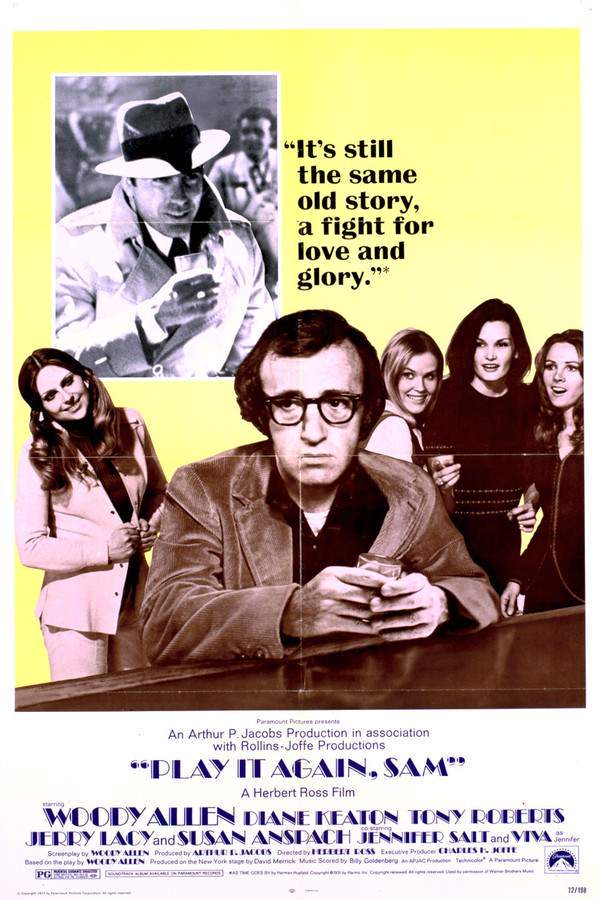
Play It Again, Sam (1972) movie poster

Plot Summary

Play It Again, Sam (1972) Plot Summary Explained

Release, runtime and language
1972 · 85 min · English
Directed by
Herbert Ross
Starring
Diane Keaton, Woody Allen, Susan Anspach, Viva, Diana Davila, Jennifer Salt

After a painful divorce, film critic Allan tries to recreate the romance of classic Hollywood by adopting the persona of Humphrey Bogart. His earnest but clumsy attempts to emulate the iconic actor’s charm and sophistication lead to a series of hilarious and disastrous romantic encounters. Allan’s journey is a comedic exploration of heartbreak, self-discovery, and the allure of cinematic heroes.

On this page (6)
  1. 1 Where to watch
  2. 2 What happens: full plot
  3. 3 Plot questions answered
  4. 4 Movie threads
  5. 5 Movies like Play It Again, Sam
  6. 6 Every angle

Where to watch

Where to Watch Play It Again, Sam (1972)

Where can you watch Play It Again, Sam? Stream, rent or buy it in the US, including on Hoopla, Kanopy and Amazon Video: current JustWatch availability with up-to-date prices.

Streaming availability powered by JustWatch

Full plot summary · contains spoilers

What Happens in Play It Again, Sam: Full Plot Summary

The whole story of Play It Again, Sam (1972) explained, from the opening scene to the final frame: every key event, every twist and what it all adds up to. Read it as a quick recap before the sequel, to check a scene you missed, or to finally understand what really happened.

Set in the vibrant backdrop of San Francisco, Play It Again, Sam opens with an iconic scene from Casablanca, featuring Humphrey Bogart and Ingrid Bergman. The protagonist, Allan Felix, sits in a cinema, utterly captivated by the film, longing to emulate the suave character of Rick. Leaving the theater, he carries a heavy heart, aware that he may never embody that kind of charisma.

Haunted by memories of his ex-wife, Nancy, who often mocked his lack of confidence in romantic situations, Allan tries to navigate the post-divorce world. He finds solace in the company of his best friend, Dick Christie, and Dick's wife, Linda, who encourage him to venture back into the dating game. However, each blind date they set him up on ends in disaster. Allan's only source of encouragement comes from the ghostly presence of Bogart, who appears solely to Allan, offering wisdom in a mix of humor and heartfelt advice. At times, Allan fantasizes conversaions with Nancy, making for both poignant and comedic moments. One particularly chaotic instance occurs when both Bogart and Nancy manifest in his imagination simultaneously.

In his quest for romance, Allan strives to project an air of sophistication reminiscent of Bogart, yet his clumsy attempts often sabotage his efforts. As he spends more time with Linda, he finds a level of comfort allowing him to be himself without pretense. Just as he is ready to confess his feelings—bolstered by Bogart’s suggestions—Nancy intervenes, creating a comical yet painful situation that disrupts Allan's moment. Linda flees but soon recognizes that Allan harbors genuine affection for her. Their embrace is beautifully underscored by the nostalgic tune of "As Time Goes By," linking back to Casablanca.

Despite their budding romance, the shadow of tragedy lurks, echoing the fateful love of Rick and Ilsa. When Dick abruptly returns from Cleveland, he unwittingly reveals his suspicions about Linda's fidelity, not realizing her true feelings for Allan. Tension mounts as the scenario mirrors classic themes of sacrifice and longing—with Allan ultimately having to let Linda choose a life with her husband.

In a powerful closing homage to Casablanca, Allan figures himself in a dreary, fog-filled airport scene, frantically racing after Linda while Dick prepares to leave on a flight. In a heartfelt moment, he echoes the legendary line, "If that plane leaves the ground and you're not on it, you'll regret it; maybe not today, maybe not tomorrow, but soon, and for the rest of your life." To which Linda responds, "That is beautiful." Allan sheepishly admits, "It's from Casablanca. ... I've waited my whole life to say it!" Completing his emotional journey, Allan has finally discovered his voice. With Bogart's spectral praise of his growth, he comes to terms with his identity, realizing he no longer needs guidance. As the familiar strains from Casablanca fill the air one last time, As Time Goes By marks the poignant end of Allan's transformative experience.

Last updated: November 16, 2024 at 11:27

Was this helpful?

Plot questions answered

Play It Again, Sam Plot Explained: Your Questions Answered

The questions people ask most about Play It Again, Sam (1972): what happens in the confusing scenes, why the characters do what they do, the twists, hidden details and what the ending means. Each answer contains spoilers.

Q1

Why does Allan pretend to be Humphrey Bogart?

Allan uses Bogart as a persona to cope with his insecurity after his divorce. He believes he lacks the confidence and charm needed for romance, so he模仿s the iconic character from Casablanca in hopes of becoming more desirable. This fictional identity serves as both a shield against rejection and a way to process his emotional wounds from the failed marriage.

Foreshadowing: The film opens with Allan watching Casablanca, establishing his deep admiration for Rick Blaine's confident demeanor.

  • allan felix
  • humphrey bogart
  • self-esteem
  • divorce
  • casablanca obsession
Q2

Is Humphrey Bogart real or in Allan's imagination?

Bogart appears only to Allan, making him a spectral guide rather than a real ghost. The film presents Bogart as a manifestation of Allan's subconscious, offering advice that blends humor with genuine emotional support. This device allows the story to explore Allan's inner dialogue about romance and masculinity without requiring external validation.

Foreshadowing: Bogart first appears after Allan leaves the cinema, suggesting he emerges from Allan's mind rather than from any supernatural source.

  • bogart ghost
  • fantasy sequence
  • allan's imagination
  • mental health
Q3

Why do Allan's blind dates always fail?

Allan's blind dates fail because his attempts to emulate Bogart come across as forced and awkward. His desperate need to appear sophisticated leads him to overcompensate, which creates uncomfortable situations. The contrast between his genuine insecurity and the confident persona he attempts to project creates the comedic disasters that punctuate the film.

Foreshadowing: Earlier scenes show Allan's internal struggle between his real self and the Bogart persona he wishes to project.

  • blind dates
  • failed romance
  • awkwardness
  • comedy of errors
Q4

Does Allan end up with Linda?

Allan does not end up with Linda. Despite their genuine connection and mutual feelings, Allan ultimately chooses to let Linda return to her husband Dick. This sacrifice mirrors the ending of Casablanca, where Rick lets Ilsa go. The bittersweet resolution shows Allan's growth into someone capable of selfless love, even though it means giving up what he wants most.

Foreshadowing: The film consistently references Casablanca's theme of sacrifice, building toward this parallel conclusion.

  • allan and linda
  • romance ending
  • sacrifice
  • casablanca parallel
Q5

Why does Allan let Linda go back to Dick?

Allan lets Linda go because he recognizes that their happiness would come at the cost of breaking up her marriage to Dick. Though he has developed genuine feelings for her, Allan chooses maturity over selfish desire. This decision represents his complete transformation from a man who could only fantasize about confident romance into someone who can actually practice selfless love, just like his cinematic hero Rick.

Foreshadowing: Dick's return from Cleveland creates the triangular tension that forces Allan to make this difficult choice.

  • allan's sacrifice
  • letting go
  • mature love
  • moral choice
Q6

Why does Nancy appear in Allan's fantasies?

Nancy appears in Allan's fantasies because she represents his unresolved emotional trauma from the divorce. Her mocking voice echoes his deepest insecurities about being unlovable. These fantasy scenes allow Allan to process his feelings about the marriage ending, and the chaotic moment when both Bogart and Nancy appear simultaneously shows the conflict between his desire for guidance and his pain from the past.

Foreshadowing: Allan's memories of Nancy mocking his romantic incompetence establish why she manifests as a negative presence in his mind.

  • nancy ex-wife
  • divorce trauma
  • psychological fantasy
  • past relationship
Q7

What does the airport scene mean at the end?

The airport scene is Allan's fantasy that recreates the famous departure from Casablanca. By quoting Rick's lines about regret, Allan finally expresses his emotions authentically rather than mimicking cinema. The fog-filled setting and desperate race to stop the plane represent his fear of losing love forever. When Linda responds "That is beautiful," she acknowledges that his romantic declaration, though borrowed, reflects genuine feeling.

Foreshadowing: The Casablanca references throughout the film build toward this climactic moment of artistic and emotional borrowing.

  • airport scene
  • casablanca recreation
  • romantic confession
  • final scene meaning
Q8

Why does Allan admit the quote is from Casablanca?

Allan's admission that his romantic line comes from Casablanca marks his moment of authentic self-acceptance. Earlier, he needed to pretend he possessed natural charm, but by acknowledging the borrowed wisdom, he shows he has integrated the lessons without losing himself. This confession demonstrates growth, he no longer needs to pretend to be Bogart because he has developed his own voice and confidence.

Foreshadowing: Throughout the film, Allan's reliance on Bogart's wisdom gradually increases his own emotional intelligence.

  • self-discovery
  • authenticity
  • growth
  • character arc
Q9

Why is Linda attracted to Allan despite his awkwardness?

Linda is drawn to Allan because she sees past his clumsy attempts at charm to the genuine, sensitive person beneath. Unlike the Bogart persona Allan projects, his authentic self shows through during their conversations, his vulnerability, honesty, and emotional depth. Linda recognizes that Allan treats her with real respect and care, which contrasts with the superficial dating encounters she has witnessed him fail at repeatedly.

Foreshadowing: As Allan spends more time with Linda, he becomes more comfortable being himself rather than performing the Bogart character.

  • Linda's attraction
  • genuine connection
  • vulnerability
  • emotional intimacy
Q10

What happens to Bogart's ghost at the end?

Bogart's spectral presence fades as Allan no longer needs his guidance. In the final scenes, Bogart gives Allan his approval and disappears, signifying Allan's psychological independence. This departure represents that Allan has internalized the confidence and wisdom he once sought from his cinematic hero, allowing him to face reality without the imaginary mentor.

Foreshadowing: Allan's increasing self-assurance throughout the film foreshadows Bogart's eventual departure.

  • bogart's departure
  • independence
  • psychological growth
  • mentor figure

Movie threads

More Movies Like Play It Again, Sam, by Mood & Story

Curated lists built around what makes Play It Again, Sam tick: the same mood, the same kind of story or the same emotional payoff. Each list explains why these movies belong together.

Neurotic Rom-Coms like Play It Again, Sam

Stories where charmingly awkward characters stumble their way toward love. If you enjoyed the charmingly awkward humor of Play It Again, Sam, you'll find more movies like it here. This collection features similar romantic comedies where anxious, self-deprecating characters navigate the complexities of dating and self-discovery with a mix of hope and hilarious missteps.

  • neurotic
  • clumsy
  • hopeful
  • romantic
  • self-deprecating
  • anxious
  • Tone: light, hopeful, self-deprecating
  • Pacing: steady, vignette-driven
Why these movies?

The story pattern: Stories typically follow a protagonist, often struggling with a recent personal crisis, as they attempt to re-enter the dating world. Their journey is punctuated by a series of comedic set pieces stemming from social anxiety and misguided attempts at courtship. The central conflict is internal—a battle between self-doubt and the desire for connection—resolved through personal growth and authentic connection.

Why they belong together: Movies are grouped here for their shared blend of witty, character-driven humor and sincere romantic longing. They balance a light, comedic tone with relatable emotional weight, creating a comforting yet funny viewing experience centered on personal transformation.

Movies with Cinematic Fantasies like Play It Again, Sam

Characters who use movie fantasies to cope with the disappointments of real life. Fans of Play It Again, Sam's imaginary Bogart will enjoy these other movies where characters use film fantasies to navigate life. Discover similar stories that blend reality with dreamlike escapes, exploring how cinema inspires and complicates our search for identity and romance.

  • nostalgic
  • dreamlike
  • romantic
  • hopeful
  • whimsical
  • self-discovery
  • Tone: whimsical, nostalgic, bittersweet
  • Pacing: steady
Why these movies?

The story pattern: The narrative pattern involves a character facing a personal struggle—heartbreak, boredom, or a lack of identity—who begins to interpret their life through a cinematic lens. This leads to fantasy sequences or deliberate attempts to live out a movie trope, creating both comedic and poignant contrasts. The arc usually involves the character learning to integrate the idealized fantasy with their authentic self.

Why they belong together: This thread groups films that share a specific structural element: the use of fantasy or cinematic homage as a central character device. They blend a grounded emotional core with a playful, meta-fictional layer, creating a unique tone that is both nostalgic and introspective.

If you liked this

Movies Like Play It Again, Sam

Similar movies to Play It Again, Sam: the same genre, themes or kind of story. Each one comes with its own plot summary, timeline and ending explained.

Browse all movie summaries

Every angle

Play It Again, Sam (1972) Explained: Plot, Timeline & Characters

Everything about Play It Again, Sam in one place: what happens in the plot summary, the timeline in chronological order, the characters and meaning and a spoiler-free summary. What's After the Movie adds the cast, box office and post-credit scenes.

Coming soon on iOS and Android

The Plot Explained Movie Summary App

Plot summaries, endings explained and timelines on your phone. Catch up on any movie in minutes, save your favorites and never miss a twist again.

Be the first to know when we launch. Your email stays private, always.

Learn more about the app