Year: 1972
Runtime: 88 min
Language: English
Director: William F. Claxton
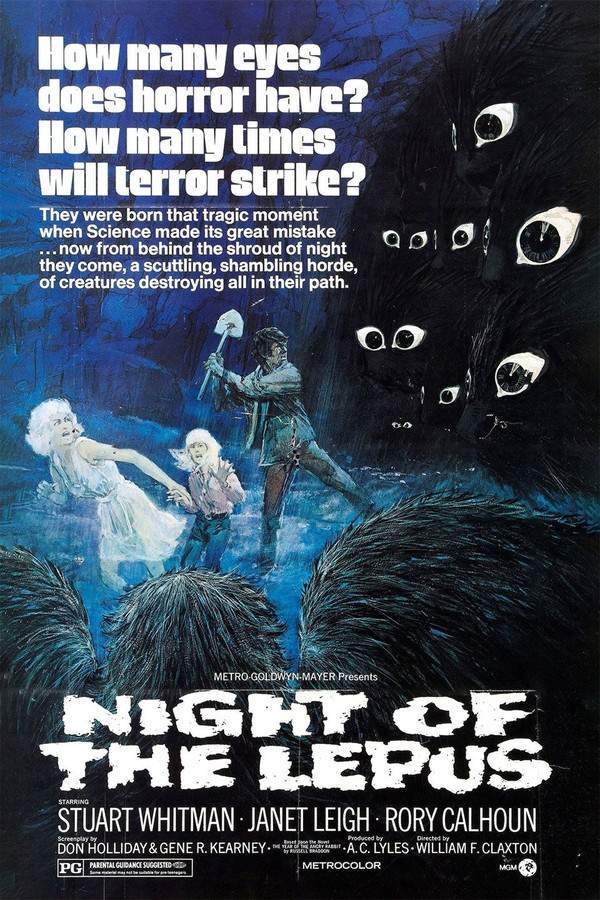
A plague of giant, genetically mutated rabbits descends upon an Arizona ranch, causing widespread devastation. Rancher Cole Hillman seeks a solution to the bizarre outbreak, but his actions trigger a terrifying escalation of the creatures' size and aggression. A team of scientists must grapple with the unintended results of their research as they battle an increasingly ferocious and overwhelming horde, struggling to survive against the unexpected threat.
Warning: spoilers below!
Haven’t seen Night of the Lepus yet? This summary contains major spoilers. Bookmark the page, watch the movie, and come back for the full breakdown. If you're ready, scroll on and relive the story!
Read the complete plot breakdown of Night of the Lepus (1972), including all key story events, major twists, and the ending explained in detail. Discover what really happened—and what it all means.
The film begins with a startling news report that highlights the issue of overpopulation, not only among humans but within the animal kingdom as well. It specifically references the rabbit outbreak in Australia during the 1950s and draws parallels to a similar crisis unfolding in the American Southwest, particularly in Arizona. Here, the rabbit population has exploded, leading to widespread devastation as these creatures consume crops, damage property, and compete aggressively with livestock for limited food and water resources.
As the story transitions to Arizona, we are introduced to Cole Hillman, played by Paul Fix, who is shown riding his horse. Unfortunately, the horse steps into a rabbit hole, injuring itself, forcing Cole to take the drastic measure of shooting it and making the long journey home on foot. Determined to find a solution to the rabbit infestation, he contacts the local university in Ajo for assistance. There, he crosses paths with Dr. Elgin Clark, portrayed by Stuart Whitman, whose initial recommendation is to bring in the same individual responsible for eradicating coyotes—an idea that makes Cole hesistant. Instead, Dr. Clark proposes that Cole consult with the Bennett family, a group of scientific researchers in search of more eco-friendly methods for wildlife control.
We then meet the Bennetts—Roy (played by Chuck Hayward), Gerry, and their daughter Amanda. During this time, Roy is conducting experiments with bats to learn how to manipulate their flight for the purpose of mosquito control, all while avoiding chemical pesticides like DDT. Dr. Clark soon visits Roy, urging him to help Cole with his rabbit dilemma. As they head to Cole’s ranch, they witness ranchers battling the rabbit infestation by shooting, reflecting the desperation of their situation.
Upon reaching the ranch, Cole explains that while he is not an environmentalist, he understands that using poison to kill the rabbits could have dire consequences for his cattle, potentially making his land toxic and barren. Despite his stubbornness, Cole is tempted by Roy’s suggestions to disrupt the rabbits’ reproductive systems or introduce a illness that exclusively targets rabbits. Roy takes some rabbits back to the lab for testing, while Amanda develops a friendship with Cole’s son, Jackie.
Meanwhile, at the university, progress stalls as their experiments yield no promising results, putting Cole’s ranch and livelihood at risk. In a moment of desperation, Cole makes one last attempt with an injection on an untested rabbit, leading to an emotional conflict with Amanda, who has grown fond of the creature. Hoping to spare it from experimentation, she swaps it with one from the control group, believing it’s innocent of harm.
As the narrative unfolds, Amanda’s new pet comes into conflict with Jackie, leading to a sequence where he inadvertently lets the rabbit loose. Tension mounts as the university’s tests continue to fail; some rabbits are growing larger but are otherwise unaffected. Determined to find an unconventional solution, Cole resorts to burning a portion of his land to create a food-less environment for the rabbits—a risky move that pays off temporarily.
The plot thickens when unnatural animal tracks lead Cole and the Bennetts into a mine, where they confront terrifyingly large rabbits. These massive creatures swiftly transform the already critical situation into a life-and-death struggle. Just as they seem to be gaining the upper hand, a series of horrifying events unfolds, including a truck driver succumbing to a rabbit attack.
A tense search ensues, and when they do discover a large number of rabbits, chaos erupts as the group tries to contain these monstrous creatures. An explosion intended to trap them only exacerbates the situation, resulting in a terrifying rabbit attack on Cole’s ranch.
The climax is reached when they strategize using a railroad to electrocute the rabbits as they pass. Reinforcements arrive, yet they face constant pressure from the advancing horde of rabbits. As they put their plan into action amidst a flurry of gunfire, the group must overcome not just the swarm of rabbits but the ensuing panic that grips the town.
In the end, as the dust settles, Cole reflects on the ordeal, revealing that life is gradually returning to normal. With the coyotes returning to help manage the local rabbit population naturally, he extends an invitation to visit his ranch, demonstrating a hopeful outlook for the future beyond disaster. The film concludes with a message about the balance of nature and the lengths we will go to when faced with an ecological crisis.
Last Updated: November 02, 2024 at 11:54
Discover curated groups of movies connected by mood, themes, and story style. Browse collections built around emotion, atmosphere, and narrative focus to easily find films that match what you feel like watching right now.
Stories where ecological tampering unleashes monstrous forces against humanity.If you liked Night of the Lepus, explore more movies about ecological horror and nature's revenge. These stories feature terrifying creatures and environmental crises triggered by human error, blending sci-fi thrills with desperate survival action in a similar tense and escalating vibe.
These narratives typically begin with a well-intentioned but flawed human intervention in nature. This action triggers an unforeseen and rapidly escalating threat, often manifesting as giant or aggressive creatures. The plot follows a group of characters, often including the responsible scientists, as they scramble to contain the outbreak and survive the overwhelming force they've unleashed.
Movies in this thread share a core theme of scientific hubris and ecological consequences. They create a specific tense mood by presenting a threat that is both familiar and grotesquely amplified, leading to fast-paced action and a focus on communal survival against a seemingly unstoppable natural force.
Tense buildups that explode into fast-paced chaos and desperate survival.Find films with a similar pacing structure to Night of the Lepus, where a slow-building tension escalates into explosive action. If you enjoyed the methodical setup followed by chaotic creature feature thrills, these movies deliver that same satisfying narrative arc from dread to desperation.
The narrative pattern involves a first act dedicated to world-building and introducing a latent problem, creating a sense of unease. The second act features a critical event that breaks the tension, unleashing the full threat. The remainder of the film is a fast-paced struggle for survival, where the initial slow burn makes the ensuing chaos feel more earned and impactful.
These films are grouped by their distinctive and effective pacing rhythm. They share a mood that evolves from anxious suspense to full-blown panic, offering a viewing experience that is both intellectually engaging in the setup and viscerally thrilling in the payoff. The contrast in pacing is a key unifying element.
Don't stop at just watching — explore Night of the Lepus in full detail. From the complete plot summary and scene-by-scene timeline to character breakdowns, thematic analysis, and a deep dive into the ending — every page helps you truly understand what Night of the Lepus is all about. Plus, discover what's next after the movie.
Track the full timeline of Night of the Lepus with every major event arranged chronologically. Perfect for decoding non-linear storytelling, flashbacks, or parallel narratives with a clear scene-by-scene breakdown.
Discover the characters, locations, and core themes that shape Night of the Lepus. Get insights into symbolic elements, setting significance, and deeper narrative meaning — ideal for thematic analysis and movie breakdowns.
Get a quick, spoiler-free overview of Night of the Lepus that covers the main plot points and key details without revealing any major twists or spoilers. Perfect for those who want to know what to expect before diving in.
Visit What's After the Movie to explore more about Night of the Lepus: box office results, cast and crew info, production details, post-credit scenes, and external links — all in one place for movie fans and researchers.
Discover movies like Night of the Lepus that share similar genres, themes, and storytelling elements. Whether you’re drawn to the atmosphere, character arcs, or plot structure, these curated recommendations will help you explore more films you’ll love.
Night of the Lepus (1972) Scene-by-Scene Movie Timeline
Night of the Lepus (1972) Movie Characters, Themes & Settings
Night of the Lepus (1972) Spoiler-Free Summary & Key Flow
Movies Like Night of the Lepus – Similar Titles You’ll Enjoy
Black Sheep (2007) Plot Summary & Ending Explained
Rabid (1977) Spoiler-Packed Plot Recap
Night of the Creeps (1986) Plot Summary & Ending Explained
Night of the Zoopocalypse (2025) Story Summary & Characters
Razorback (1984) Spoiler-Packed Plot Recap
The Night of the Beast (1988) Spoiler-Packed Plot Recap
Night Creature (1978) Spoiler-Packed Plot Recap
Kingdom of the Spiders (1977) Ending Explained & Film Insights
Night Fright (1967) Complete Plot Breakdown
Tarantula (1955) Ending Explained & Film Insights
The Werewolf (1956) Complete Plot Breakdown
Night of the Bloody Apes (1969) Story Summary & Characters
Day of the Animals (1977) Film Overview & Timeline
Night of the Blood Beast (1958) Film Overview & Timeline
Alien Raiders (2008) Movie Recap & Themes