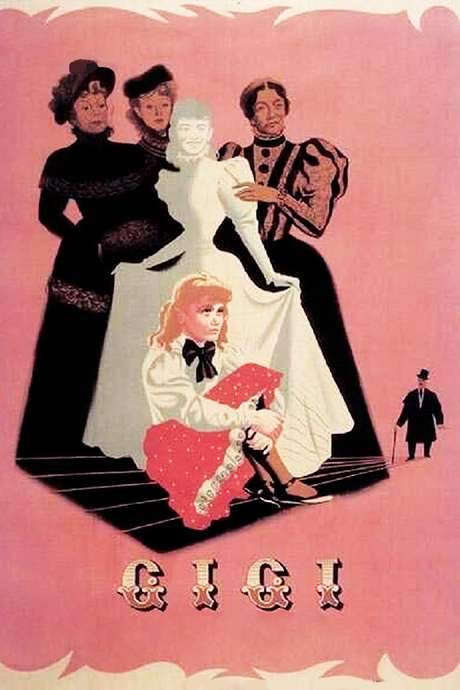
Set against the fin de siècle atmosphere of 1900 Paris, the story unfolds through the patient gaze of the elderly Honoré LaChaille, who watches his old friend's sixteen-year-old ward Gilberte 'Gigi' Alvarez. Gigi is the granddaughter of Mme. Alvarez, and her world is the fluttering stage of high society that surrounds Gaston LaChaille, Honoré’s nephew, the center of Parisian life and the heir to France’s sugar empire. Bored with the constant social theatre, Gaston finds a kind of peace in the Alvarez apartment, where he frequently visits and서 escapes the glare of the city’s endless parties.
Gigi’s education in taste and manners is diligently overseen by her grandmother and her great-aunt, Alicia, who insist that every grace—every gesture, every word—be learned as an art form. It is this meticulous cultivation that will shape Gigi’s future, even as her own heart grows curious about the wider world that lies beyond the salon walls. When Gaston first notices Gigi at the Alvarez home, he is drawn to her youth and vitality, and he begins to test the boundaries of their different worlds.
Gaston invites the sixteen-year-old to share a skating outing with him and his current mistress, Liane d'Exelmans. The day’s event spirals into tension when Gigi tells Gaston that Liane is dull and uninteresting, and Gaston grows suspicious that the skating instructor might be involved with Liane. The moment marks a turning point: Gaston seeks guidance from his uncle, and he subtly engineers an ending to his relationship with Liane, paying the instructor to go.
With Honoré’s quiet encouragement, Gaston throws himself into Parisian society to show that the breakup has not rattled him. He stops visiting Mme Alvarez for weeks, while Gigi keeps tabs on his escapades through the newspapers and the gossip they generate. Then, out of the blue, Gaston returns to Mme Alvarez’s apartment bearing champagne and chocolate, and he declares that he will soon travel to a seaside resort. Gigi, bold and playful, bets that if she can beat him at a card game, he must take her and Mme Alvarez along. She wins, and Honoré accompanies them on the trip, a gesture that hints at the enduring bond between the young girl, her guardians, and the city that watches them.
Alicia’s fury grows as she observes Gigi socializing with Gaston while her formal education remains incomplete. The two elderly guardians decide that Gigi must be kept away from Gaston during the critical training period, a decision that weighs heavily on both the young woman and the man who has begun to feel a real connection to her. When Gaston travels to Monte Carlo for a few weeks, Gigi undergoes an intensive course in courtesy, conversation, fashion, and etiquette, transforming from an impetuous girl into a poised and measured young woman.
The transformation unsettles Gaston, who returns to find her changed in ways that charm yet complicate the hope he once had. He proposes a riskier path—an invitation to a popular club for tea that promises to blur the lines between love and reputation—but Alicia refuses to let Gigi’s reputation be compromised. Though offended, Gaston slowly comes to see the depth of Gigi’s maturation and the sincerity of his own feelings for her.
In time, the two guardians acknowledge that Gigi has grown into something more substantial than a mere social ornament; they come to a tacit understanding, and Gaston confesses that he has fallen in love with her. Gigi is initially shocked and hurt by the idea that she was being shaped into someone else’s plan, and the couple parts on tense terms. Yet the emotional current between them does not disappear; after a period of reflection, Gigi sends a note to Gaston, signaling her willingness to accept the arc their relationship might take, even if the path is not conventional.
Gaston returns and the pair attend another social event, where the question of their future again tests them. Gaston, unsettled by the new, more sophisticated version of Gigi, brings her home early and wrestles with the possibility that their bond may be shaped by more than romance. After long hours of wandering through the night streets of Paris, a turning point arrives: Gaston rises to ask for Gigi’s hand in marriage, showing that what began as a social experiment has evolved into something deeper and lasting.
In the end, the story remains a delicate study of growing up, love tempered by society’s codes, and the patient counsel of the older generation as they watch a girl become a woman who can choose her own future. The emotional texture is built through the interwoven perspectives of Honoré, Gigi, Gaston, Alicia, and the broader circle of Parisian society, all anchored by a city that moves at a decade-spanning pace—from the quiet rooms of the Alvarez home to the glittering corridors of Monte Carlo and beyond.