Plot Explained Spoilers guaranteed!
Plot Explained

Browse by genre

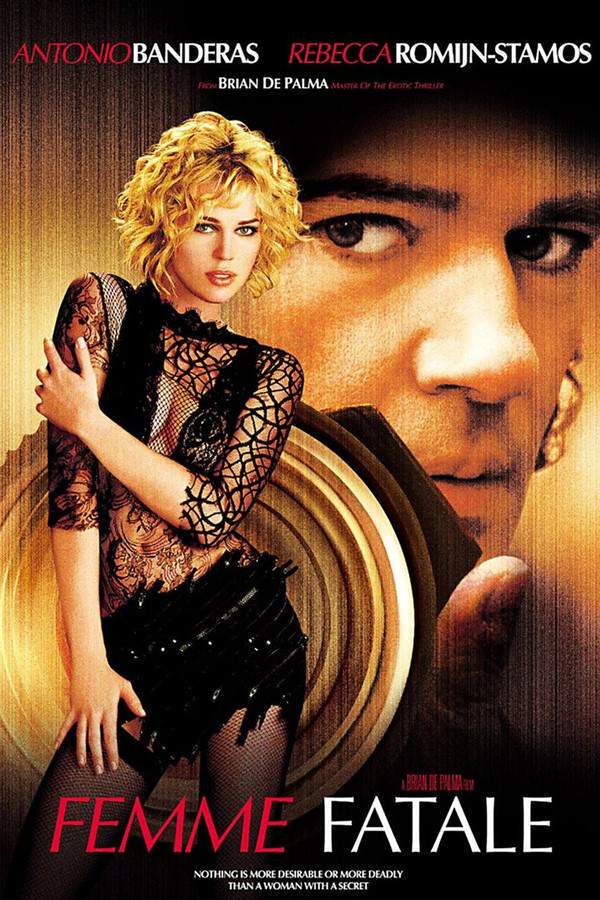
Femme Fatale (2002) movie poster

Plot Summary

Femme Fatale (2002) Plot Summary Explained

Release, runtime and language
2002 · 114 min · English
JustWatch #2,104 30
Directed by
Brian De Palma
Starring
Antonio Banderas, Peter Coyote, Rebecca Romijn

In the glamorous and dangerous world of crime, Laure is a skilled thief and seductive manipulator who orchestrates a major heist. After successfully stealing a valuable prize, she disappears, betraying her partners and leaving a tangled web of lies behind. Her plans for a fresh start are complicated when she encounters a woman who looks exactly like her, prompting a risky attempt at a new identity. However, a persistent paparazzo and a host of hidden truths jeopardize her carefully constructed facade and threaten to reveal her past.

On this page (6)
  1. 1 Where to watch
  2. 2 What happens: full plot
  3. 3 Plot questions answered
  4. 4 Movie threads
  5. 5 Movies like Femme Fatale
  6. 6 Every angle

Where to watch

Where to Watch Femme Fatale (2002)

Where can you watch Femme Fatale? Stream, rent or buy it in the US, including on Amazon Prime Video, Fawesome and Plex: current JustWatch availability with up-to-date prices.

Streaming availability powered by JustWatch

Full plot summary · contains spoilers

What Happens in Femme Fatale: Full Plot Summary

The whole story of Femme Fatale (2002) explained, from the opening scene to the final frame: every key event, every twist and what it all adds up to. Read it as a quick recap before the sequel, to check a scene you missed, or to finally understand what really happened.

Mercenary thief Laure Ash (Rebecca Romijn) is part of a team carrying out a daring diamond heist at the glamorous Cannes Film Festival. The coveted diamonds are ingeniously hidden in a striking gold outfit worn by model Veronica (Rie Rasmussen), who is attending the premiere of East/West with the film's director, Régis Wargnier. To get closer to Veronica and secure the diamonds, Laure uses her charm and seduction, all while her accomplices—Black Tie (Eriq Ebouaney) and Racine (Édouard Montoute)—provide crucial backup.

Inside the event's mundane restrooms, Laure captivates Veronica and deftly removes each piece of the ensemble, with Black Tie skillfully switching them out for replicas. Unfortunately, the plan goes awry when the security system is triggered as Laure disentangles the outfit, leading to chaos. The restroom guard enters, resulting in a deadly confrontation that propels Laure into a moment of treachery as she chooses to spare Veronica's life from Black Tie's vengeful hand, instead fleeing to Paris with the diamonds in her possession.

Upon her arrival in Paris, turns of fate lead to Laure being mistaken for a local woman named Lily, who had gone missing shortly before. Enjoying a luxurious soak in Lily's bath, Laure bears witness to Lily’s tragic return and subsequent suicide, allowing her to seize Lily's identity and escape to the United States.

Fast forward seven years, and Laure, now living as "Lily," emerges back in Paris as the wife of Bruce Watts, the newly appointed American ambassador to France (Peter Coyote). Here, she becomes the subject of intrigue for a Spanish paparazzo named Nicolas Bardo (Antonio Banderas), who snaps a photo of her under perilous circumstances. This photo circulates through Paris, catching the eye of Black Tie, who has recently been released from prison and is none too pleased to see Laure’s face again.

Fearful of her past catching up with her, Laure concocts a plan to frame Bardo for her staged kidnapping. To ensure he notices her injuries, she makes it clear she has been abused by Bruce. As Bardo follows her through a web of lies, Laure manipulates him into helping with her fabricated escape, leading to his arrest after she calls the police on him. Inspector Serra (Thierry Frémont) grows suspicious but ultimately, Bruce claims to have spoken with Laure, debunking her alleged kidnapping.

As their complex relationship unfolds, Laure confesses her dark past to Bardo, who initially shows sympathy but is pulled deeper into her dangerous game. Their romance shifts into high stakes as they seek to negotiate a ransom for her supposed safety, but in a moment of moral conflict, Bardo sabotages the plan. In a fit of rage, Laure ruthlessly eliminates both Bruce and Bardo, only to be ambushed by her ex-accomplices who cast her off a bridge, seemingly sealing her fate.

In a remarkable twist, the subsequent events are unveiled as nothing more than a dream. Laure intercepts Lily during her suicide attempt and, seven years later, shares a successful heist reminiscence with Veronica, who has been her accomplice all along. As Black Tie and Racine emerge seeking vengeance, the narrative takes a daring turn as they meet their end in a manner reminiscent of the dramatic twists that define Laure's life. In the end, a chance encounter leads Bardo to reintroduce himself to Laure, commenting on the surreal connection they share, to which she cryptically replies, > "Only in my dreams."
Last updated: October 27, 2024 at 19:16

Was this helpful?

Plot questions answered

Femme Fatale Plot Explained: Your Questions Answered

The questions people ask most about Femme Fatale (2002): what happens in the confusing scenes, why the characters do what they do, the twists, hidden details and what the ending means. Each answer contains spoilers.

Q1

Why did Laure spare Veronica's life during the heist?

Laure chose to spare Veronica because she was unwilling to kill an innocent woman. When Black Tie was about to kill Veronica to eliminate witnesses, Laure intervened and convinced him to let Veronica live. This decision reflects Laure's moral line, she steals but doesn't murder innocent people. The choice also sets up the film's exploration of identity and redemption, as Laure's compassion becomes meaningful later in the story.

Foreshadowing: Earlier in the heist, Laure takes time to charm and connect with Veronica, showing she views her as a person rather than merely a target.

  • laure ash
  • veronica
  • diamond heist
  • mercy
  • cannes
Q2

How did Laure assume Lily's identity in Paris?

Upon arriving in Paris with the diamonds, Laure was mistaken for Lily, a local woman who had gone missing. While soaking in Lily's bath, Laure witnessed Lily return home and commit suicide. Instead of helping Lily, Laure allowed the tragedy to happen and took over her identity, documents, and luxurious lifestyle. This identity theft forms the foundation of her new life as the ambassador's wife.

Foreshadowing: The transition from Cannes to Paris happens quickly, with Laure fleeing alone rather than rejoining her partners, indicating she already had alternative plans.

  • laure
  • lily
  • identity theft
  • paris
  • impersonation
Q3

Why did Laure frame Bardo for kidnapping?

Laure framed Bardo because she recognized him taking her photograph and feared he would expose her true identity to the world. When Black Tie was released from prison and saw the photo, Laure knew her past would catch up with her. By staging a kidnapping and manipulating Bardo into appearing guilty, she hoped to silence him permanently while removing suspicion from herself. The plan also involved falsely claiming she had been abused by her husband Bruce to make her appear victimized.

Foreshadowing: The photo Bardo takes under dangerous circumstances circulates through Paris, directly reaching Black Tie, showing how the image becomes Laure's undoing.

  • bardo
  • kidnapping
  • frame
  • black tie
  • photo
Q4

What was the dream sequence in Femme Fatale about?

The dream sequence reveals that everything after Laure leaves Cannes, her seven-year marriage to Bruce, her manipulation of Bardo, her murders, and her death at the hands of her ex-accomplices, never actually happened. This twist recontextualizes the entire second half of the film. The dream appears to be Laure's subconscious processing her guilt and desires: she gets the diamonds, avoids prison, lives a luxurious life, but ultimately cannot escape the consequences of her choices. The dream also shows an alternate reality where she prevents Lily's suicide and where Veronica was her accomplice all along.

Foreshadowing: The transition to the dream sequence follows Laure's death, with her falling off a bridge, symbolizing her literal fall from reality.

  • dream sequence
  • twist
  • revelation
  • reality
  • surreal
Q5

Why did Laure kill Bruce and Bardo?

Laure killed Bruce and Bardo after Bardo sabotaged their ransom scheme. When Bardo experienced moral conflict and refused to go through with extorting money for Laure's 'safe return,' he betrayed her plan. In a fit of rage over losing control and being exposed, Laure shot and killed both men. This moment demonstrates how Laure's desperation to protect her false identity transforms her from a thief willing to spare lives into a cold-blooded killer when her security is threatened.

Foreshadowing: Laure's confession to Bardo about her past shows her growing instability and willingness to involve him in her dangerous game.

  • bruce watts
  • bardo
  • murder
  • ransom
  • betrayal
Q6

Is the ending of Femme Fatale real or a dream?

The ending exists in a ambiguous space that combines elements of both the dream and potential reality. The final scene shows Laure encountering Bardo in Paris, where he reintroduces himself and comments on their surreal connection. Laure's cryptic reply 'Only in my dreams' suggests this encounter may also be part of her dream, leaving the entire narrative, including whether she truly escaped her past, permanently uncertain. The film deliberately blurs the line between fantasy and reality throughout.

Foreshadowing: The recurring motif of mirrors and dual identities throughout the film foreshadows the dream's influence on what Laure perceives as reality.

  • ending
  • real
  • dream
  • ambiguous
  • final scene
Q7

What happened to Black Tie and Racine after the heist?

In the dream sequence, Black Tie and Racine are shown pursuing Laure for revenge after she betrayed them and kept the diamonds. They eventually catch up to her and throw her off a bridge, appearing to kill her. However, since this entire storyline is revealed to be a dream, their fate in reality remains unclear. The dream depiction suggests Laure fears the consequences of betraying her partners, symbolizing the guilt that haunts her throughout the film.

Foreshadowing: After Laure's betrayal in Cannes, Black Tie's vengeful nature is established when he tries to kill Veronica, showing he would not forgive her theft.

  • black tie
  • racine
  • revenge
  • death
  • accomplices
Q8

Was Veronica an accomplice in the heist from the beginning?

In the dream sequence, it is revealed that Veronica was Laure's accomplice all along, not an innocent victim. The two share a nostalgic conversation about their successful heist seven years earlier, suggesting they worked together to steal the diamonds and split the profits. This twist implies the entire heist at Cannes was a setup between Laure and Veronica, with the 'dream' revealing what Laure wishes had happened rather than what actually occurred.

Foreshadowing: Veronica's cooperation during the heist, such as allowing Laure into the restroom and not resisting the diamond removal, hints at her being complicit.

  • veronica
  • accomplice
  • heist
  • partnership
  • collusion
Q9

Why did Lily commit suicide in Femme Fatale?

Lily's suicide appears to be driven by personal despair, though the film does not specify her exact reasons. She had been missing before her return home, suggesting she was already struggling with something in her life. When she returned to find Laure in her bath, the shock and intrusion may have been the final straw. Laure witnessing the suicide without intervening represents one of her most morally compromised moments, as she allows a tragedy to happen to steal someone's life.

Foreshadowing: The film establishes early that Laure is willing to do whatever it takes to survive and prosper, even at others' expense.

  • lily
  • suicide
  • despair
  • identity
  • paris
Q10

Why did Laure confess her past to Bardo?

Laure confesses her criminal past to Bardo because she becomes emotionally vulnerable during their developing relationship and genuinely desires connection. As their romantic involvement deepens, Laure feels torn between maintaining her false identity and being honest with someone she is falling for. However, her confession is also strategic, she manipulates Bardo by playing on his sympathy, using his compassion to draw him deeper into her dangerous scheme. This moment reveals Laure's internal conflict between her criminal nature and her longing for authentic human connection.

Foreshadowing: Bardo's initial sympathy for Laure's tragic backstory shows her effectiveness at manipulating his emotions.

  • confession
  • bardo
  • romance
  • manipulation
  • trust
Q11

What does Laure mean by 'Only in my dreams' at the end?

Laure's final line 'Only in my dreams' is deliberately ambiguous and suggests multiple interpretations. It could mean her entire life, even meeting Bardo, is a construct of her imagination. It might refer specifically to their romantic connection being fantastical. Alternatively, it could imply that in her ideal reality, she would escape consequences and find happiness. The line reinforces the film's central theme of identity as fluid and reality as subjective, leaving viewers uncertain whether any of the film actually happened.

Foreshadowing: The Throughout the film uses dreams, identity theft, and mirrors to blur reality, making this final line a culmination of those themes.

  • final line
  • dreams
  • meaning
  • quote
  • ambiguity

Movie threads

More Movies Like Femme Fatale, by Mood & Story

Curated lists built around what makes Femme Fatale tick: the same mood, the same kind of story or the same emotional payoff. Each list explains why these movies belong together.

Stylish Thrillers of Deception like Femme Fatale

Fast-paced stories where seduction, theft, and reality begin to blur. If you enjoyed the twisty, dreamlike plot of Femme Fatale, explore movies that share a similar flair for stylish deception. These films feature complex narratives, manipulative characters, and a thrilling sense of uncertainty where nothing is quite as it seems, perfect for fans of sophisticated crime stories.

  • suspenseful
  • seductive
  • dreamlike
  • unpredictable
  • stylish
  • manipulative
  • Tone: tense, seductive, ambiguous
  • Pacing: fast, propulsive
Why these movies?

The story pattern: Stories in this thread often follow a master manipulator—a thief, a con artist, or a seductress—whose intricate plans are jeopardized by unforeseen complications or a fundamental questioning of reality itself. The plot structure frequently involves nonlinear elements, shocking reveals, and an ambiguous resolution that leaves the audience questioning the truth.

Why they belong together: These movies are grouped by their shared commitment to a specific tone: a tense, seductive, and stylistically heightened reality. They mix high-stakes crime with psychological games, often employing surreal or dreamlike sequences to challenge the viewer's perception and create a uniquely disorienting, yet thrilling, experience.

Heist and Betrayal Movies like Femme Fatale

Criminal masterminds pull off a perfect crime, only to be undone by betrayal. Fans of the high-stakes crime and shifting loyalties in Femme Fatale will find more gripping tales here. These movies feature elaborate thefts, cunning double-crosses, and characters on the run, forced to confront the consequences of their actions in a dangerous world of shifting allegiances.

  • suspenseful
  • dangerous
  • unpredictable
  • tense
  • cunning
  • paranoid
  • Tone: tense, dangerous, bleak
  • Pacing: fast, relentless
Why these movies?

The story pattern: The narrative pattern typically has three acts: a meticulously planned and executed crime, a pivotal betrayal that shatters the team's trust, and a tense cat-and-mouse chase as the protagonist tries to disappear or outmaneuver their former allies. The journey is one of rising paranoia and the crumbling of carefully laid plans.

Why they belong together: These films are unified by their plot structure and core themes. They share a fast pace, high tension, and a focus on the logistics of crime and the psychological toll of betrayal. The appeal lies in the clever plot mechanics and the constant threat of being caught, either by the law or vengeful former partners.

If you liked this

Movies Like Femme Fatale

Similar movies to Femme Fatale: the same genre, themes or kind of story. Each one comes with its own plot summary, timeline and ending explained.

Browse all movie summaries

Every angle

Femme Fatale (2002) Explained: Plot, Timeline & Characters

Everything about Femme Fatale in one place: what happens in the plot summary, the timeline in chronological order, the characters and meaning and a spoiler-free summary. What's After the Movie adds the cast, box office and post-credit scenes.

Coming soon on iOS and Android

The Plot Explained Movie Summary App

Plot summaries, endings explained and timelines on your phone. Catch up on any movie in minutes, save your favorites and never miss a twist again.

Be the first to know when we launch. Your email stays private, always.

Learn more about the app