Plot Explained Spoilers guaranteed!
Plot Explained

Browse by genre

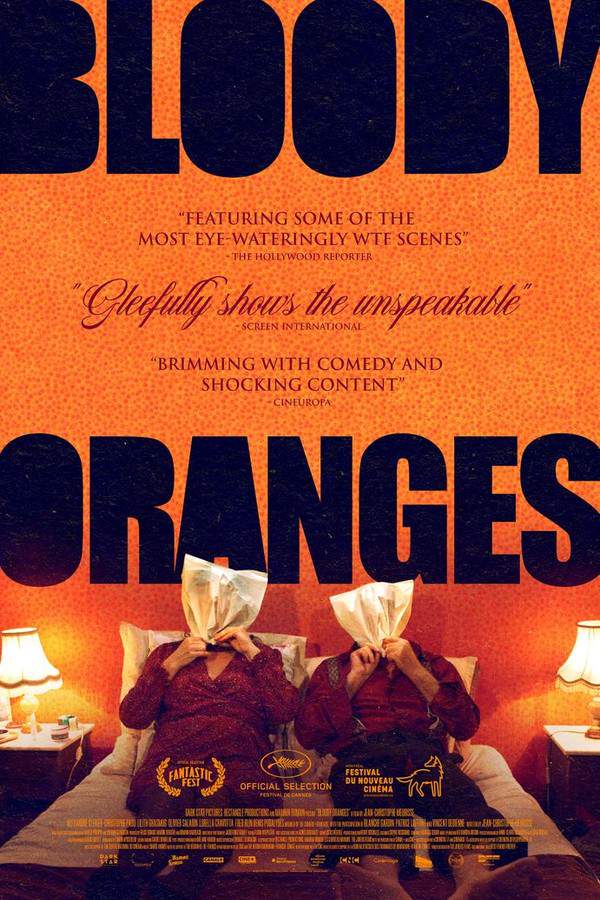
Bloody Oranges (2022) movie poster

Plot Summary

Bloody Oranges (2022) Plot Summary Explained

Release, runtime and language
2022 · 102 min · French
Echo score 70
JustWatch #8,210 5
Directed by
Jean-Christophe Meurisse
Starring
Blanche Gardin, Lilith Grasmug, Florence Janas, Denis Podalydès, Alexandre Steiger, Céline Fuhrer

In contemporary France, the lives of several individuals unexpectedly converge. A couple, burdened by debt, risks everything in pursuit of dance success, while allegations of corruption plague the economy minister. Simultaneously, a teenage girl confronts the challenges of growing up, and a young lawyer strives for professional advancement. As tensions escalate and the stakes become higher, it remains uncertain who will ultimately prevail or even achieve their goals.

On this page (6)
  1. 1 Where to watch
  2. 2 What happens: full plot
  3. 3 Plot questions answered
  4. 4 Movie threads
  5. 5 Movies like Bloody Oranges
  6. 6 Every angle

Where to watch

Where to Watch Bloody Oranges (2022)

Where can you watch Bloody Oranges? Stream, rent or buy it in the US, including on Amazon Prime Video, Kanopy and Fandango at Home Free: current JustWatch availability with up-to-date prices.

Streaming availability powered by JustWatch

Full plot summary · contains spoilers

What Happens in Bloody Oranges: Full Plot Summary

The whole story of Bloody Oranges (2022) explained, from the opening scene to the final frame: every key event, every twist and what it all adds up to. Read it as a quick recap before the sequel, to check a scene you missed, or to finally understand what really happened.

In a bustling gymnastics arena, a panel of judges is faced with the challenge of assessing various duos in a rock dancing competition. The conversation takes an intriguing turn when they debate whether one participant's performance should be rated more favorably due to her walking with a limp—a situation triggering an intense discussion about disability politics and the concept of positive discrimination. Just as the debate heats up, the competition host, Patrice Laffont, intervenes, suggesting that an elderly couple be included in the top three finalists to cater to their sponsor's desire for diversity.

During the thrilling competition, multiple couples perform energetic swing dances to lively American rock melodies. Among them are Laurence (Lorella Cravotta) and Olivier (Olivier Saladin), a spirited older couple whose captivating performance earns them a well-deserved standing ovation. They ultimately advance to the final round, only to learn from their bankers that they are deeply in debt—78,000 euros to be precise. The couple realizes that winning the competition would grant them an SUV, which could significantly alleviate their financial woes if sold. They can find solace in each other as they watch a program featuring the Minister of Finance, who ardently defends new pension policies.

Meanwhile, Stéphane Lemarchand (Christophe Paou), the Minister of Finance, is entangled in a meeting with Thierry (Denis Podalydès) and Alexandre (Alexandre Steiger), his son, as he worries about a journalist inquiring about his alleged foreign bank accounts. In the backdrop, Louise (Lilith Grasmug), a 16-year-old, nervously attends her first gynecological appointment. She candidly asks her doctor, Blanche Gardin, about losing her virginity to an older boy at an upcoming gathering.

In the political arena, Lemarchand finds himself grappling with financial shortcomings, brainstorming with his team about generating an additional 22 billion euros in a mere three months. Ideas are thrown around, including doubling university fees and imposing stricter taxes on social benefits, showcasing the lengths to which they will go to protect their interests.

As the narrative shifts, Louise faces a humiliating encounter with a rude taxi driver while on her bike, leading her to vividly retaliate against him. At a family dinner celebrating Laurence's 60th birthday, Alexandre voices his discontent about various aspects of the evening, sparking family grievances. Adding tension, Olivier's card is unexpectedly declined, while Laurence steps in to cover the expenses.

In a bid to rebuild his public image, Lemarchand participates in a staged interview designed to portray him as relatable. However, behind closed doors, he and his associates acknowledge risks surrounding undisclosed financial dealings. The Minister then finds himself in dire straits when a flat tire leads him to a sketchy house, where he unwittingly becomes the victim of a heinous act.

As the plot develops, both scenes of the elegant dance competition and its stark, violent counterpoint intertwine, with Olivier and Laurence showcasing their passion while Lemarchand endures a brutal humiliation, culminating in his public exposure in front of Parliament.

Louise, on her ecstatic return from a party, faces the horror of being abducted by a nefarious individual. After a horrifying ordeal, she bravely turns the tables, resulting in a dramatic confrontation that shakes the audience. After this tumultuous chain of events, Laurence and Olivier face contemplation of a tragic end, leaving their futures shrouded in despair.

As dawn breaks, their fateful decision leads to shocking revelations for Alexandre, who learns of his parents' hidden struggles just as he encounters the same taxi driver from earlier, resulting in a painful confrontation that exemplifies the tangled threads of their lives.

The shocking events culminate in a courtroom, where Alexandre is compelled to represent Louise, who wishes to frame her actions as a conscious act of retribution, defying expectations to reveal her powerful agency. The narrative comes full circle with the image of Louise exiting the courthouse, surrounded by supporters who regard her as a symbol of resilience, as she navigates a world rife with challenges following her harrowing journey. The final twist leaves audiences in awe as the rude taxi driver spirals into chaos, symbolizing the sometimes poetic and brutal nature of fate.
Last updated: November 04, 2024 at 01:24

Was this helpful?

Plot questions answered

Bloody Oranges Plot Explained: Your Questions Answered

The questions people ask most about Bloody Oranges (2022): what happens in the confusing scenes, why the characters do what they do, the twists, hidden details and what the ending means. Each answer contains spoilers.

Q1

Why does Louise want to frame her actions as retribution in court?

After being abducted and enduring a horrific ordeal, Louise takes control of her narrative by reframing her violent response to her captor as a deliberate act of retribution rather than a desperate survival reaction. This framing allows her to assert agency over her trauma and present herself not as a victim but as someone who consciously chose to fight back, turning her traumatic experience into a statement of power and self-determination.

Foreshadowing: Earlier in the film, Louise is shown confronting a rude taxi driver while on her bike, establishing her willingness to violently resist mistreatment.

  • louise
  • court
  • retribution
  • abduction
  • agency
  • self-defense
Q2

What happens to the Finance Minister at the sketchy house?

After getting a flat tire, Stéphane Lemarchand stops at a suspicious house where he becomes the victim of a brutal attack involving humiliation, violence, and sexual assault. This violent encounter marks a dramatic turning point that leads to his public exposure and downfall, contrasting sharply with the elegance of the earlier dance competition scenes.

Foreshadowing: Earlier meetings acknowledge risks surrounding his undisclosed financial dealings, hinting that his secrets make him vulnerable to exploitation.

  • lemarchand
  • minister
  • attack
  • house
  • humiliation
  • downfall
Q3

How are all the storylines connected in Bloody Oranges?

The multiple narratives, Laurece and Olivier's dance competition, the Finance Minister's corruption, Louise's abduction, and Alexandre's family drama, connect thematically through social critique rather than direct plot links. Characters like Alexandre serve as bridges, being both the Finance Minister's son and representing Louise in court, while the rude taxi driver appears in both Louise's and Alexandre's storylines, symbolizing how random violence and cruelty ripple through unrelated lives.

Foreshadowing: The film explicitly weaves scenes of elegant dance competition alongside brutal events, using tonal contrast to emphasize thematic connections about fate and social structures.

  • storylines
  • connection
  • thematic
  • convergence
  • characters
Q4

Why does Laurence and Olivier contemplate a tragic end?

After learning they are 78,000 euros in debt and facing overwhelming financial pressure despite their dance competition success, Laurence and Olivier reach a breaking point. The mounting stress from their debt, family tensions at Laurence's 60th birthday dinner, and the contrast between their dreams and harsh reality lead them to contemplate ending their lives as they see no way out of their dire financial situation.

Foreshadowing: Their debt is revealed immediately after their standing ovation, creating an ironic contrast between their success on stage and failure in life.
  • laurence
  • olivier
  • suicide
  • debt
  • despair
  • financial struggles
Q5

What triggers the Finance Minister's public downfall?

The Finance Minister's downfall begins when a journalist investigates his alleged foreign bank accounts, forcing him to orchestrate a staged interview to rebuild his public image. His vulnerability peaks when, after a flat tire, he encounters dangerous individuals who assault and humiliate him. These events culminate in his public exposure, with the brutal attack ultimately being revealed and destroying his political career.

Foreshadowing: His team acknowledges the risks of his undisclosed financial dealings, and the staged interview is designed to preempt damaging revelations.

  • lemarchand
  • downfall
  • scandal
  • exposure
  • political corruption
Q6

Why does Alexandre confront the taxi driver at the end?

The taxi driver previously humiliated Louise when she was on her bike, treating her rudely and dismissively. When Alexandre encounters the same driver at dawn, he attacks him in what appears to be retaliation for the driver's earlier mistreatment of Louise, though the exact motivation remains ambiguous. This violent encounter exemplifies how cruelty ripples between characters and how the film ties together its seemingly disconnected storylines through vengeful impulses.

Foreshadowing: The taxi driver first appears being rude to Louise on her bike, establishing him as a symbol of casual cruelty that will have consequences.

  • taxi driver
  • alexandre
  • confrontation
  • revenge
  • louise
Q7

How does Louise escape her abduction?

After being abducted by a nefarious individual on her way home from a party, Louise endures a horrifying ordeal before managing to turn the tables on her captor. She bravely confronts and overpowers him in a dramatic confrontation, resulting in a violent confrontation that shifts the dynamic from victim to survivor. This empowering moment allows her to regain control of her situation.

Foreshadowing: Her earlier confrontation with the rude taxi driver establishes her as someone willing to respond violently to mistreatment.

  • louise
  • abduction
  • escape
  • confrontation
  • survival
Q8

What happens to Laurence and Olivier after the dance competition?

Despite earning a standing ovation and advancing to the final round of the rock dancing competition, Laurence and Olivier discover their dire financial situation, 78,000 euros in debt. While the competition prize of an SUV offers temporary hope they could sell for money, the film indicates their situation deteriorates significantly, with them ultimately contemplating a tragic end. Their storyline serves as a tragic counterpoint to dreams of success and escape.

Foreshadowing: Their debt is revealed immediately after their performance triumph, establishing the ironic gap between their stage success and real-life failure.

  • laurence
  • olivier
  • dance competition
  • debt
  • ending
  • tragedy
Q9

Why does Alexandre represent Louise in court?

Alexandre, who is both the son of the Finance Minister and present during the family's financial struggles, becomes Louise's lawyer in court. His representation connects the different storylines and places him in an unusual position, defending a young woman whose actions were born from trauma while his own family faces collapse. The courtroom becomes a space where Louise asserts her agency by framing her violent response as conscious retribution.

Foreshadowing: Alexandre's discontent at the family dinner and his discovery of his parents' hidden struggles establish his conflicted position within the narrative.

  • alexandre
  • louise
  • court
  • lawyer
  • representation
Q10

What does the ending scene with the taxi driver represent?

The final scene shows the rude taxi driver descending into chaos, representing the film's theme of fate's brutal and often poetic nature. Having been cruel to Louise earlier and attacked by Alexandre at dawn, his chaotic downfall symbolizes how random acts of cruelty and violence ripple unpredictably through people's lives. The ending reflects the film's bleak worldview where consequences are arbitrary and systemic injustice remains largely unaddressed.

Foreshadowing: The taxi driver's earlier rudeness to Louise establishes him as a vector of casual cruelty whose actions will have unintended consequences.

  • taxi driver
  • ending
  • fate
  • chaos
  • symbolism
  • consequence
Q11

What financial scheme is the Minister of Finance trying to hide?

Stéphane Lemarchand faces scrutiny over alleged foreign bank accounts, with a journalist pressing for answers about his hidden wealth. To address what appears to be a massive financial shortfall, his team proposes generating 22 billion euros in three months through measures like doubling university fees and imposing stricter taxes on social benefits. These desperate proposals reveal the lengths to which he and his associates will go to protect their interests while exposing systemic corruption.

Foreshadowing: The earlier scene of the Minister watching a broadcast about pension policies while Laurence and Olivier watch establishes the disconnect between political messaging and personal greed.

  • lemarchand
  • corruption
  • financial scheme
  • foreign accounts
  • 22 billion

Movie threads

More Movies Like Bloody Oranges, by Mood & Story

Curated lists built around what makes Bloody Oranges tick: the same mood, the same kind of story or the same emotional payoff. Each list explains why these movies belong together.

Dark social satires like Bloody Oranges

Movies that use bleak comedy to dissect the corrupt underbelly of modern society. If you liked the biting social commentary and bleak humor of Bloody Oranges, explore this list of movies that similarly use satire to dissect modern corruption and moral decay. These films share a darkly humorous yet unsettling vibe.

  • satirical
  • unsettling
  • grim
  • darkly humorous
  • brutal
  • anxious
  • Tone: dark, satirical, unsettling
  • Pacing: variable, often building to chaotic peaks
Why these movies?

The story pattern: These narratives often follow intersecting lives or a central institution, using absurd or extreme situations to highlight systemic flaws. The plots frequently involve characters navigating corrupt systems, with their personal struggles serving as microcosms of larger societal issues, culminating in ambiguous or mixed outcomes that reflect a cynical worldview.

Why they belong together: Movies are grouped here for their shared commitment to using dark comedy and brutal realism as tools for social critique. They create a cohesive experience through a specific tonal blend of satire, tension, and a pervasive sense of moral and societal collapse.

Movies with bleak interlocking narratives like Bloody Oranges

Stories where disparate characters collide under the weight of debt and violence. Find movies similar to Bloody Oranges that feature complex, intersecting storylines about desperate characters. If you enjoyed the narrative structure and heavy themes of converging fates, these films offer a comparable experience.

  • anxious
  • brutal
  • oppressive
  • chaotic
  • grim
  • unsettling
  • Tone: grim, tense, bleak
  • Pacing: variable, alternating steady build with chaotic events
Why these movies?

The story pattern: The narrative pattern involves several parallel storylines that may not directly interact but converge thematically around core ideas like debt, violence, and the struggle for agency. The structure emphasizes the randomness and brutality of life, with pacing that shifts between character-driven development and sudden, intense crises.

Why they belong together: These films are grouped by their complex, multi-threaded narrative structure and their focus on characters pushed to their limits. The shared experience is one of observing a tapestry of desperation, where individual dramas contribute to a larger, grim portrait of human nature.

If you liked this

Movies Like Bloody Oranges

Similar movies to Bloody Oranges: the same genre, themes or kind of story. Each one comes with its own plot summary, timeline and ending explained.

Browse all movie summaries

Every angle

Bloody Oranges (2022) Explained: Plot, Timeline & Characters

Everything about Bloody Oranges in one place: what happens in the plot summary, the timeline in chronological order, the characters and meaning and a spoiler-free summary. What's After the Movie adds the cast, box office and post-credit scenes.

Coming soon on iOS and Android

The Plot Explained Movie Summary App

Plot summaries, endings explained and timelines on your phone. Catch up on any movie in minutes, save your favorites and never miss a twist again.

Be the first to know when we launch. Your email stays private, always.

Learn more about the app