Plot Explained Spoilers guaranteed!
Plot Explained

Browse by genre

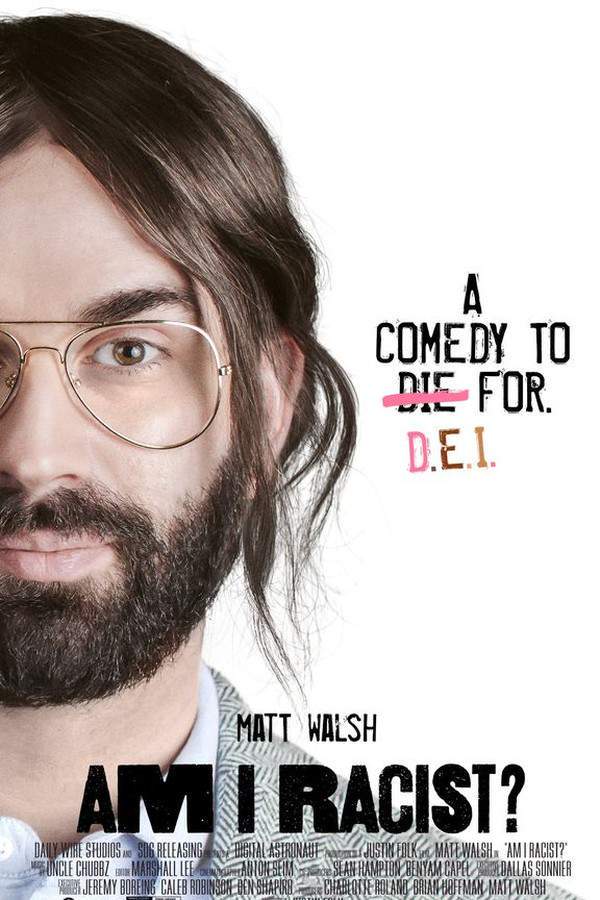
Am I Racist? (2024) movie poster

Timeline

Am I Racist? (2024) Timeline Explained – Every Event in Order

Release, runtime and language
2024 · 1 h 41 m · English
Echo score 57
Directed by
Justin Folk
Starring
Matt Walsh, Robin DiAngelo
Budget
$3M

Using hidden cameras and a skeptical approach, this film explores the complexities of Diversity, Equity, and Inclusion (DEI) initiatives. Through undercover experiments, it examines the often surprising and sometimes unsettling realities that emerge when striving for a more equitable society, highlighting both the intentions and the unintended consequences of these practices.

On this page (6)
  1. 1 Events in order (12)
  2. 2 Timeline questions answered
  3. 3 Movie threads
  4. 4 Movies like Am I Racist?
  5. 5 Categories
  6. 6 Every angle

12 events in order · contains spoilers

Am I Racist? Timeline: Events in Chronological Order

Every key event of Am I Racist? (2024) in order, scene by scene, with when and where it takes place. Use it to untangle flashbacks, time jumps and parallel storylines, to refresh your memory before the sequel or to find the exact scene you are thinking of.

  1. Moment of Reflection

    Comedian Matt Walsh sits down with a steaming cup of coffee and begins to reflect on the pervasive issue of racism in today’s society. This contemplation serves as the spark for his journey of self-exploration regarding any hidden racist inclinations he may have.

  2. Exit from Support Group

    After an awkward experience, Walsh finds himself leaving a 'white guilt' support group rather unceremoniously. This departure marks a significant turning point as he sets the stage for the next phase of his exploration into racism.

  3. Adopting a New Persona

    In an attempt to gain deeper insights, Walsh adopts the persona of a gender studies professor from a previous project. This transformation, fueled by a freshly acquired DEI certification, allows him to position himself as a self-proclaimed 'DEI expert'.

  4. Petition for Renaming Monument

    Embarking on his mission to 'do the work', Walsh initiates a bold and controversial campaign. He persuades unsuspecting citizens to sign a petition demanding the renaming of the Washington Monument to the 'George Floyd Monument', proposing it be enlarged and repainted black.

    Where
    Washington D.C.
  5. Entering the Biker Bar

    To further investigate societal racism, Walsh bravely steps into a biker bar, a venue often associated with a 'white hillbilly' demographic. This venture signifies his willingness to confront uncomfortable truths in the pursuit of understanding and exposing underlying prejudices.

    Where
    Biker Bar
  6. Conversations with Community

    During his exploration, Walsh engages in meaningful conversations with Black Americans. They share with him a profound yet straightforward solution to racism: the power of love, prompting a reflective response within him.

  7. The Do the Work Workshop

    At the climax of Walsh's journey, he conducts the controversial *Do the Work Workshop*. Here, he presents a provocative claim to a room full of white participants, suggesting that they all harbor inherent racist tendencies.

    Where
    Workshop Venue
  8. Public Denouncement

    As part of his demonstration in the workshop, Walsh starkly denounces his uncle Frank for a distasteful joke made years ago. This bold move serves to illustrate his commitment to confronting racism, no matter the personal cost.

  9. Controversial Remedies

    In an effort to address feelings of white guilt, Walsh controversially suggests acts of self-flagellation as a form of atonement. This suggestion stirs discussions among attendees about the lengths to which one should go to rectify perceived wrongs.

  10. Change of Heart

    In a surprising twist, Walsh experiences a sudden shift in perspective during the workshop. This revelation leads him to abruptly halt the proceedings, transforming the entire exercise into a calculated ruse.

    Where
    Workshop Venue
  11. Reflecting on Lessons Learned

    The film concludes with Walsh contemplating how to share his newfound insights with the wider public. He reflects on the complexities of racism and his own journey through this multifaceted topic.

  12. Coffee Date with Uncle Frank

    As a poignant ending, the movie closes with a lighthearted coffee date between Walsh and his uncle Frank. This moment signifies reconciliation and the importance of family and open dialogue in addressing societal issues.

    Where
    Coffee Shop

Last updated: November 16, 2024 at 19:16

Was this helpful?

Timeline questions answered

Am I Racist? Timeline Explained: Your Questions Answered

When does it happen, and why in that order? The questions people ask about the chronology of Am I Racist? (2024): time jumps, flashbacks, cause and effect between scenes and the correct order of events, each answered with spoilers.

Q1

Why did Matt Walsh join a white guilt support group?

Walsh joined the group as part of his self-described quest to determine whether he harbored any latent racist sentiments. The awkward experience led him to leave unceremoniously, but it served as the initial spark for his subsequent undercover investigation into racism and DEI practices.

  • white guilt support group
  • matt walsh
  • self-exploration
  • racism test
Q2

Why did Matt Walsh get a DEI certification?

Walsh obtained a DEI certification to adopt a credible persona for his investigation. Drawing from his previous project 'What is a Woman?' where he encountered a gender studies professor, he crafted the image of a self-styled 'DEI expert' to gain access and trust from organizations and individuals he aimed to examine.

  • dei certification
  • matt walsh
  • undercover persona
  • investigation
Q3

What was the purpose of the George Floyd Monument petition?

Walsh used the controversial petition as a social experiment to test how far ordinary citizens would go in supporting extreme racial reparations. He convinced people to sign a petition calling for the Washington Monument to be renamed the 'George Floyd Monument', increased by 30% in height, and painted black, an intentionally absurd request designed to expose people's willingness to comply with radical proposals.

  • george floyd monument
  • washington monument petition
  • social experiment
  • undercover
Q4

Why did Matt Walsh go into the biker bar?

Walsh intentionally entered the biker bar, a venue associated with the 'white hillbilly' demographic, to investigate and expose what he believed to be underlying racism within that community. The visit was part of his confrontational approach to uncovering prejudice in everyday American spaces.

  • biker bar
  • white hillbilly
  • matt walsh
  • exposing racism
Q5

What did Black Americans tell Matt Walsh about fixing racism?

During his conversations with Black Americans, Walsh encountered a surprisingly simple answer: love. Several Black Americans he spoke with proposed love as the fundamental antidote to racism, offering a straightforward solution that contrasted with the more convoluted approaches he encountered in DEI workshops and institutional settings.

  • black americans
  • love
  • solution to racism
  • conversation
Q6

What happened at the Do the Work Workshop?

The workshop served as the film's climax, where Walsh confronted a room of white participants with the provocative claim that they all harbored inherent racist tendencies. As part of the demonstration, he publicly denounced his uncle Frank for a distasteful joke made twenty years earlier and controversially suggested acts of self-flagellation as a remedy for white guilt.

  • do the work workshop
  • white guilt
  • self-flagellation
  • matt walsh uncle frank
Q7

Why did Matt Walsh publicly denounce his uncle Frank?

Walsh used the public denouncement of his uncle Frank as a dramatic demonstration of what he called 'taking a stand' against racism. The tasteful joke made two decades prior became a prop in his workshop to illustrate the concept of confronting racist behavior within one's own family, regardless of how long ago it occurred.

  • uncle frank
  • denouncement
  • family
  • racism
  • public confrontation
Q8

Why did Matt Walsh suddenly stop the workshop and reveal it was a ruse?

In a surprising twist, Walsh experienced a sudden change in perspective during the workshop. He abruptly halted the proceedings and revealed the entire undertaking to be a calculated ruse, essentially an exposé of the DEI industry and workshop culture itself rather than a genuine attempt to address racism.

  • workshop twist
  • reveal
  • ruse
  • change of heart
  • dei critique
Q9

What was the message or conclusion of the film?

The film concludes with Walsh contemplating how to share his newfound insights with the public, ending on a relaxed coffee date with his uncle Frank. The ambiguous ending, revealing the workshop as a ruse, leaves viewers to interpret the filmmaker's true conclusions rather than providing a definitive resolution, suggesting a satirical critique of performative DEI practices while raising questions about genuine versus superficial approaches to addressing racism.

  • conclusion
  • message
  • coffee date
  • uncle frank
  • satire
  • dei critique
Q10

Why did the film include the self-flagellation suggestion?

Walsh's suggestion of self-flagellation as a remedy for white guilt was intentionally controversial, designed to highlight what he perceived as the extreme and absurd lengths of certain DEI practices. This moment, along with the workshop's dramatic confrontations, served the film's satirical purpose of critiquing performative activism and guilt-driven approaches to racial reconciliation.

  • self-flagellation
  • white guilt
  • extreme
  • satire
  • dei criticism

Movie threads

More Movies Like Am I Racist?, by Mood & Story

Curated lists built around what makes Am I Racist? tick: the same mood, the same kind of story or the same emotional payoff. Each list explains why these movies belong together.

Satirical Documentaries like Am I Racist?

Documentaries that use provocative methods to question social norms. If you enjoyed the hidden-camera experiments in Am I Racist?, you'll appreciate these movies. This list features provocative documentaries that use satire and unconventional methods to explore serious social, cultural, and political topics, offering a unique and skeptical perspective.

  • satirical
  • experimental
  • provocative
  • investigative
  • skeptical
  • confrontational
  • Tone: skeptical, neutral, provocative
  • Pacing: steady, investigative
Why these movies?

The story pattern: The narrative pattern typically involves a filmmaker or subject setting up a social experiment to test a hypothesis about human behavior or societal structures. The story unfolds as the experiment is conducted, revealing unexpected results and forcing a re-evaluation of the initial premise, often leaving the audience with more questions than answers.

Why they belong together: Movies are grouped here based on their shared use of satire and experimental documentary formats to dissect serious subjects. They create a specific viewing experience that blends investigative journalism with comedic or provocative framing, prioritizing critical reflection over straightforward messaging.

Ambiguous Social Investigations like Am I Racist?

Stories that delve into social issues without providing clear answers. Looking for more movies like Am I Racist? that explore complex social issues without a clear-cut conclusion? These films offer reflective and often confrontational journeys into topics like race relations and societal critique, leaving you to ponder the implications long after the credits roll.

  • reflective
  • confrontational
  • unsettling
  • societal critique
  • complex
  • ambiguous
  • Tone: reflective, confrontational, neutral
  • Pacing: steady, deliberate
Why these movies?

The story pattern: Narratives in this thread follow an inquisitive arc, where a protagonist or filmmaker seeks to understand a complex social problem. The journey exposes layers of nuance and contradiction, challenging simple narratives. The story typically concludes on an ambiguous or open-ended note, emphasizing the ongoing nature of the inquiry rather than delivering a definitive solution.

Why they belong together: These films are connected by their commitment to exploring difficult social questions without resorting to didactic answers. They share a reflective mood, a medium emotional weight that engages without overwhelming, and an ending feel that is deliberately ambiguous to stimulate continued thought and discussion.

If you liked this

Movies Like Am I Racist?

Similar movies to Am I Racist?: the same genre, themes or kind of story. Each one comes with its own plot summary, timeline and ending explained.

Browse all movie summaries

Categories

Movie Lists Featuring Am I Racist?

Am I Racist? appears in these hand-built movie categories. Each one groups movies by a specific mood, theme or story type, with their plot summaries and endings explained.

View all movie categories

Every angle

Am I Racist? (2024) Explained: Plot, Timeline & Characters

Everything about Am I Racist? in one place: what happens in the plot summary, the timeline in chronological order, the characters and meaning and a spoiler-free summary. What's After the Movie adds the cast, box office and post-credit scenes.

Coming soon on iOS and Android

The Plot Explained Movie Summary App

Plot summaries, endings explained and timelines on your phone. Catch up on any movie in minutes, save your favorites and never miss a twist again.

Be the first to know when we launch. Your email stays private, always.

Learn more about the app