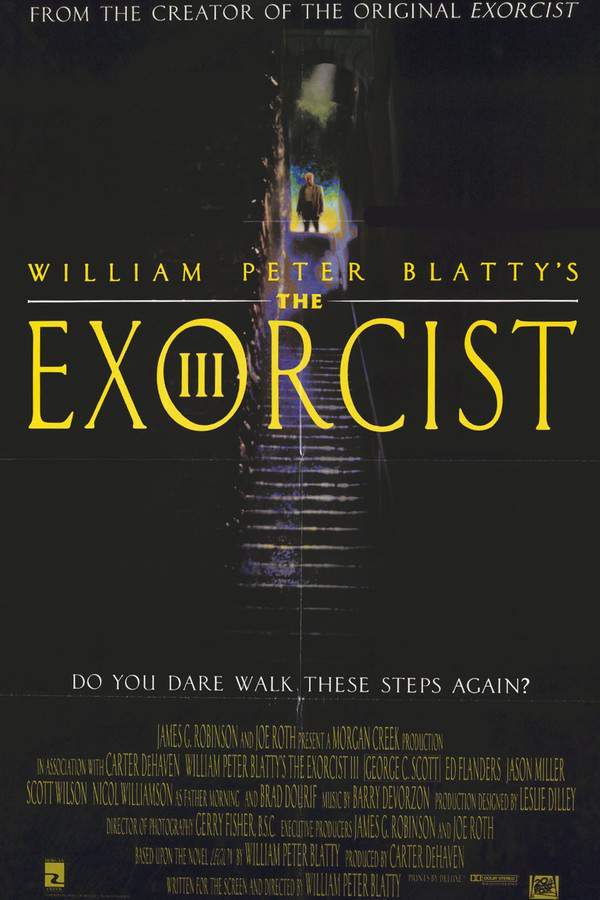
The Exorcist III

The Exorcist III

Year: 1990

Runtime: 110 min

Language: English

Director: William Peter Blatty

DramaMysteryHorror

Police Lt. Kinderman investigates a series of disturbing murders that bear a chilling resemblance to crimes committed by the Gemini killer fifteen years earlier. As he pursues the copycat killer, Kinderman is confronted with the unsettling possibility that the infamous serial killer may have somehow returned from the death row. The investigation leads him down a dark and terrifying path, forcing him to question his sanity and the nature of evil itself.

Warning: spoilers below!

Haven’t seen The Exorcist III yet? This summary contains major spoilers. Bookmark the page, watch the movie, and come back for the full breakdown. If you're ready, scroll on and relive the story!

The Exorcist III (1990) – Full Plot Summary & Ending Explained

Read the complete plot breakdown of The Exorcist III (1990), including all key story events, major twists, and the ending explained in detail. Discover what really happened—and what it all means.

The film opens with a haunting perspective as someone strolls through the streets of Georgetown, accompanied by a disembodied voice echoing, “I have dreams… of a rose… and of falling down a long flight of stairs.” This unsettling viewpoint reveals a sinister presence approaching a church later that night. As chaos ensues, ominous growls pierce the air while debris flings itself towards the church, culminating in a crucifix manifesting a life of its own.

We are then introduced to Lieutenant William F. Kinderman, portrayed by George C. Scott, at a gruesome crime scene where the brutal murder of a 12-year-old boy named Thomas Kintry has taken place. In an effort to seek solace, Kinderman invites his friend, Father Dyer, played by Ed Flanders, to watch their cherished film, It’s a Wonderful Life. Over popcorn, Kinderman darkly recounts the murder details, including the shocking manner in which the boy was killed, leaving behind a grim atmosphere.

The tension escalates when another murder rocks the community; a priest is gruesomely discovered decapitated within the very walls of a church. The unease intensifies as Dyer finds himself in the hospital, only to be later found murdered himself, with the chilling phrase “IT’S A WONDERFULL LIFE” scrawled using his blood. Each crime scene presents a baffling twist: the fingerprints do not correspond, suggesting multiple perpetrators. Kinderman expresses his trepidation regarding a notorious serial killer known as “The Gemini,” played by Brad Dourif, who was executed fifteen years prior. This killer notoriously removed the right index finger of each victim and marked them with the Gemini sign.

During his investigation, Kinderman learns of a mysterious patient in a psychiatric ward named Dr. Temple, portrayed by Scott Wilson. He discovers that this man, once wandering in amnesia, has recently become violent and claims to be the Gemini Killer. The man bears an uncanny resemblance to Father Damien Karras, played by Jason Miller, who has been deceased. However, this patient insists he is the very essence of the Gemini Killer, ignorant of Karras’s identity and proud of killing Dyer.

The plot thickens when, the following day, a nurse and Dr. Temple turn up dead. The patient in Cell 11 reveals, to Kinderman’s horror, that after the Gemini’s execution, his spirit invaded Karras’s dying body. The malevolent demon Pazuzu, known for possessing Regan MacNeil, is enraged by being expelled and seeks vengeance by transferring the Gemini Killer’s spirit into Karras. Each night, the Gemini trades places with elderly patients suffering from dementia to carry out his heinous acts.

In a shocking turn of events, the Gemini posseses an old woman, who attempts to murder Kinderman’s daughter, Julie. The fight escalates when the old woman attacks Kinderman, retreating only when Father Paul Morning, played by Nicol Williamson, steps in to perform an exorcism. However, Pazuzu intervenes, resulting in the priest’s devastating defeat. Kinderman, witnessing the chaos, intends to put Karras to rest upon finding Morning’s lifeless body. In a gripping confrontation, Karras momentarily regains his consciousness and pleads, “Bill, now, shoot now, kill me now!” Kinderman pulls the trigger without hesitation, mortally wounding Karras.

As Karras welcomes liberation from the Gemini’s grasp, he breathes his last words, “We won, Bill, now free me.” Ultimately, Kinderman stands somberly over Karras’ grave, the film drawing to a haunting conclusion with lingering questions of morality and redemption.
Last Updated: October 27, 2024 at 16:42

Mobile App Preview

Coming soon on iOS and Android

The Plot Explained Mobile App

From blockbusters to hidden gems — dive into movie stories anytime, anywhere. Save your favorites, discover plots faster, and never miss a twist again.
Sign up to be the first to know when we launch. Your email stays private — always.
Explore Movie Threads

Discover curated groups of movies connected by mood, themes, and story style. Browse collections built around emotion, atmosphere, and narrative focus to easily find films that match what you feel like watching right now.

Supernatural Police Procedurals with Grim Atmosphere like The Exorcist III

Investigation stories where earthly crimes are tainted by forces beyond reason.For fans of The Exorcist III seeking movies where a detective's investigation uncovers a supernatural evil. These films blend crime-solving with horror, featuring a dark tone, steady pacing, and a heavy emotional weight that leaves characters questioning reality. If you liked the grim procedural elements and unsettling dread of The Exorcist III, you'll find similar stories here.

oppressiveunsettlinginvestigativesupernatural horrorpsychological tormentgrittydread-filled

Narrative Summary

These narratives typically follow a seasoned detective as they investigate a series of crimes that initially seem solvable. However, clues begin to point towards a supernatural origin, creating a profound conflict between the character's rationality and the mounting, unexplainable evidence. The journey is one of escalating dread and psychological unraveling as the line between criminal and demonic blurs.

Why These Movies?

Movies in this thread are united by their core premise: a rational investigation colliding with the irrational. They share a dark, oppressive mood, a steady procedural pacing that builds tension, and a high intensity born from the fusion of real-world violence and supernatural horror. The emotional journey consistently involves a loss of certainty and a confrontation with absolute evil.

Psychological Horror Movies About Questioning Reality like The Exorcist III

Stories where the protagonist's grip on reality is systematically dismantled.If you liked the psychological torment and reality-bending horror of The Exorcist III, this thread is for you. It features movies where characters descend into madness, face demonic forces that warp their minds, or grapple with the terrifying uncertainty of their own sanity. These stories share a dark tone, high intensity, and a heavy, haunting emotional impact.

psychologically grimunsettlinganxioushauntinginsanityquestioning realitymind-bendingoppressive

Narrative Summary

The narrative pattern involves a protagonist, often a figure of authority or rationality, who is confronted with events that challenge their fundamental understanding of the world. As the story progresses, their sanity is tested through psychological manipulation, surreal occurrences, or direct supernatural assault. The conflict is internal as much as external, leading to a climax where reality itself is the battleground.

Why These Movies?

These films are grouped by their intense focus on psychological unraveling and the theme of unreliable reality. They share a dark, anxious, and psychologically grim mood, high tension, and a heavy emotional weight centered on fear and existential doubt. The experience is defined by making the viewer, along with the character, question what is truly happening.

Unlock the Full Story of The Exorcist III

Don't stop at just watching — explore The Exorcist III in full detail. From the complete plot summary and scene-by-scene timeline to character breakdowns, thematic analysis, and a deep dive into the ending — every page helps you truly understand what The Exorcist III is all about. Plus, discover what's next after the movie.

The Exorcist III Timeline

Track the full timeline of The Exorcist III with every major event arranged chronologically. Perfect for decoding non-linear storytelling, flashbacks, or parallel narratives with a clear scene-by-scene breakdown.

The Exorcist III Timeline

Characters, Settings & Themes in The Exorcist III

Discover the characters, locations, and core themes that shape The Exorcist III. Get insights into symbolic elements, setting significance, and deeper narrative meaning — ideal for thematic analysis and movie breakdowns.

Characters, Settings & Themes in The Exorcist III

The Exorcist III Spoiler-Free Summary

Get a quick, spoiler-free overview of The Exorcist III that covers the main plot points and key details without revealing any major twists or spoilers. Perfect for those who want to know what to expect before diving in.

The Exorcist III Spoiler-Free Summary

More About The Exorcist III

Visit What's After the Movie to explore more about The Exorcist III: box office results, cast and crew info, production details, post-credit scenes, and external links — all in one place for movie fans and researchers.

More About The Exorcist III