Plot Explained Spoilers guaranteed!
Plot Explained

Browse by genre

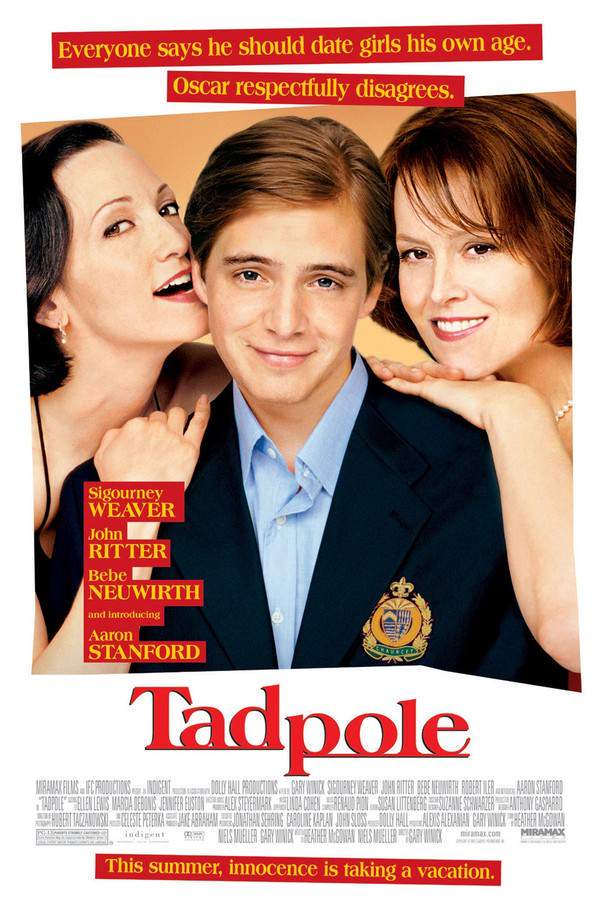
Tadpole (2002) movie poster

Plot Summary

Tadpole (2002) Plot Summary Explained

Release, runtime and language
2002 · 78 min · English
Directed by
Gary Winick
Starring
Sigourney Weaver, Aaron Stanford

Oscar Grubman, a fifteen-year-old, experiences an unusual romantic pursuit when several women are drawn to what they perceive as his sophistication. He finds himself unexpectedly charming and pursued, leading him to navigate the confusing world of adolescence and romance. The film explores themes of love, identity, and the challenges of growing up, as Oscar’s innocence and idealism are tested in a humorous and heartwarming story.

On this page (6)
  1. 1 Where to watch
  2. 2 What happens: full plot
  3. 3 Plot questions answered
  4. 4 Movie threads
  5. 5 Movies like Tadpole
  6. 6 Every angle

Where to watch

Where to Watch Tadpole (2002)

Where can you watch Tadpole? Stream, rent or buy it in the US, including on Amazon Video, Apple TV Store and Fandango At Home: current JustWatch availability with up-to-date prices.

Streaming availability powered by JustWatch

Full plot summary · contains spoilers

What Happens in Tadpole: Full Plot Summary

The whole story of Tadpole (2002) explained, from the opening scene to the final frame: every key event, every twist and what it all adds up to. Read it as a quick recap before the sequel, to check a scene you missed, or to finally understand what really happened.

Oscar Grubman, a 15-year-old portrayed by Aaron Stanford, is a remarkably mature teen who is heading home from school just in time for Thanksgiving. He possesses a talent for speaking French, has a fondness for quoting Voltaire, and finds his peers, particularly girls his age, to be far too superficial and inexperienced. When Miranda Spear (played by Kate Mara), an attractive classmate, expresses interest in him, Oscar tactfully declines her advances. Instead, he reveals to his friend Charlie (Robert Iler) that his heart is set on a more mature woman—his stepmother.

Oscar arrives at the home of his father, Stanley Grubman, a university history professor portrayed by John Ritter, and his stepmother, the passionate cardiologist, Eve, played by Sigourney Weaver. During the evening, the Grubmans host a party where Stanley tries to introduce Oscar to a girl closer to his age, but Oscar turns her down, his gaze fixed on Eve—the object of his affection. When he attempts to express his feelings, Eve remains completely oblivious to his advances. Following Stanley's suggestion to walk the girl home, Oscar instead hails a cab for her.

Feeling dejected after his thwarted attempts, Oscar sneaks out to a bar with a fake ID and consumes alcohol. There, he unexpectedly encounters Diane Lodder (Bebe Neuwirth), Eve's best friend. Observing his inebriated state, she offers him solace at her apartment. As events unfold, Diane gives him a massage, and they end up in a surprising romantic encounter. Awaking the next morning brings an awkward confrontation with Diane's boyfriend, Phil.

Determined to make things right, Oscar concocts a story for Stanley when asked about his whereabouts. He prepares a surprise lunch for Eve, bringing her newfound perspective on love to the table—shouldn't the liver be the symbol of affection instead of the heart? However, their uplifting discussion is cut short by a phone call from Stanley, who casually mentions Diane’s attendance for dinner. Anxious about the possible revelation of his secret rendezvous, Oscar seeks out Diane at a tea room, where he finds her surrounded by friends who all seem to be in on the prior night’s escapade.

During dinner, tensions rise as Diane flirts playfully with Oscar, even engaging in a game of footsie. After excusing herself, Oscar follows her, leading to a kiss that doesn’t go unnoticed by Stanley. Diane ultimately confesses their relationship to both Stanley and Eve, prompting Eve to scold Diane for seducing someone so young. In the wake of this chaos, Oscar faces Eve in a competitive game of tennis where exchanged barbs quickly escalate; he ends up hit by a tennis ball, inadvertently confessing that his actions with Diane were merely the result of drunkenness and Eve's scarf.

This leads to a pivotal moment where Eve begins to grasp the depth of his feelings for her, culminating in a heated kiss that leaves them both flustered. As Thanksgiving break comes to an end, Eve and Stanley accompany Oscar to the train station. They exchange lighthearted banter about his "liver," which he claims is sore but intact. On the train, he reunites with Charlie and unexpectedly sees Miranda again. As she references Voltaire with a wistful gaze, Oscar reflects on his previous obsession with Eve, admitting to Charlie that it wasn’t as significant as it once felt. Oscar’s smile as the train moves forward reveals a subtle shift in his perspective on love and maturity.

Last updated: November 02, 2024 at 13:54

Was this helpful?

Plot questions answered

Tadpole Plot Explained: Your Questions Answered

The questions people ask most about Tadpole (2002): what happens in the confusing scenes, why the characters do what they do, the twists, hidden details and what the ending means. Each answer contains spoilers.

Q1

Why is Oscar so fixated on his stepmother Eve?

Oscar views his peers as superficial and inexperienced. He quotes Voltaire and speaks French fluently, making him feel intellectually mature beyond his age. When he arrives home, he sees Eve, a passionate cardiologist, as the ideal sophisticated woman, contrasting her with the immature girls at school. His feelings stem from intellectual vanity rather than genuine romantic connection.

Foreshadowing: Earlier, Oscar tells Charlie he finds girls his age too immature and prefers a more mature woman.

  • Oscar
  • Eve
  • stepmother
  • infatuation
  • maturation
  • intellectual
Q2

How does Oscar end up in a relationship with Diane?

After his failed attempts to express feelings to Eve at the Thanksgiving party, Oscar sneaks out to a bar using a fake ID. Feeling dejected, he meets Diane Lodder, Eve's best friend, who consoles him at her apartment after seeing his intoxicated state. One thing leads to another, and they have a romantic encounter. The next morning, he's caught by Diane's boyfriend Phil, creating immediate complications.

Foreshadowing: Oscar's rejection at the party and his decision to drink alone set the stage for this unexpected encounter.

  • Diane
  • bar
  • one night stand
  • betrayal
  • Eve best friend
Q3

Why does Eve kiss Oscar back during their tennis match?

Throughout the film, Eve remains oblivious to Oscar's advances. However, during their heated tennis match where Oscar is accidentally hit by a ball, he blurts out that his actions with Diane were just a substitute, motivated by his feelings for Eve and even her scarf. This confession triggers Eve to finally recognize the depth of his obsession. In a moment of emotional complexity, she kisses him, though both become flustered by the inappropriate nature of the moment.

Foreshadowing: Oscar's earlier attempts to express his feelings and Eve's complete obliviousness make this sudden recognition more impactful.

  • Eve
  • kiss
  • tennis
  • confession
  • emotional recognition
Q4

What is the significance of Oscar bringing up the liver as a symbol of love?

Oscar prepares a surprise lunch for Eve where he argues that the liver, not the heart, should be the symbol of affection. He explains that the liver filters everything you consume, representing true filtering of life's experiences, whereas the heart simply pumps blood. This quirky philosophical discussion reflects Oscar's pretentious, intellectual nature and his attempt to impress Eve with his unconventional thinking.

Foreshadowing: This scene establishes Oscar's pattern of using intellectual arguments to express romantic feelings.

  • liver
  • heart
  • symbolism
  • love
  • Oscar intellectual
Q5

How does Oscar change by the end of the movie?

At the end, Oscar is on the train reunited with his friend Charlie when he sees Miranda again. She quotes Voltaire, echoing Oscar's earlier intellectual pretensions. This time, Oscar admits to Charlie that his obsession with Eve wasn't as significant as he once believed. His smile as the train departs shows he's gained perspective and matured, moving past his initial infatuation with his stepmother.

Foreshadowing: Oscar's earlier dialogue about finding everyone his age immature sets up this moment of realization.

  • growth
  • maturity
  • Oscar
  • perspective
  • change
  • Voltaire
Q6

What happens during the tense dinner scene?

During dinner, Diane playfully flirts with Oscar under the table, even engaging in footsie. When Oscar follows her after she excuses herself, they share a kiss that Stanley witnesses. Diane then confesses the full nature of their relationship to both Stanley and Eve, revealing Oscar's secret. This triggers Eve to scold Diane for seducing someone so young, creating a major family conflict.

Foreshadowing: Diane's earlier flirtation during dinner builds to this public revelation.

  • dinner
  • confession
  • Diane
  • Stanley
  • Eve
  • confrontation
Q7

Why does the movie treat such a controversial subject so lightly?

The film uses a comedic framing to address the inappropriate adult-minor dynamic. Oscar is portrayed as remarkably mature for his age, speaking French, quoting philosophy, which creates a ironic distance from his actual youth. The tone remains light because the narrative focuses on his intellectual precocity and eventual growth. The happy ending emphasizes Oscar's gain in perspective rather than dwelling on the problematic elements, allowing the film to function as a coming-of-age comedy.

Foreshadowing: The opening scenes establish Oscar's unusual maturity as the film's central conceit.

  • tone
  • comedy
  • controversial
  • maturity
  • lighthearted
Q8

What is the significance of Miranda reappearing at the end?

Miranda, the classmate Oscar earlier rejected as too superficial, reappears on the train at the end. She references Voltaire, something that earlier would have impressed Oscar, and looks at him wistfully. This parallel to his earlier behavior shows how Oscar has changed: rather than being seduced by intellectual display, he now recognizes his past obsessions were overstated. His reflection on Eve shows genuine growth.

Foreshadowing: Oscar's initial rejection of Miranda establishes her as a contrast to his idealized versions of women.

  • Miranda
  • Voltaire
  • return
  • growth
  • contrast

Movie threads

More Movies Like Tadpole, by Mood & Story

Curated lists built around what makes Tadpole tick: the same mood, the same kind of story or the same emotional payoff. Each list explains why these movies belong together.

Movies about precocious teenagers like Tadpole

Stories of intellectually advanced teens navigating the confusing terrain of first love. If you enjoyed the clever and awkward charm of Tadpole, explore these other films about intellectually gifted teens. This collection features similar coming-of-age stories where youthful sophistication leads to humorous and heartwarming misadventures in love and self-discovery.

  • witty
  • youthful
  • awkward
  • heartwarming
  • reflective
  • humorous
  • Tone: light, witty, humorous
  • Pacing: steady, character-driven
Why these movies?

The story pattern: The narrative typically follows a bright, articulate teenager who believes they are more mature than their peers, leading them into a romantic situation they are not emotionally equipped to handle. The journey involves a humbling but ultimately growth-oriented experience that bridges the gap between intellectual and emotional maturity.
Why they belong together: These movies are grouped by their focus on a specific character archetype—the precocious teen—and the shared tone of lighthearted, witty humor that treats adolescent angst with affection rather than heavy drama. They blend comedy and drama while maintaining a steady, character-driven pace.

Holiday-set intimate dramedies like Tadpole

Character-driven stories where a family holiday becomes a catalyst for personal revelation. Fans of Tadpole's Thanksgiving setting will enjoy these movies that use a holiday backdrop to explore family and romance. Discover similar films where a short break from routine leads to humorous confessions, awkward encounters, and moments of sincere connection among characters.

  • heartwarming
  • humorous
  • family
  • reflective
  • intimate
  • awkward
  • Tone: light, heartfelt, humorous
  • Pacing: steady, condensed timeline
Why these movies?

The story pattern: The plot unfolds over a brief holiday gathering, using the familial expectations and forced proximity to accelerate character conflicts and romantic entanglements. The structure is often straightforward, focusing on a linear series of revelations and resolutions before the holiday ends, leading to a positive or bittersweet conclusion.

Why they belong together: These films share a specific narrative structure (a short timeline) and a consistent mood blend of humor and drama within a family setting. The pacing is steady, driven by dialogue and character interaction, and the intensity is medium, stemming from interpersonal tension rather than external threats.

If you liked this

Movies Like Tadpole

Similar movies to Tadpole: the same genre, themes or kind of story. Each one comes with its own plot summary, timeline and ending explained.

Browse all movie summaries

Every angle

Tadpole (2002) Explained: Plot, Timeline & Characters

Everything about Tadpole in one place: what happens in the plot summary, the timeline in chronological order, the characters and meaning and a spoiler-free summary. What's After the Movie adds the cast, box office and post-credit scenes.

Coming soon on iOS and Android

The Plot Explained Movie Summary App

Plot summaries, endings explained and timelines on your phone. Catch up on any movie in minutes, save your favorites and never miss a twist again.

Be the first to know when we launch. Your email stays private, always.

Learn more about the app