Plot Explained Spoilers guaranteed!
Plot Explained

Browse by genre

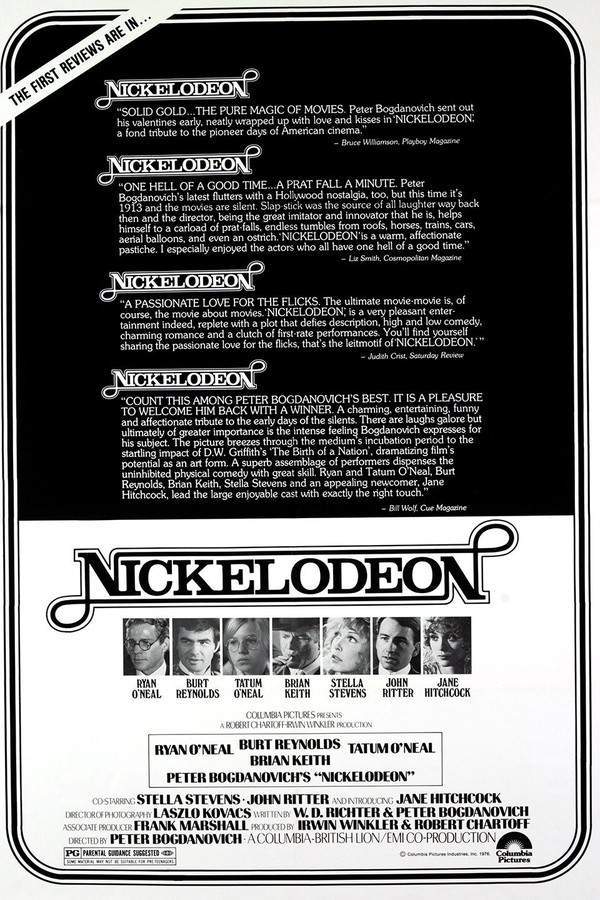
Nickelodeon (1976) movie poster

Plot Summary

Nickelodeon (1976) Plot Summary Explained

Release, runtime and language
1976 · 121 min · English
Directed by
Peter Bogdanovich
Starring
Ryan O'Neal, Burt Reynolds, Brian Keith, John Ritter, Tatum O'Neal, Brion James

During the 1920s in Hollywood, lawyer Leo Harrigan and his friend Buck Greenway abandon their legal careers to join a group of unconventional filmmakers. Leo finds an unexpected talent for directing, while Buck’s charisma leads him to become a popular leading actor. However, their burgeoning success is complicated by a fierce competition for the affections of the captivating actress Kathleen Cooke, threatening to derail their partnership and ambitions.

On this page (6)
  1. 1 Where to watch
  2. 2 What happens: full plot
  3. 3 Plot questions answered
  4. 4 Movie threads
  5. 5 Movies like Nickelodeon
  6. 6 Every angle

Where to watch

Where to Watch Nickelodeon (1976)

Where can you watch Nickelodeon? Stream, rent or buy it in the US, including on YouTube Free, Amazon Video and Apple TV Store: current JustWatch availability with up-to-date prices.

Streaming availability powered by JustWatch

Full plot summary · contains spoilers

What Happens in Nickelodeon: Full Plot Summary

The whole story of Nickelodeon (1976) explained, from the opening scene to the final frame: every key event, every twist and what it all adds up to. Read it as a quick recap before the sequel, to check a scene you missed, or to finally understand what really happened.

In the bustling streets of Chicago back in 1910, the story centers around Leo Taylor Harrigan, a beleaguered attorney who finds himself in a precarious situation, desperately trying to evade an irate client. As he navigates the chaos, Leo catches a glimpse of H.H. Cobb, the influential owner of the Kinegraph Company, which specializes in producing motion pictures. Seizing the opportunity, Leo hopes to introduce himself to Cobb, but their encounter is consistently interrupted by discussions about “patents agents” and the latest movie plots.

Cobb eventually elaborates on how his company operates as an independent studio, distinct from the oppressive Motion Picture Patents Company—a conglomerate determined to eliminate competition within the filmmaking sphere. As Leo follows Cobb and his crew onto a streetcar, the unexpected happens; Waldo, a zany writer from Kinegraph, chimes in with a bizarre story concept about a man with a crab in his pants. With Leo injecting his own flair and creativity into the narrative, Cobb hires him for $15 per scenario, marking the start of Leo's cinematic adventure. Amidst the pandemonium, he notices Kathleen "Kathy" Cooke, portrayed by Tatum O'Neal, a near-sighted actress who comically tumbles inside the streetcar, and an instant spark ignites between them.

However, Kathy is soon off to join the Chautauqua Show in New York City. Upon her arrival in New York, she again finds herself in a clumsy predicament, tripping in front of Thomas "Buck" Greenway, played by John Ritter, who is there to deliver a saddle. Their encounter mirrors that of Leo and Kathy, as another burst of love blooms at first sight. Then, due to a mix-up, Kathy unwittingly switches suitcases with Buck before embarking on her national tour. Meanwhile, Buck receives a job offer as a rider in a stage production titled The Clansman, only to discover that his new employer is connected to a front for an independent movie studio.

As fate would have it, when Patents Company thugs invade the bakery, Buck inadvertently knocks one of the bakers out cold. His actions attract the thugs' attention, who later recruit him to work for them in California. Back in Chicago, time passes, and Cobb becomes increasingly anxious about his production team in Cucamonga. Consequently, he sends Leo to act not only as a scenarist but also as a crucial link to the home office.

On his journey westward, Leo and Kathy unintentionally swap their suitcases once again, leading to a flurry of misunderstandings. Upon arriving in Cucamonga, Leo receives a warm welcome from Alice "Princess" Forsyte, a spirited young girl driving a truck for an ostrich farm. He soon encounters the Kinegraph cast assembled in a saloon, where chaos reigns among lead actors Margaret "Marty" Reeves and Reginald Kingsley, alongside cameraman Franklin "Frank" Frank—also Marty's boyfriend.

With the realization that their director vanished a month prior with the payroll, Leo must step up to take charge. As the plot unfolds, humor ensues when Buck finds himself donning Leo’s clothes, while Leo must wear Buck's attire for filming. A rivalry brews as Leo challenges Buck in a fistfight only to discover they appear just like each other.

As the seasons change, the Chautauqua troupe lands in Cucamonga with inventive ideas brewing, leading to unexpected adventures involving a hot air balloon—intended for a film titled Romeo's Balloon. With Buck uneasy about flying, circumstances take a turn when Kathy accidentally finds herself in the balloon, landing on a train’s caboose and creating a whirlwind of excitement.

However, jealousy soon rears its head as Leo navigates his feelings towards Kathy, especially as she and Buck start discussing nuptials. The story continues as their paths collide with H.H. Cobb, who is now accompanied by Marty and is eager to recruit the talented group for more dramatic endeavors.

In the exhilarating whirlwind that follows, Leo, Buck, Kathy, and their band of misfits confront the insatiable demands of the film industry, culminating in moments of laughter, rivalry, and ultimately, the drive to create and succeed in a town rife with opportunity and heartache. In an unforgettable climax that solidifies their friendships and dreams, they encounter the whims of the cinematic world, affirming that the journey of filmmaking is as exhilarating as the stories they long to tell.

Now picture it: on Christmas Day in 1913, they congregate for a lavish celebration under Cobb's influence, only to be met with an unexpected spectacle of fame that leaves them grappling with their own identities in this vibrant yet merciless realm of motion pictures. As they embark on their shared journeys, their creative spirits and ambitions intertwine, creating a melodious tale of love, ambition, and the unyielding passion for storytelling amidst the chaos of the early film industry.

Last updated: January 18, 2025 at 14:36

Was this helpful?

Plot questions answered

Nickelodeon Plot Explained: Your Questions Answered

The questions people ask most about Nickelodeon (1976): what happens in the confusing scenes, why the characters do what they do, the twists, hidden details and what the ending means. Each answer contains spoilers.

Q1

Why does Leo Harrigan leave his career as a lawyer?

Leo abandons his law career after encountering H.H. Cobb, the owner of Kinegraph Company. While hiding from an angry client in Chicago, Leo sees an opportunity to break into the film industry. He impresses Cobb with his creative ideas for a movie script about a man with a crab in his pants, and Cobb hires him for $15 per scenario. This marks Leo's transition from a struggling attorney to a screenwriter.

Foreshadowing: The opening scene establishes Leo's desperation to escape his legal career, as he's literally running from an irate client when he spots his opportunity in filmmaking.

  • Leo Harrigan
  • lawyer
  • Kinegraph
  • screenwriter career change
Q2

What is the Patents Company in the movie?

The Patents Company refers to the Motion Picture Patents Company, a conglomerate mentioned by H.H. Cobb as an oppressive force trying to eliminate competition in filmmaking. Independent studios like Kinegraph struggle against this monopoly. The Patents Company thugs later appear as antagonists who attack a bakery and eventually recruit Buck to work for them in California, representing the broader conflict between independent filmmakers and established industry powers.

Foreshadowing: Cobb explains early on that Kinegraph operates as an independent studio distinctly separate from this powerful conglomerate.

  • Patents Company
  • Motion Picture Patents Company
  • independent studio
  • film industry monopoly
Q3

Why do Leo and Buck end up swapping clothes?

Leo and Buck swap clothes as part of a comedic mix-up during filming in Cucamonga. When the director disappears with the payroll, Leo must step up to direct despite having no experience. During the chaos of production, Buck ends up wearing Leo's clothes while Leo wears Buck's attire. This leads to a humorous rivalry where they fistfight and discover they look strikingly similar, emphasizing the film's themes of mistaken identity and the chaotic early film industry.

Foreshadowing: Earlier suitcase mix-ups between Leo and Buck establish the pattern of them accidentally exchanging belongings throughout the story.

  • Leo
  • Buck
  • clothes swap
  • Cucamonga
  • film production
Q4

Why does Kathy end up with Buck instead of Leo?

Kathy ends up marrying Buck rather than Leo due to a series of coincidences and timing. She first meets Leo in Chicago on a streetcar where they share an instant connection, but she leaves for New York before anything develops. In New York, she meets Buck Greenway, who she also connects with immediately. Multiple suitcase mix-ups throughout their journeys keep Leo and Kathy apart while bringing her closer to Buck. Eventually, while Leo is occupied with directing and dealing with professional chaos, Kathy and Buck decide to marry at the ostrich farm in Cucamonga, leaving Leo to deal with his jealousy.

Foreshadowing: The repeated suitcase switches and the parallel 'love at first sight' meetings with both men establish the triangular dynamic that ultimately leads to Buck and Kathy's marriage.

  • Kathy Cooke
  • Buck Greenway
  • love triangle
  • marriage
  • Leo love interest
Q5

What happens to the director in Cucamonga?

When Leo arrives in Cucamonga to work for Kinegraph, he discovers that the film unit has been without a director for a month because the previous director vanished with the payroll. With no one else willing or able to step up, Leo must take charge of the production despite having no prior directing experience. This forces him to learn on the job and demonstrates the ramshackle nature of early independent filmmaking.

Foreshadowing: Cobb's anxiety about his production team in Cucamonga hints at problems before Leo arrives.

  • director disappearance
  • Cucamonga
  • Kinegraph
  • payroll
  • film production chaos
Q6

What is Tuttle's Muddle and why does it upset the group?

Tuttle's Muddle is a film screened on Christmas Day in 1913 that features unauthorized clips of Buck and Kathy. The film incorporates real footage of them without permission, which enrages the group because it represents the exploitation of actors by the industry. This moment highlights the power imbalance between filmmakers and performers in early Hollywood, prompting the group to confront Cobb about better wages, though they are simply discharged for their demands.

Foreshadowing: The earlier tensions about wages and creative control foreshadow this confrontation with industry exploitation.

  • Tuttle's Muddle
  • Christmas 1913
  • unauthorized footage
  • film industry exploitation
Q7

Why do Leo, Buck, and Frank steal cameras from Atlantic Pictures?

After being discharged by Cobb following the Tuttle's Muddle confrontation, the group finds themselves working at Atlantic Pictures but feeling frustrated with their situation. In a desperate attempt to take control of their own careers, they steal cameras from Atlantic Pictures to produce their own independent film called The Half-Breed Kid. This act represents their refusal to remain exploited by the industry and their determination to become creators rather than just workers.

Foreshadowing: The ongoing conflict with Cobb and the industry powers builds to this point of outright rebellion.

  • camera theft
  • Atlantic Pictures
  • The Half-Breed Kid
  • independent filmmaking
Q8

What is the significance of The Clansman premiere in 1915?

On February 8, 1915, the group attends the premiere of D.W. Griffith's epic film The Clansman, which would later become known as The Birth of a Nation. This film is historically significant as one of the first feature-length films and represents the culmination of many themes explored in the movie, the power of cinema, the industry's evolution, and the complex relationship between the characters and the medium they love. Their attendance at this premiere marks a pivotal moment reflecting their journey through early Hollywood.

Foreshadowing: Earlier references to Buck performing in a stage production called The Clansman establish the connection to this historical film.

  • The Clansman
  • Birth of a Nation
  • D.W. Griffith
  • 1915 premiere
  • film history
Q9

Why do Leo and Buck have a fistfight in Cucamonga?

Leo and Buck fistfight in Cucamonga after discovering their romantic rivalry over Kathy has created tension between them. The fight is triggered by their jealousy and competition for Kathy's affection, but the comedy comes from the fact that they discover they look nearly identical, making it difficult to tell them apart. This physical confrontation represents the peak of their professional and romantic tension before events push them toward reconciliation.

Foreshadowing: The rivalry between Leo and Buck for Kathy's affection builds throughout the narrative, creating the tension that leads to this confrontation.

  • Leo
  • Buck
  • fistfight
  • Cucamonga
  • rivalry
  • love triangle
Q10

Why does Buck end up working for the Patents Company thugs?

Buck becomes involved with the Patents Company thugs after defending a baker whose shop is invaded by these thugs. When Buck accidentally knocks one of the bakers unconscious with a punch meant for the thugs, his actions draw their attention. Rather than punishing him, the thugs recruit him to work for them in California, pulling him into the conflict between independent filmmakers and the established monopoly.

Foreshadowing: This recruitment establishes Buck's complicated position in the industry conflict between independence and corporate control.

  • Buck Greenway
  • Patents Company
  • thugs
  • recruitment
  • California

Movie threads

More Movies Like Nickelodeon, by Mood & Story

Curated lists built around what makes Nickelodeon tick: the same mood, the same kind of story or the same emotional payoff. Each list explains why these movies belong together.

Chaotic Hollywood Comedies like Nickelodeon

Fast-paced comedies capturing the joyful chaos and adventure of early moviemaking. If you loved the fast-paced, whimsical energy of Nickelodeon, you'll enjoy these movies that capture the chaotic spirit of early filmmaking. This thread highlights comedies filled with ambitious characters, creative rivalry, and romantic entanglements set against the backdrop of Hollywood's beginnings.

  • whimsical
  • energetic
  • nostalgic
  • comical
  • hopeful
  • sentimental
  • Tone: light, whimsical, nostalgic
  • Pacing: fast and energetic
Why these movies?

The story pattern: Stories typically follow a group of dreamers or rivals as they plunge headfirst into the burgeoning film industry. The narrative is propelled by a series of comedic setbacks, rapid career changes, and a central romantic rivalry, culminating in a celebratory resolution that affirms the joy of creation.
Why they belong together: These films are grouped by their shared LIGHT tone, FAST pacing, and focus on a specific, nostalgic setting. They blend historical whimsy with romantic comedy and slapstick humor, creating a uniquely energetic and hopeful viewing experience centered on creative passion.

Movies with Friendship and Love Triangles like Nickelodeon

Stories where friendship is tested by shared career dreams and a captivating love interest. For viewers who enjoyed the dynamic between Leo, Buck, and Kathleen in Nickelodeon, this thread finds similar stories about friendship tested by romantic rivalry. Discover comedies and dramedies where career ambition and love intertwine, leading to comical chaos and a hopeful resolution.

  • romantic
  • comical
  • sentimental
  • hopeful
  • rivalry
  • friendship
  • Tone: light, comical, sentimental
  • Pacing: steady to fast, event-driven
Why these movies?

The story pattern: The narrative pattern involves two friends—often a more practical one and a charismatic one—embarking on a joint venture. Their success is complicated by the introduction of a love interest who creates a triangle, leading to a period of rivalry and misunderstanding before a reconciling, happy ending reaffirms their bond.

Why they belong together: These movies share a specific character dynamic and plot structure. The combination of a strong friendship, a collaborative career goal, and a romantic rivalry creates a MODERATE complexity narrative with LIGHT emotional weight, resulting in a feel-good story about overcoming conflict.

If you liked this

Movies Like Nickelodeon

Similar movies to Nickelodeon: the same genre, themes or kind of story. Each one comes with its own plot summary, timeline and ending explained.

Browse all movie summaries

Every angle

Nickelodeon (1976) Explained: Plot, Timeline & Characters

Everything about Nickelodeon in one place: what happens in the plot summary, the timeline in chronological order, the characters and meaning and a spoiler-free summary. What's After the Movie adds the cast, box office and post-credit scenes.

Coming soon on iOS and Android

The Plot Explained Movie Summary App

Plot summaries, endings explained and timelines on your phone. Catch up on any movie in minutes, save your favorites and never miss a twist again.

Be the first to know when we launch. Your email stays private, always.

Learn more about the app