Plot Explained Spoilers guaranteed!
Plot Explained

Browse by genre

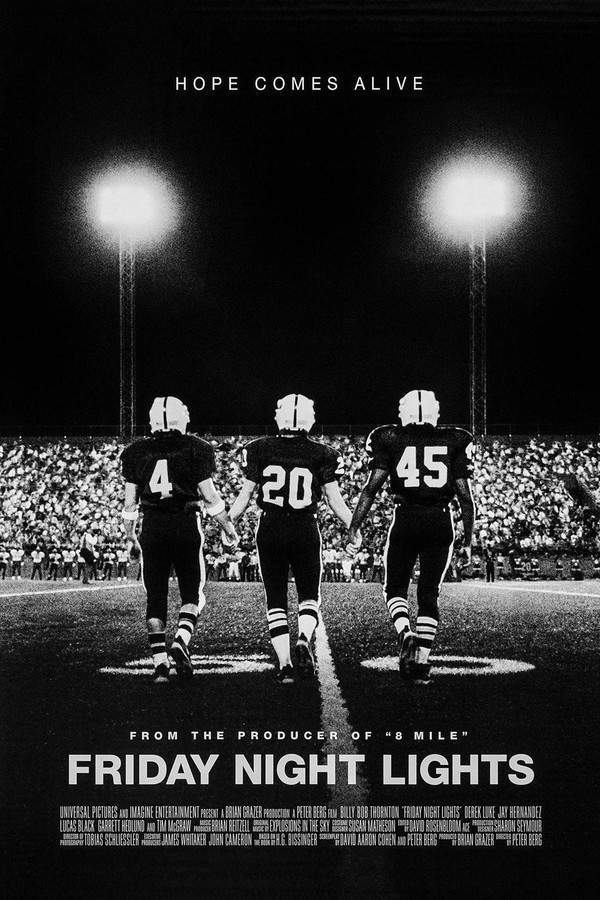
Friday Night Lights (2004) movie poster

Plot Summary

Friday Night Lights (2004) Plot Summary Explained

Release, runtime and language
2004 · 118 min · English
JustWatch #3,492 19
Directed by
Peter Berg
Starring
Billy Bob Thornton, Derek Luke, Jay Hernandez, Lucas Black
Budget
$30M

In a tight-knit Texas community where high school football is everything, the team's hopes are shaken when a star player suffers a serious injury. As the season progresses, Coach Gary Gaines faces immense pressure to lead the team to victory while navigating complex social issues and the anxieties of the town. Through unwavering dedication and the strength of the community, he strives to inspire a team revival and restore hope.

On this page (7)
  1. 1 Where to watch
  2. 2 What happens: full plot
  3. 3 Plot questions answered
  4. 4 The book behind the movie
  5. 5 Movie threads
  6. 6 Movies like Friday Night Lights
  7. 7 Every angle

Where to watch

Where to Watch Friday Night Lights (2004)

Where can you watch Friday Night Lights? Stream, rent or buy it in the US, including on Netflix, Netflix Standard and Amazon Video: current JustWatch availability with up-to-date prices.

Streaming availability powered by JustWatch

Full plot summary · contains spoilers

What Happens in Friday Night Lights: Full Plot Summary

The whole story of Friday Night Lights (2004) explained, from the opening scene to the final frame: every key event, every twist and what it all adds up to. Read it as a quick recap before the sequel, to check a scene you missed, or to finally understand what really happened.

Bissinger chronicled the 1988 season of the Permian Panthers, a high school football team in Odessa, Texas, which ultimately faced heartbreak in the State semi-finals against Dallas’ Carter High School—who would go on to win the championship, only to have their title revoked due to fielding an ineligible player. The narrative weaves through a tapestry of social and political challenges in Odessa, highlighting issues such as socioeconomic disparity, racism, segregation, and poverty, all inherently linked to the Panthers.

The team's coach, Gary Gaines, finds himself under constant pressure. After facing a tough loss, he discovers "For Sale" signs placed on his lawn, epitomizing the stakes involved with his performance. The fates of the team and its coach are inextricably intertwined with the personal struggles faced by the players, both on and off the field. A prominent figure is running back James "Boobie" Miles, whose overuse leads to a severe injury—tearing his ACL—which not only sidelines him during the playoffs but also leaves him with a permanent limp. The aftermath plunges Miles into despair as his dreams of college football slip away, and he is confronted by his dismal academic prospects.

Quarterback Mike Winchell grapples with inconsistency and his inability to assert himself. Fullback Don Billingsley deals with a tumultuous relationship with his father, a former champion at Permian, who holds high expectations for Don, leading to tension despite his son’s best efforts. Meanwhile, third-string running back Chris Comer, thrust into a pivotal role following Miles' injury, battles his own fears regarding injury and the daunting prospect of fulfilling his ambitions for recognition in football.

The narrative also highlights safety Brian Chavez, who is marginalized by peers for lacking instinct, despite being the smartest player, showcasing the myriad dynamics within the team's locker room. Coach Gaines juggles the dual challenges of achieving victories and forging connections with his players throughout the arduous season. As the Panthers strain toward playoff qualification, they find themselves in a three-way tie at the season's conclusion—a scenario that leads to a dramatic coin-toss to determine their fate.

In a bid to avert chaos, the details of the coin-toss remain under wraps, eventually aired live in the dead of night. Miraculously, Permian secures the tie and advances to the finals, where they face a powerhouse from Dallas. The game concludes with tears from the players, yet they are united in realizing the immeasurable successes of their season, transcending the notion of winning a mere championship. The film closes with Coach Gaines reflecting on the departing seniors, marking their names off the depth chart, which includes "Case," referencing Stoney Case, the real-life backup quarterback who would lead the Panthers to a state title the subsequent year, ultimately paving his way to the NFL. The final scene captures Winchell throwing a football to a group of young kids playing pickup games, accompanied by Billingsley and Chavez.
Last updated: November 16, 2024 at 17:50

Was this helpful?

Plot questions answered

Friday Night Lights Plot Explained: Your Questions Answered

The questions people ask most about Friday Night Lights (2004): what happens in the confusing scenes, why the characters do what they do, the twists, hidden details and what the ending means. Each answer contains spoilers.

Q1

Why did James 'Boobie' Miles get injured and miss the playoffs

Boobie Miles suffered a severe injury during the season when he tore his ACL while playing. The injury happened due to overuse - he was the team's star running back and was being relied on heavily throughout the season. The injury not only sidelined him during the playoffs but also left him with a permanent limp, effectively ending his dreams of playing college football.

Foreshadowing: The narrative hints at the physical toll of relying on a single star player before the injury occurs.

  • boobie miles
  • acl injury
  • running back
  • playoffs
  • college football
Q2

Why was Coach Gary Gaines under so much pressure

Coach Gaines faced immense pressure because the town's entire identity revolved around the football team. After a tough loss, he discovered 'For Sale' signs placed on his lawn, which directly tied his job security to the team's performance. In Odessa, Texas, high school football determines not just team standings but also community morale and the coach's personal livelihood.

Foreshadowing: The 'For Sale' signs appear early in the film, establishing the stakes immediately.

  • gary gains
  • coach
  • pressure
  • job
  • for sale signs
Q3

What was the three-way tie and why was there a coin toss

At the end of the regular season, the Permian Panthers found themselves in a three-way tie with two other teams for playoff qualification. To determine which team would advance, the Texas high school football association conducted a dramatic coin toss. The details were kept secret and aired live at night to prevent chaos from spreading, and miraculously, Permian won the toss and advanced to the finals.

  • three-way tie
  • coin toss
  • playoffs
  • permian panthers
Q4

Why did the Panthers lose to Dallas Carter in the state finals

The Panthers faced Dallas' Carter High School in the state semi-finals (the film depicts this as the finals). Despite their best efforts, Carter was simply the stronger team and ultimately won. However, Carter's championship title was later revoked due to fielding an ineligible player, making this a hollow victory. The Panthers played with honor and unity, finding meaning beyond just winning.

  • dallas carter
  • state finals
  • loss
  • championship
  • ineligible player
Q5

Why was Don Billingsley's relationship with his father so difficult

Don's father was a former champion player at Permian who held impossibly high expectations for his son. This created constant tension between them, as Don struggled to live up to his father's legacy while forging his own identity on the team. The pressure from his father represented the weight of generational expectations placed on young athletes in the community.

  • don billingsley
  • father
  • conflict
  • expectations
  • legacy
Q6

What was Brian Chavez's role on the team and why was he marginalized

Brian Chavez played as safety on the team. Despite being the smartest player on the roster, he faced rejection from his peers who perceived him as lacking instinct for the game. His struggle highlights the complex dynamics within the locker room, where intelligence and academic ability were often undervalued in favor of raw physical talent and instinct.

  • brian chavez
  • safety
  • smart
  • marginalized
  • locker room
Q7

Who is Stoney Case and why does the movie mention him

Stoney Case was the backup quarterback for the Panthers during the 1988 season. The film references him in the final scene when Coach Gaines marks names off the depth chart. His significance lies in what happened the following year - he became the starting quarterback and led the Panthers to a state title, eventually making his way to the NFL. He represents hope for the future beyond the current season's disappointment.

Foreshadowing: The ending specifically references Case's future success, providing closure to the narrative.

  • stoney case
  • backup quarterback
  • state title
  • nfl
  • future
Q8

What struggles did Mike Winchell face as quarterback

Mike Winchell struggled with inconsistency throughout the season and often doubted his ability to lead the team. As the quarterback, he faced enormous pressure to perform and make critical decisions under intense circumstances. His personal journey reflects the psychological burden placed on young athletes in high-stakes positions.

  • mike winchell
  • quarterback
  • inconsistency
  • pressure
  • leadership
Q9

What social issues did the movie highlight in Odessa

The film wove in several interconnected social issues affecting the Permian Panthers and their community, including socioeconomic disparity, racism, segregation, and poverty. These factors intrinsically shaped the players' lives both on and off the field, demonstrating how football served as both an escape from and a reflection of the broader challenges facing Odessa.

  • socioeconomic
  • racism
  • segregation
  • poverty
  • odessa
Q10

Why did Chris Comer become an important player for the team

After Boobie Miles' injury, third-string running back Chris Comer was thrust into a pivotal role. He had to confront his own fears about getting injured while dealing with the weight of expectations from the team and community. His rise represented the next man up mentality in football and the challenges faced by backup players suddenly called upon to fill significant roles.

  • chris comer
  • running back
  • backup
  • injury
  • opportunity
Q11

What does the ending scene with Mike Winchell throwing football mean

The final scene shows Mike Winchell throwing a football to young kids playing pickup games, joined by Don Billingsley and Brian Chavez. This symbolizes the cycle of mentorship and hope within the community - the players who just finished their season are now passing the torch to the next generation. It represents continuity and the enduring spirit of Permian football despite the championship loss.

  • ending
  • young kids
  • pickup games
  • mentorship
  • hope
Q12

What was the overall message of the season for the Panthers

Despite failing to win the championship, the Panthers found profound meaning in their journey together. The final game ended in tears, but the players united in realizing their season's true value transcended winning. They learned about perseverance, community, and personal growth - understanding that their accomplishments as a team mattered more than the final score.

  • team unity
  • perseverance
  • championship loss
  • growth
  • community

Movie threads

More Movies Like Friday Night Lights, by Mood & Story

Curated lists built around what makes Friday Night Lights tick: the same mood, the same kind of story or the same emotional payoff. Each list explains why these movies belong together.

Movies about small town pressure like Friday Night Lights

Stories where a community's identity hinges on the success of its team. If you enjoyed the high-stakes pressure of the Odessa community in Friday Night Lights, explore other movies like it. These films capture the weight of expectation in small towns where a team's success or failure defines the community's spirit, focusing on collective hope and the burden of being a local symbol.

  • tense
  • hopeful
  • anxious
  • gritty
  • nostalgic
  • underdog
  • Tone: bittersweet, tense
  • Pacing: steady, building
Why these movies?

The story pattern: These narratives often follow a linear build-up to a climactic event, like a championship game. The central conflict is not just within the team, but between the team and the overwhelming expectations of the town. Character arcs involve navigating this public pressure while pursuing personal goals, often leading to a redefinition of what true success means.

Why they belong together: Movies are grouped here for their shared focus on a community's identity being tied to a single entity. They share a medium intensity driven by social pressure, a bittersweet tone balancing hope with reality, and a steady pacing that builds towards a defining moment for the town.

Bittersweet underdog sports movies like Friday Night Lights

Where the fight itself is the victory, even if the ultimate goal isn't achieved. Fans of the heartfelt underdog story in Friday Night Lights will find similar movies here. These films focus on teams that may not win the championship but find a deeper victory in their journey, capturing a bittersweet, hopeful, and gritty emotional tone that prioritizes character over trophy.

  • underdog
  • hopeful
  • melancholic
  • gritty
  • inspiring
  • tense
  • Tone: bittersweet, hopeful
  • Pacing: steady, linear
Why these movies?

The story pattern: The narrative pattern involves an underdog group facing significant obstacles—social, economic, or physical. The story builds through their efforts to overcome these challenges, emphasizing personal growth and team cohesion. The climax often redefines winning, concluding with a sense of pride and accomplishment that transcends a simple victory or loss.

Why they belong together: This thread groups films based on a specific emotional arc: the bittersweet underdog story. They share a tone that balances struggle with hope, a pacing that steadily builds investment in the team's effort, and an ending feel that is poignant and meaningful without being purely happy.

If you liked this

Movies Like Friday Night Lights

Similar movies to Friday Night Lights: the same genre, themes or kind of story. Each one comes with its own plot summary, timeline and ending explained.

Browse all movie summaries

Every angle

Friday Night Lights (2004) Explained: Plot, Timeline & Characters

Everything about Friday Night Lights in one place: what happens in the plot summary, the timeline in chronological order, the characters and meaning and a spoiler-free summary. What's After the Movie adds the cast, box office and post-credit scenes.

Coming soon on iOS and Android

The Plot Explained Movie Summary App

Plot summaries, endings explained and timelines on your phone. Catch up on any movie in minutes, save your favorites and never miss a twist again.

Be the first to know when we launch. Your email stays private, always.

Learn more about the app