Plot Explained Spoilers guaranteed!
Plot Explained

Browse by genre

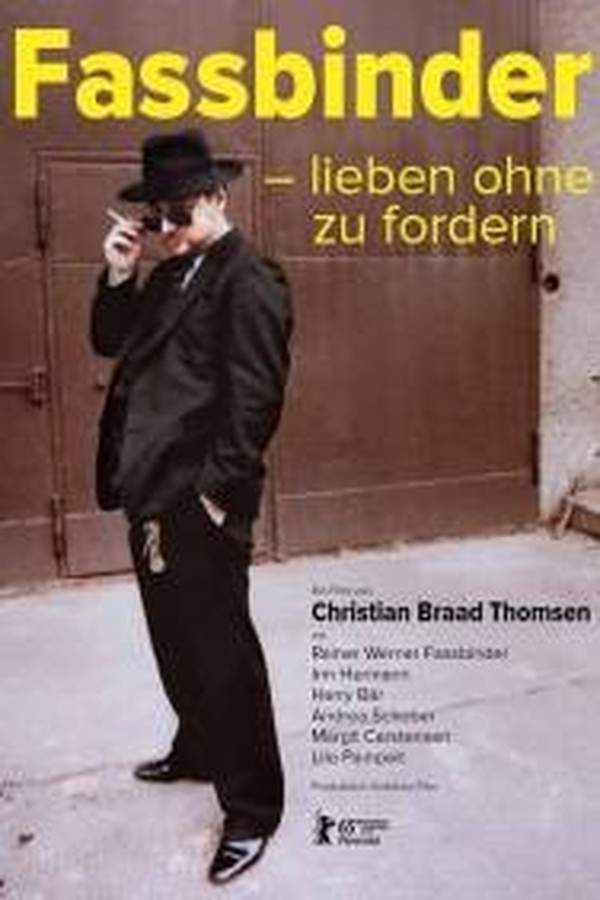
Fassbinder: To Love Without Demands (2016) movie poster

Timeline

Fassbinder: To Love Without Demands (2016) Timeline Explained – Every Event in Order

Release, runtime and language
2016 · 109 min
Directed by
Christian Braad Thomsen

This documentary explores the life and work of filmmaker Rainer Werner Fassbinder through interviews filmed by Braad Thomsen in the 1970s. Viewers gain a unique insight into Fassbinder’s creative process and his perspectives on love, filmmaking techniques, and the challenges of living a full and expressive life. The film reveals the complexities of his artistic vision and personal philosophies.

On this page (5)
  1. 1 Events in order (13)
  2. 2 Timeline questions answered
  3. 3 Movie threads
  4. 4 Movies like Fassbinder: To Love Without Demands
  5. 5 Every angle

13 events in order · contains spoilers

Fassbinder: To Love Without Demands Timeline: Events in Chronological Order

Every key event of Fassbinder: To Love Without Demands (2016) in order, scene by scene, with when and where it takes place. Use it to untangle flashbacks, time jumps and parallel storylines, to refresh your memory before the sequel or to find the exact scene you are thinking of.

  1. Meeting at Berlinale 1969

    Christian Braad Thomsen meets Rainer Werner Fassbinder when Fassbinder showcases his debut film, 'Love is colder than death', at the Berlinale film festival in 1969. This encounter marks the beginning of a deep friendship between the director and the future icon of German cinema.

    When
    1969
    Where
    Berlinale, Germany
  2. Last Encounter

    Braad Thomsen and Fassbinder share their final meeting three weeks before Fassbinder's untimely death. This poignant moment underscores the importance of their friendship and the impact Fassbinder had on Thomsen's life and work.

  3. Recording with Lilo Pempeit

    Following Fassbinder's death, Christian Braad Thomsen records a conversation with Fassbinder's mother, Lilo Pempeit. Through her memories, she recounts Fassbinder's unusual childhood experiences growing up in post-war Germany, shedding light on the artist's formative years.

  4. Irm Hermann's Memories

    The film presents new interviews with actress Irm Hermann, who was among the first to recognize Fassbinder's talent before he gained public acclaim. Her support played a crucial role in Fassbinder's journey as he pursued grand dreams of making Hollywood films.

  5. Harry Bär's Final Conversations

    Actor and producer Harry Bär shares his recollections, including the last conversation he had with Fassbinder just hours before his passing. They discussed plans for a new film based on Joachim Witt's song 'Ich bin das Glück dieser Erde', revealing Fassbinder's unfulfilled ambitions.

  6. Andrea Schober's Perspective

    Andrea Schober, who starred as a child in Fassbinder's early films, offers her insights during an interview. Their bond was rooted in mutual yearning – Schober for a father figure and Fassbinder for a child – illuminating the emotional depth of their relationship.

  7. Fassbinder's Artistic Journey

    Fassbinder emerges as one of the most prolific filmmakers in history, creating 60 films for cinema and television in just 14 years. His ability to reach a wide audience while remaining true to his avant-garde roots is a central theme of the documentary.

  8. Reflecting on German History

    Fassbinder's work is recognized as a visual interpretation of 20th-century German history, addressing significant events from the Weimar Republic's demise to the terrorism of the 1970s. His films uniquely explore how historical narratives impact individual lives.

  9. Understanding Creativity

    Through the documentary, Christian Braad Thomsen seeks to unravel the complexities of Fassbinder's creativity, tracing it back to his extraordinary childhood. The interplay of his upbringing and the relationships he formed heavily influenced his artistic vision.

  10. Fassbinder's Love Story

    The film articulates Fassbinder's internal struggles with love, marriage, and madness, as he candidly discusses his feelings in front of Thomsen’s camera. His first film's title serves as an ironic reflection of his life and the deep connections formed with those around him.

  11. Final Thoughts

    Just hours before his death, Fassbinder articulates a profound insight during an interview, stating, 'To be complete, you need to double yourself.' This reflective statement encapsulates the complexities of his life and art, highlighting the profound contradictions he navigated.

  12. Compiling the Documentary

    The documentary weaves together interviews, personal memories, and archival footage to form a nuanced portrait of Fassbinder. This multifaceted approach provides viewers with a deeper understanding of both the artist and the man behind the legend.

  13. Legacy in Cinema

    Fassbinder's legacy as a filmmaker is solidified as an avant-garde pioneer who continuously pushed boundaries. His commitment to presenting authentic narratives about the human experience leaves an enduring impact on cinema and filmmakers worldwide.

Last updated: May 12, 2025 at 07:04

Was this helpful?

Timeline questions answered

Fassbinder: To Love Without Demands Timeline Explained: Your Questions Answered

When does it happen, and why in that order? The questions people ask about the chronology of Fassbinder: To Love Without Demands (2016): time jumps, flashbacks, cause and effect between scenes and the correct order of events, each answered with spoilers.

Q1

Why was Rainer Werner Fassbinder so prolific?

Fassbinder created an astonishing 60 films for cinema and television in just 14 years. This productivity stemmed from his intense work ethic and his belief that filmmaking was essential to processing his experiences. Rather than compromising his avant-garde vision, he maintained his artistic integrity while reaching a wide audience, treating filmmaking as both a personal necessity and a way to visually represent 20th-century German history.

Foreshadowing: Earlier in the documentary, Thomsen notes that Fassbinder spent more time in cinemas than in school as a child, hinting at his lifelong obsession with film.

  • prolific filmmaker
  • 60 films
  • German cinema
  • work ethic
Q2

How did Fassbinder's childhood influence his filmmaking?

Fassbinder grew up with numerous surrogate parents who were primarily refugees, and these figures constantly came and went from his life. This constant instability and loneliness led him to spend excessive time in cinemas. The documentary explores how this extraordinary childhood, marked by abandonment and isolation, directly shaped his artistic vision, his fascination with human relationships, and his need to process the impact of post-war German history through his work.

Foreshadowing: The documentary reveals that his debut film title, 'Love is Colder Than Death,' reflects the emotional detachment he experienced during his formative years.

  • childhood
  • post-war Germany
  • upbringing
  • artistic vision
  • refugees
Q3

What made the 1969 Berlinale meeting significant?

Christian Braad Thomsen met Rainer Werner Fassbinder at the 1969 Berlinale where Fassbinder presented his debut film 'Love is Colder Than Death.' This encounter marked the beginning of a deep friendship that would last until Fassbinder's death. Thomsen subsequently filmed extensive interviews with Fassbinder throughout the 1970s, which remained unpublished until this documentary, making their relationship the documentary's emotional backbone.

Foreshadowing: The documentary's final moments reveal an interview conducted just hours before Fassbinder's death, completing the circle of their friendship.

  • Berlinale 1969
  • Christian Braad Thomsen
  • meeting
  • friendship
Q4

Why does the documentary include a recording of Fassbinder's mother?

After Fassbinder's untimely death, Christian Braad Thomsen recorded a conversation with his mother Lilo Pempeit. This poignant tape recording captures her reflecting on his remarkable upbringing amidst the ruins of post-war Germany. The inclusion provides intimate insight into Fassbinder's formative years and helps explain the emotional foundation behind his complex artistic vision, adding a personal dimension that interviews with colleagues cannot provide.

Foreshadowing: Earlier sections establish Fassbinder's unusual childhood with surrogate parents, and his mother's memories directly corroborate and expand on this background.

  • Lilo Pempeit
  • mother
  • post-war Germany
  • childhood
  • interview
Q5

What did Fassbinder mean by 'To be complete, you need to double yourself'?

Fassbinder made this profound statement during an interview conducted just hours before his death. The quote encapsulates the central contradictions of his life and art, he was someone who explored duality, separation, and the need for connection throughout his work. As a filmmaker who constantly examined human relationships and his own identity, this final reflection suggests he viewed artistic creation and personal relationships as ways to achieve completeness or transcendence.

Foreshadowing: The documentary's title 'To Love Without Demands' and Fassbinder's earlier film 'Love is Colder Than Death' both hint at his lifelong exploration of love's complexities.

  • final quote
  • duality
  • identity
  • contradictions
  • death
Q6

Who was Irm Hermann in Fassbinder's life?

Irm Hermann was among the first people to recognize Fassbinder's talent when he was virtually unknown. She became a steadfast ally during a time when he held extravagant aspirations of working in Hollywood but had no recognition. Her support played a crucial role in nurturing his ambitious dreams during his early, struggling years as a filmmaker, making her an important figure in his journey toward global acclaim.

Foreshadowing: The documentary shows that despite his later success, Fassbinder never abandoned his original artistic vision, something Hermann witnessed from the beginning.

  • Irm Hermann
  • actress
  • early career
  • support
  • Hollywood dreams
Q7

What film project was Fassbinder working on when he died?

Just hours before his death, Fassbinder had a conversation with actor and producer Harry Bär about a new film project. They were planning to create a film inspired by Joachim Witt's song 'Ich bin das Glück dieser Erde.' This unfinished project reveals that Fassbinder remained creatively active until the end, still pursuing new artistic directions and collaborations despite his declining health.

Foreshadowing: Harry Bär's interview provides this detail, demonstrating that Fassbinder's creative energy never diminished even as he approached the end of his life.

  • final project
  • Joachim Witt
  • Harry Bär
  • unfinished film
Q8

Why did Fassbinder form a bond with child actor Andrea Schober?

Andrea Schober portrayed child roles in Fassbinder's early works, and their bond was deeply emotional. Both were seeking to fill voids in their lives, Fassbinder yearned for a paternal connection while Andrea sought a father figure. This mutual emotional need created a profound relationship that transcended the typical filmmaker-actor dynamic, revealing how Fassbinder's personal longing shaped his professional relationships.

Foreshadowing: The documentary frames this relationship as one of many ways Fassbinder attempted to process his complicated childhood through connections with others.

  • Andrea Schober
  • child actor
  • father figure
  • emotional bond
Q9

How did post-war Germany influence Fassbinder's films?

Fassbinder's work is recognized as a powerful visual representation of 20th-century German history, capturing the transition from the Weimar Republic to the societal upheavals of the 1970s. A defining aspect of his films is the profound exploration of how historical events shape individual lives. Growing up in post-war Germany amid ruins and refugee populations, he directly experienced the historical trauma he later translated into cinema.

Foreshadowing: The documentary shows how his unusual childhood during this period, being raised by revolving surrogate parents who were refugees, directly informed his perspective.

  • post-war Germany
  • Weimar Republic
  • 1970s terrorism
  • German history
  • visual representation
Q10

Why did Fassbinder want to make Hollywood films?

Despite emerging as an avant-garde German filmmaker, Fassbinder held extravagant aspirations of working in Hollywood. This ambition was nurtured by early supporters like Irm Hermann, who believed in his talent before he gained public recognition. His desire to work in Hollywood represented his drive for broader reach and recognition, though he ultimately achieved global acclaim without compromising his distinctive artistic vision.

Foreshadowing: The documentary contrasts his Hollywood ambitions with his commitment to remaining true to his avant-garde roots, showing he succeeded on his own terms.

  • Hollywood
  • dreams
  • ambition
  • avant-garde
  • recognition
Q11

What contradictions defined Fassbinder's character?

Through this documentary, Christian Braad Thomsen seeks to unravel the complex contradictions that defined Fassbinder. These included his ability to be both emotionally distant and deeply connected, his prolific output alongside personal struggles with love and madness, and his avant-garde sensibilities combined with a desire for wide audiences. His final quote about needing to 'double yourself' to be complete encapsulates these inherent tensions.

Foreshadowing: The film weaves together multiple perspectives from friends and colleagues to explore these contradictions, showing how they manifested in both his life and work.

  • contradictions
  • character
  • complexity
  • duality
  • personality

Movie threads

More Movies Like Fassbinder: To Love Without Demands, by Mood & Story

Curated lists built around what makes Fassbinder: To Love Without Demands tick: the same mood, the same kind of story or the same emotional payoff. Each list explains why these movies belong together.

Movies like Fassbinder: To Love Without Demands about complex artists

Reflective films that explore the triumphs and tragedies of a creator's life. If you were captivated by the reflective and melancholic portrait of Rainer Werner Fassbinder, you'll find similar stories in this collection. These movies explore the lives of complex artists, filmmakers, and writers, using interviews and archival footage to build an intimate, bittersweet look at creative genius and its personal toll.

  • melancholic
  • reflective
  • intimate
  • poignant
  • contemplative
  • reverent
  • Tone: melancholic, reflective, reverent
  • Pacing: slow, contemplative
Why these movies?

The story pattern: These stories typically unfold through a non-linear or reflective structure, weaving together personal accounts, creative works, and historical context. The narrative often centers on the contradictions within the artist—their brilliance alongside their flaws—and the impact of their work and life on those around them, culminating in a reflection on their enduring legacy.

Why they belong together: Movies are grouped here for their shared focus on biographical exploration, their melancholic and reflective tone, and their intimate pacing that allows for a deep character study. They all grapple with themes of creation, legacy, and the personal sacrifices often tied to great artistic achievement.
Bittersweet films about legacy and remembrance like Fassbinder: To Love Without Demands

Stories that look back on a life, balancing loss with the enduring impact left behind. Fans of the bittersweet reflection on Fassbinder's life and legacy will appreciate these movies. They similarly explore themes of grief, friendship, and the lasting impact a person leaves behind, often using personal memories and interviews to build a poignant narrative that is both sad and celebratory.

  • bittersweet
  • poignant
  • reflective
  • contemplative
  • nostalgic
  • reverent
  • Tone: bittersweet, poignant, contemplative
  • Pacing: slow, steady
Why these movies?

The story pattern: The narrative structure is often built from memories and testimonies, piecing together a life from fragments of the past. The journey is one of reconciliation for the audience and the subjects, moving from a sense of loss toward an acceptance and celebration of an enduring influence, resulting in a emotionally complex, bittersweet conclusion.

Why they belong together: These films are connected by their central theme of examining a legacy after a death or significant ending. They share a specific emotional mix of sadness and hope, a reflective and often slow pacing, and a focus on how personal relationships and creative output can transcend a life cut short.

If you liked this

Movies Like Fassbinder: To Love Without Demands

Similar movies to Fassbinder: To Love Without Demands: the same genre, themes or kind of story. Each one comes with its own plot summary, timeline and ending explained.

Browse all movie summaries

Every angle

Fassbinder: To Love Without Demands (2016) Explained: Plot, Timeline & Characters

Everything about Fassbinder: To Love Without Demands in one place: what happens in the plot summary, the timeline in chronological order, the characters and meaning and a spoiler-free summary. What's After the Movie adds the cast, box office and post-credit scenes.

Coming soon on iOS and Android

The Plot Explained Movie Summary App

Plot summaries, endings explained and timelines on your phone. Catch up on any movie in minutes, save your favorites and never miss a twist again.

Be the first to know when we launch. Your email stays private, always.

Learn more about the app