Plot Explained Spoilers guaranteed!
Plot Explained

Browse by genre

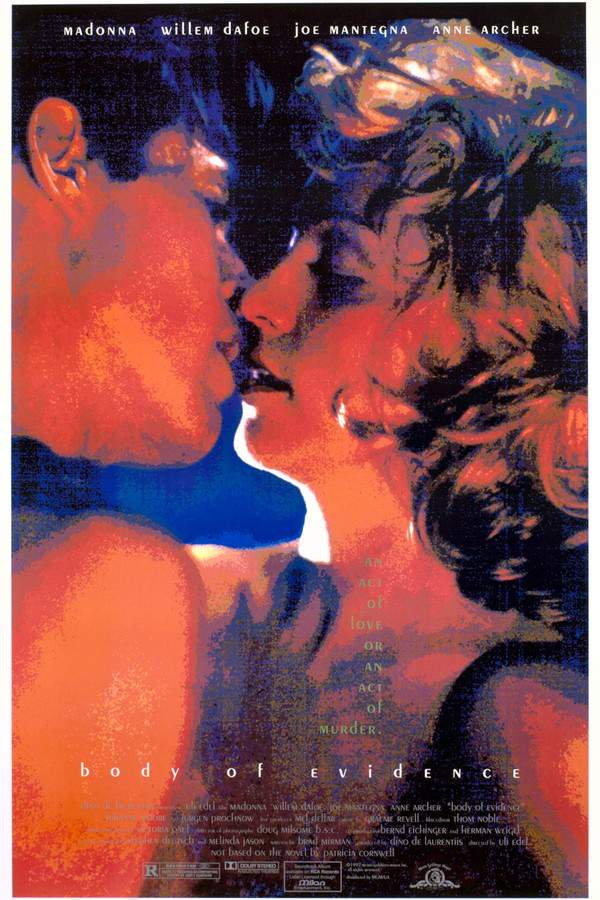
Body of Evidence (1993) movie poster

Plot Summary

Body of Evidence (1993) Plot Summary Explained

Release, runtime and language
1993 · 99 min · English
Loading streaming availability…
Directed by
Uli Edel
Starring
Willem Dafoe, Joe Mantegna, Madonna, Charles Hallahan, Mark Rolston, Richard Riehle
Budget
$30M

When an elderly millionaire is found dead, a complex mystery of greed and suspicion arises. Rebecca, played by Madonna, unexpectedly inherits a substantial fortune, immediately placing her under suspicion and the intense scrutiny of prosecutor Joe Mantegna. As Willem Dafoe’s defense attorney investigates, he uncovers a dangerous game where the lines between justice and obsession become increasingly blurred, threatening to consume everyone involved.

On this page (6)
  1. 1 Where to watch
  2. 2 What happens: full plot
  3. 3 Plot questions answered
  4. 4 Movie threads
  5. 5 Movies like Body of Evidence
  6. 6 Every angle
Loading streaming availability…

Full plot summary · contains spoilers

What Happens in Body of Evidence: Full Plot Summary

The whole story of Body of Evidence (1993) explained, from the opening scene to the final frame: every key event, every twist and what it all adds up to. Read it as a quick recap before the sequel, to check a scene you missed, or to finally understand what really happened.

An older gentleman, Andrew Marsh, finds himself engrossed in a homemade pornographic tape. Tragedy strikes as it is later disclosed that he succumbed to fatal complications associated with erotic asphyxiation. The primary suspect behind this disturbing case is none other than the woman featured in the film, Rebecca Carlson (Madonna). Following the charges laid against her for murder, she secures the legal services of lawyer Frank Dulaney (Willem Dafoe).

The courtroom drama unfolds in Portland, Oregon, where the tension begins to rise. It doesn't take long before an intense, sadomasochistic sexual relationship blossoms between Rebecca and Frank. This clandestine affair occurs right under the nose of Dulaney's unsuspecting wife, who is played by Julianne Moore. Their passionate encounters escalate to the point where Rebecca inflicts hot candle wax onto Frank during their intimate activities.

Rebecca continuously asserts her innocence, both in private conversations with Frank and during the court proceedings. However, the prosecutor, district attorney Robert Garrett (Joe Mantegna), is determined to paint a picture that suggests Rebecca intentionally caused Marsh's death through their sexual exploits, motivated by the lucrative sum of $8 million that he left her in his will.

As the trial progresses, the testimony of Marsh's private secretary, Joanne Braslow (Anne Archer), reveals that her own intimate relationship with him could have contributed to his demise, thus introducing significant doubt surrounding Rebecca's guilt. Despite his undeniable physical attraction to Rebecca, Frank grapples with a lack of trust in her intentions. His wife begins to notice the marks on his skin, leading her to piece together the affair that has been unfolding behind her back.

In court, Rebecca's emotional testimony conveys that she never intended for her husband's death to occur, swaying the jury and ultimately earning her an acquittal. However, as she exits the courtroom, she mockingly thanks Frank for his role in freeing her. It dawns upon Frank that Rebecca indeed orchestrated Marsh's murder through their sexual relationship, but due to the stringent rules of attorney-client privilege, he cannot disclose what he has come to know.

The implications of the double jeopardy rule weigh heavily on Frank's mind; it dictates that she cannot be tried again for the same crime, even with new evidence or an admission of guilt. That very night, he confronts her at her home, discovering her in the company of Marsh's doctor, Alan Payley (Jürgen Prochnow). In an unsettling conversation, they both discuss their heinous plot against Marsh for his wealth. Feeling invulnerable, Rebecca warns Payley to keep quiet as he could find himself on trial for perjury.

In a moment of heated anger, Payley violently confronts Rebecca, leading to a shocking escalation where he shoots her twice. She plummets from a window, meeting her demise in the water below.

In a haunting conclusion, as the authorities apprehend Payley, Frank turns to Garrett, poignant and contemplative, stating, "You should have won the case, Rob." The response is chilling; Garrett coldly asserts, "I did." The story leaves viewers with a profound sense of moral ambiguity and the unsettling consequences embedded within the complex dynamics of power and desire.
Last updated: January 14, 2025 at 19:25

Was this helpful?

Plot questions answered

Body of Evidence Plot Explained: Your Questions Answered

The questions people ask most about Body of Evidence (1993): what happens in the confusing scenes, why the characters do what they do, the twists, hidden details and what the ending means. Each answer contains spoilers.

Q1

Why was Rebecca acquitted if she actually killed Andrew Marsh?

Rebecca was acquitted because her emotional testimony convinced the jury that she never intended for Marsh's death to occur. The prosecution failed to prove deliberate intent, and the jury believed her claim that his death was an accident during consensual sexual activity. Additionally, the testimony of Marsh's secretary Joanne Braslow introduced reasonable doubt by revealing her own intimate relationship with Marsh, suggesting his death could have had other causes.

  • rebecca acquitted
  • not guilty verdict
  • murder trial
  • jury decision
  • emotional testimony
Q2

What is double jeopardy and why couldn't Frank disclose Rebecca's guilt?

Double jeopardy is a legal principle that prevents someone from being tried twice for the same crime. Once Rebecca was acquitted of murdering Marsh, she could not be retried even if new evidence emerged. Additionally, attorney-client privilege prevented Frank from disclosing confidential information about his client's crimes. This left Frank trapped - he knew Rebecca was guilty but legally could not reveal it.

  • double jeopardy
  • attorney-client privilege
  • legal ethics
  • can t disclose confession
Q3

Who killed Rebecca at the end of the movie?

Dr. Alan Payley, Marsh's personal physician who had helped Rebecca orchestrate Marsh's death, killed Rebecca. After Frank confronted them about their conspiracy, Payley became enraged when Rebecca mocked him and warned he could be accused of perjury. He shot her twice, causing her to fall from the window into the water below.

  • alan payley kills rebecca
  • rebecca death scene
  • final confrontation
Q4

What did Garrett mean when he said 'I did' after losing the case?

Garrett's chilling reply reveals he intentionally lost the murder case knowing Rebecca would eventually face consequences. By letting an apparently guilty Rebecca walk free, he ensured she would be killed by her co-conspirators, achieving justice through murder rather than the legal system. His statement suggests a cynical view that the outcome mattered more than following proper legal procedure.

Foreshadowing: Earlier scenes establish Garrett's intense determination to convict Rebecca, making his 'loss' seem intentional.

  • robert garrett i did win
  • prosecutor ending
  • justice vs law
  • cynical victory
Q5

What was the conspiracy between Rebecca and Dr. Payley?

Rebecca and Dr. Alan Payley conspired to kill Andrew Marsh for his $8 million inheritance. Payley, as Marsh's physician, provided medical knowledge that made the death appear as accidental erotic asphyxiation rather than murder. Their plan involved Rebecca engaging Marsh in the sexual activity that led to his death, with Payley's medical expertise ensuring the cause of death would be misattributed.

  • rebecca payley conspiracy
  • marsh murder plot
  • 8 million inheritance plan
Q6

Who was Joanne Braslow and why was her testimony important?

Joanne Braslow was Andrew Marsh's private secretary who testified during the trial. Her testimony revealed she had an intimate relationship with Marsh as well, suggesting his death could have resulted from activities with her rather than Rebecca. This introduced reasonable doubt about the prosecution's case and helped establish that Rebecca might not have been the cause of Marsh's death.

  • joanne braslow testimony
  • secretary witness
  • reasonable doubt marsh death
Q7

Why did Frank become romantically involved with Rebecca despite suspecting her?

Frank was drawn into an intense sadomasochistic relationship with Rebecca despite his suspicions because she manipulated him psychologically while he defended her case. The intimacy developed during their late-night work sessions, and Rebecca's apparent vulnerability during trial preparations created emotional dependency. Frank's own desires conflicted with his professional judgment, leading him into an affair that clouded his ability to see her true nature.

  • frank rebecca affair
  • sadomasochistic relationship
  • attorney manipulated
Q8

What was the significance of the candle wax scene between Rebecca and Frank?

The candle wax scene demonstrated the escalating sadomasochistic nature of Rebecca and Frank's secret affair. It symbolized Rebecca's control in the relationship and her propensity for dangerous sexual behavior. The scene also foreshadowed her violent nature and ability to dominate men, which later connects to how she manipulated both Marsh and Payley.

  • candle wax scene
  • s m relationship
  • rebecca dominance
Q9

How did Frank's wife discover the affair?

Frank's wife noticed physical marks on his body from his encounters with Rebecca, specifically the injuries from their sadomasochistic activities. This visual evidence led her to piece together that her husband was having an affair, though the full truth of Rebecca's involvement came later.

  • frank wife discovers affair
  • marks on skin
  • julianne moore character
Q10

How did Andrew Marsh actually die?

Andrew Marsh died from complications of erotic asphyxiation, a sexual practice involving oxygen restriction. While officially ruled accidental, the movie reveals this was actually a deliberate murder plot orchestrated by Rebecca and Dr. Payley. The sexual encounter with Rebecca was designed to appear as an unfortunate accident while being a calculated killing.

  • andrew marsh death cause
  • erotic asphyxiation
  • how marsh died

Movie threads

More Movies Like Body of Evidence, by Mood & Story

Curated lists built around what makes Body of Evidence tick: the same mood, the same kind of story or the same emotional payoff. Each list explains why these movies belong together.

Erotic Noir Thrillers with a Femme Fatale like Body of Evidence

Deadly obsessions and dangerous liaisons blur the lines of guilt in the courtroom. If you liked the dangerous dynamics and legal intrigue of Body of Evidence, explore more movies like it. This collection features similar erotic thrillers and noir stories where a femme fatale ensnares a protagonist in a web of lust, murder, and moral ambiguity, leading to bleak conclusions.

  • erotic
  • suspenseful
  • cynical
  • dangerous
  • manipulative
  • noir
  • Tone: dark, cynical, tense
  • Pacing: steady, methodical
Why these movies?

The story pattern: A protagonist, often an attorney or investigator, is drawn into a case that revolves around a seductive and mysterious figure. As their professional and personal boundaries dissolve, they become entangled in a dangerous game of manipulation, where uncovering the truth threatens to destroy them.

Why they belong together: They are grouped by their core premise of a legal or investigative framework corrupted by a dark, obsessive romance. The shared mood is one of erotic suspense, cynicism, and grim outcomes, with a steady pacing that builds tension between procedural elements and personal downfall.

Bleak Legal Dramas of Personal Corruption like Body of Evidence

Stories where the legal system becomes a stage for personal downfall and ethical collapse. Fans of Body of Evidence who appreciated its grim portrayal of the legal world will find similar movies here. These stories focus on attorneys and investigators whose involvement in a case leads to their own moral and psychological undoing, featuring heavy emotional weight and dark tones.

  • grim
  • cynical
  • suspenseful
  • moral ambiguity
  • corruption
  • downfall
  • Tone: dark, grim, morally ambiguous
  • Pacing: steady, deliberate
Why these movies?

The story pattern: A legal professional takes on a high-stakes case that forces them to confront the darkest aspects of human nature—and themselves. The process of the law becomes secondary to the internal and interpersonal corruption it unleashes, culminating in a resolution that offers no redemption or hope.

Why they belong together: They share a dark, heavy tone and a focus on how the legal process corrupts rather than cleanses. The central theme is the collapse of morality within a system designed to uphold it, resulting in a consistently bleak and suspenseful viewing experience with high emotional stakes.

If you liked this

Movies Like Body of Evidence

Similar movies to Body of Evidence: the same genre, themes or kind of story. Each one comes with its own plot summary, timeline and ending explained.

Browse all movie summaries

Every angle

Body of Evidence (1993) Explained: Plot, Timeline & Characters

Everything about Body of Evidence in one place: what happens in the plot summary, the timeline in chronological order, the characters and meaning and a spoiler-free summary. What's After the Movie adds the cast, box office and post-credit scenes.

Coming soon on iOS and Android

The Plot Explained Movie Summary App

Plot summaries, endings explained and timelines on your phone. Catch up on any movie in minutes, save your favorites and never miss a twist again.

Be the first to know when we launch. Your email stays private, always.

Learn more about the app