Plot Explained Spoilers guaranteed!
Plot Explained

Browse by genre

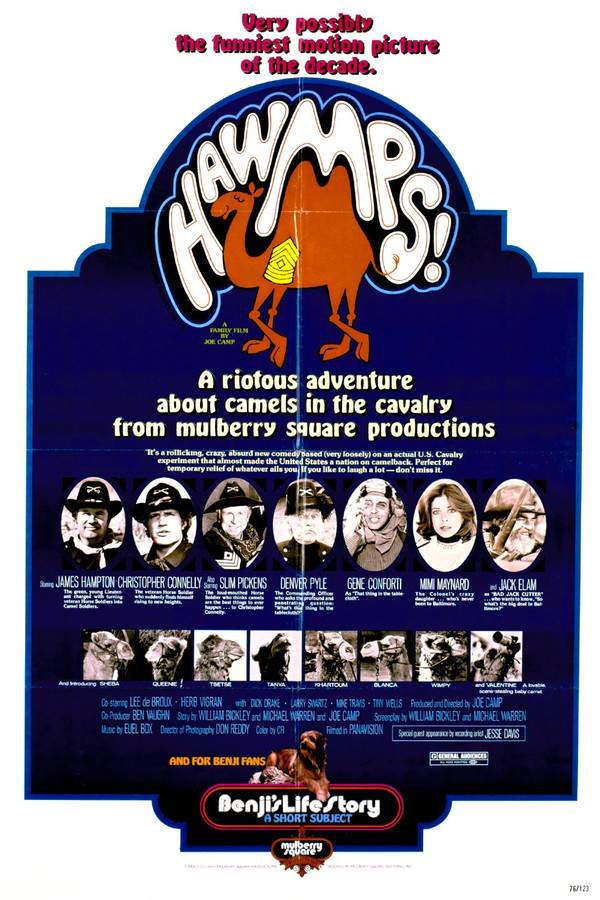
Hawmps! (1976) movie poster

Plot Summary

Hawmps! (1976) Plot Summary Explained

Release, runtime and language
1976 · 113 min · English
Loading streaming availability…
Directed by
Joe Camp
Starring
Slim Pickens, Herb Vigran, James Hampton, Denver Pyle, Lee de Broux, Frank Inn

A hapless Army officer and his loyal companion attempt to revolutionize the Texas cavalry by introducing camels instead of horses. Their ambitious plan quickly spirals into hilarious chaos as they struggle to adapt the unfamiliar animals to the challenging terrain of the American West, encountering resistance and unexpected complications along the way.

On this page (6)
  1. 1 Where to watch
  2. 2 What happens: full plot
  3. 3 Plot questions answered
  4. 4 Movie threads
  5. 5 Movies like Hawmps!
  6. 6 Every angle
Loading streaming availability…

Full plot summary · contains spoilers

What Happens in Hawmps!: Full Plot Summary

The whole story of Hawmps! (1976) explained, from the opening scene to the final frame: every key event, every twist and what it all adds up to. Read it as a quick recap before the sequel, to check a scene you missed, or to finally understand what really happened.

As Howard Clemmons captivates his grandchildren with engaging stories of his adventurous past, he transports them back to the year 1854. At this time, Clemmons, portrayed by Slim Pickens, was a young U.S. Cavalry Lieutenant thrust into an unusual experiment. Lacking seniority and notable influence within the army, Clemmons was selected for his modest demeanor to spearhead a remarkable project: employing camels as cavalry mounts in the arid landscapes of the southwestern United States.

His reminiscence begins at Fort Val Verde, Texas, where he is met by Sgt. Uriah Tibbs, played by James Hampton, who eagerly anticipates the arrival of Arabian horses. A mischievous tone creeps into Clemmons' narration as he highlights Tibbs' fierce competition for a spot in this esteemed initiative, leaving Tibbs puzzled as to why Clemmons remains secretive about the true identity of his "Arabian" mounts. Meanwhile, Col. Seymour Hawkins, the fort's commander, seems more preoccupied with perfecting his cannon skills than paying attention to Clemmons' camel aspirations.

As Clemmons inspects the assembled troops, including Nathaniel R. Higgins, played by Denver Pyle, who reenlisted solely for the privilege of riding a grand Arabian horse, a conflict stirs within Clemmons. Torn between divulging the truth and maintaining the facade surrounding the camels, his hesitation is interrupted when a careless cook douses him with a bucket of dishwater.

Later, while at the local saloon with Tibbs to discuss their ambitious project, they encounter the furious Sgt. Naman Tucker, whose ire is directed at Clemmons for the false promises of Arabian horses to his men. In a moment of awkwardness, Clemmons slides under the table as the two sergeants erupt into a brawl.

With the dawn of a new day, camels finally arrive at the fort, only for the cavalrymen to withdraw in alarm, leaving Clemmons to grapple with the challenges of camel handling. The skilled Hi Jolly, who is well-versed in all things camel, steps forward to assist Clemmons as they navigate the town streets. This escapade causes chaos: horses leap in terror, ladies scream, dogs bark frantically, a wagon overturns, and a barrel bursts, leaving Col. Hawkins' daughter, Jennifer, covered in sticky molasses. Enraged, the Colonel storms into Clemmons' quarters, threatening to cancel the entire operation. Nevertheless, Clemmons remains steadfast, asserting that he has received direct orders from Jefferson Davis, the Secretary of War. That night, Jennifer visits him, pouring molasses over his head in playful revenge and inviting him to afternoon tea.

As Hi Jolly initiates the camels' training, Tucker rides in to provoke Tibbs' men. Clemmons warns Tucker that further disrespect will lead to serious repercussions. Meanwhile, the pressure mounts and Clemmons faints from the stress. The soldiers' attempts to ride the camels result in comical failures, culminating in chaotic spills into dirt and water troughs. One night, Tucker makes a wager claiming he can lasso a camel, and when he succeeds, the agitated animal bolts, dragging him along.

As weeks slip by, Clemmons and the men gradually learn the art of camel riding, while he finds himself romantically involved with Jennifer. However, his luck takes a turn when he's tasked with capturing a Native American renegade. In their pursuit, Clemmons and his men are thrown off their camels at a river, leading Hi Jolly to explain that camels are naturally wary of water. Had Clemmons demonstrated the safety of the river, they would have navigated it without issue. During a quiet evening stroll, Clemmons confides in Jennifer about his struggles with the camel project, prompting her to challenge him to fight for his beliefs and career.

In a bold move, Clemmons proposes a daring 300-mile race against Tucker's horses, intending to prove the value of his camel initiative. When Hawkins declines, Clemmons resorts to deception, claiming the project has the President's endorsement. Unfortunately, Hi Jolly suffers injuries from a brawl, leaving him off the roster for the crucial journey. With encouragement from Jennifer, who gifts him a book on camel care, Clemmons feels invigorated and more connected to her.

As the race begins, cannon fire heralds the start, and Tucker's horses charge ahead. Yet, fueled by Clemmons' resolve, his men begin to catch up. Just when victory seems imminent, disaster strikes as Tucker and his men fall into the clutches of the nefarious outlaw Bad Jack Cutter at Dagger's Point.

Fueled by righteous anger, Clemmons launches a rescue mission, enlisting the help of Tibbs. They adopt disguises and integrate themselves into Bad Jack's gang, risking everything to save their captured comrades. Upon discovering Tucker and his men locked in a cell, their efforts to free them are met with a mix of tactics—first with a horse and finally using the strength of a camel to burst open the prison bars. However, during their escape, Tucker’s men abandon Clemmons and Tibbs, resulting in an all-out gunfight against overwhelming odds.

Just as desperation sets in, Clemmons' men arrive astride their camels, unleashing a valiant charge that sends the outlaws reeling. Yet, amid the celebration, Clemmons realizes a critical water barrel has been lost, leaving the group parched in an unforgiving landscape. While Tibbs urges a return to the river, Clemmons stubbornly presses forward, believing the mountains will lead them to salvation. After two grueling days of riding, they arrive at an oasis that turns out to be a desert mirage—dry and unwelcoming.

As tensions flare, Clemmons unexpectedly finds water, but his triumph is swiftly replaced by peril as Black Jack ambushes him. A fierce gunfight ensues, but fortune intervenes when a book Jennifer gave him serves as an unlikely bulletproof shield. As dawn breaks, Clemmons' gallant cavalry troop confronts Tucker and his weary horsemen near Dos Rios. In a moment of celebration, he learns through a telegram that Congress has authorized the construction of a transcontinental railroad, making the camel project obsolete. Despite protests from Tibbs and his comrades about the fate of the camels, Clemmons must acquiesce to orders to release them into the wild.

As Howard concludes his marvelous tale to enraptured grandchildren, his wife, Jennifer, calls for dinner from inside the house. With a warm smile, he steps out to ring the dinner bell, interrupted only by Hi Jolly, Higgins, and Tibbs, who inform him that one of their camels is about to give birth. As the four old soldiers shuffle toward the barn, Higgins reflects on the monotony of his new routine, lamenting, “Each day I must walk a mile for a camel,” his voice tinged with a mix of resignation and affection for the misadventures of his past.
Last updated: November 17, 2024 at 19:40

Was this helpful?

Plot questions answered

Hawmps! Plot Explained: Your Questions Answered

The questions people ask most about Hawmps! (1976): what happens in the confusing scenes, why the characters do what they do, the twists, hidden details and what the ending means. Each answer contains spoilers.

Q1

Why was Lieutenant Clemmons chosen to lead the camel cavalry project?

Clemmons was selected because he lacked seniority and influence within the army. His modest demeanor made him appear compliant and unlikely to question orders or raise objections about the unusual experiment. The army wanted someone who would simply carry out the directive without pushing back against the unconventional plan.

Foreshadowing: Earlier, the film establishes that Clemmons was a young lieutenant without notable rank or standing in the cavalry hierarchy.

  • lieutenant clemmons
  • camel project
  • army selection
  • jefferson davis
Q2

Why did the army want to use camels instead of horses in the American West?

Camels were well-suited to arid southwestern terrain where horses struggled. They could travel longer distances without water, handle harsh desert conditions better, and required less maintenance than horses in extreme heat. The U.S. Army saw potential in this experiment to revolutionize cavalry operations in the Southwest.

  • camels
  • horses
  • desert
  • army experiment
  • american west
Q3

Why did the camels refuse to cross the river during the pursuit of the Native American renegade?

Camels are naturally wary of water and refuse to enter it unless shown that it is safe. Hi Jolly explained that if Clemmons had demonstrated the river was safe, the camels would have crossed without issue. This natural aversion caused the cavalrymen to be thrown from their mounts.

Foreshadowing: This moment connects to earlier training scenes where soldiers struggled with the camels' unpredictable behavior around unfamiliar situations.

  • camels
  • river
  • crossing
  • hi jolly
  • native american
Q4

How did Clemmons rescue Tucker and his men from Bad Jack Cutter?

Clemmons and Tibbs disguised themselves and infiltrated Bad Jack's gang. They discovered Tucker locked in a cell and attempted to free him, first with a horse to break the bars, then using a camel's strength to finally break through. During the escape, Tucker’s men abandoned Clemmons and Tibbs, leading to a gunfight until Clemmons' camel-mounted cavalry arrived.

Foreshadowing: The earlier tension between Tucker and Clemmons sets up this rescue, transforming their rivalry into cooperation.

  • bad jack cutter
  • tucker
  • rescue
  • disguise
  • camel charge
Q5

Why was the camel cavalry project canceled after the race?

Congress authorized the construction of a transcontinental railroad, making the camel project obsolete. The railroad would handle the transportation needs the camels were meant to fulfill, rendering the entire experiment unnecessary. Clemmons received orders to release the camels into the wild.

  • congress
  • transcontinental railroad
  • canceled
  • obsolete
  • orders
Q6

How did the book Jennifer gave Clemmons save his life?

When Black Jack ambushed Clemmons and shot him, the book Jennifer had gifted him, which contained information about camel care, served as an unlikely bulletproof shield. The bullet struck the book rather than Clemmons, saving him from serious injury or death.

Foreshadowing: Jennifer gave Clemmons the book on camel care earlier, encouraging him to fight for his beliefs and career.

  • jennifer
  • book
  • bullet
  • black jack
  • survival
Q7

What happened to the camels after the project ended?

Clemmons was ordered to release the camels into the wild. The soldiers, particularly Tibbs and his comrades, protested the fate of the camels they had grown to know. Despite their objections, the camels were set free as the project was officially deemed obsolete.

  • camels
  • released
  • wild
  • tibbs
  • obsolete
Q8

Why did Clemmons propose the 300-mile race against Tucker's horses?

Clemmons proposed the race to prove the value of his camel initiative and silence critics who doubted the camels' usefulness. He wanted to demonstrate that camels could outperform horses in a long-distance challenge, which would justify the entire project to his superiors.

Foreshadowing: The race was Clemmons' response to the mounting pressure and skepticism from Hawkins and others at the fort.

  • 300 mile race
  • tucker
  • horses
  • cammels
  • competition
Q9

Why did Jennifer pour molasses over Clemmons?

Jennifer poured molasses over Clemmons in playful revenge for the chaos the camels caused in town. When the camels arrived, they startled horses, overturned a wagon, and knocked over a barrel of sticky molasses, all over Jennifer. She visited Clemmons that night to return the favor and invite him to tea.

Foreshadowing: Earlier, the camels caused complete chaos in town, with Jennifer getting covered in molasses from the overturned barrel.

  • jennifer
  • molasses
  • revenge
  • romance
  • fort
Q10

Why was Hi Jolly essential to the camel experiment?

Hi Jolly was the skilled camel handler who understood all aspects of camel behavior and care. He trained the camels and taught the soldiers how to handle them. When Hi Jolly was injured in a brawl before the crucial journey, Clemmons was forced to proceed without his expertise, making the challenges even greater.

Foreshadowing: Hi Jolly's expertise was introduced early when he stepped forward to assist Clemmons with the camels upon their arrival.

  • hi jolly
  • camel trainer
  • injury
  • journey
  • expertise
Q11

What was the significance of the oasis mirage in the desert?

After two grueling days of travel without water, Clemmons and his men discovered an oasis, only to find it was a mirage, offering no relief. This moment heightened the desperation of their situation before Clemmons unexpectedly found actual water nearby, providing temporary salvation.

  • oasis
  • mirage
  • desert
  • water
  • desperation
Q12

Why was Sgt. Tucker so hostile toward the camel project?

Tucker was angry because Clemmons had promised his men Arabian horses but instead delivered camels. This deception made Tucker and his men feel betrayed, leading to ongoing antagonism between Tucker and Clemmons throughout the experiment.

Foreshadowing: The film establishes early on that Tibbs and Tucker were competing for spots, expecting Arabian horses.

  • tucker
  • arabian horses
  • deception
  • hostility
  • sergeant

Movie threads

More Movies Like Hawmps!, by Mood & Story

Curated lists built around what makes Hawmps! tick: the same mood, the same kind of story or the same emotional payoff. Each list explains why these movies belong together.

Comical Historical Misadventures like Hawmps!

Well-meaning underdogs create hilarious chaos by challenging tradition. If you enjoyed the lighthearted chaos of Hawmps!, explore more movies like it. This thread gathers historical comedies and whimsical underdog stories where ambitious, unconventional ideas lead to hilarious misadventures and a nostalgic, feel-good vibe.

  • comical
  • lighthearted
  • whimsical
  • adventurous
  • nostalgic
  • feel-good
  • Tone: light, whimsical
  • Pacing: steady, event-driven
Why these movies?

The story pattern: The narrative pattern follows an optimistic protagonist with an unconventional idea that challenges the status quo. Their plan inevitably spirals into chaos, punctuated by slapstick humor and unforeseen complications, but ultimately leads to a personal victory even if the grand scheme fails.

Why they belong together: These movies are grouped by their light tone, low-stakes comedic pacing, and focus on historical or period settings where a 'fish out of water' premise drives the humor. They share a sense of whimsical adventure without heavy emotional consequences.

Bittersweet Underdog Triumphs like Hawmps!

Personal success shines against a backdrop of larger futility. For viewers who liked the ending of Hawmps!, this thread finds similar movies with bittersweet conclusions. These stories feature underdogs who prove themselves personally, even if their grand projects fail, blending feel-good character arcs with a touch of historical or situational poignancy.

  • bittersweet
  • feel-good
  • nostalgic
  • underdog
  • poignant
  • triumphant
  • Tone: lighthearted, bittersweet
  • Pacing: steady
Why these movies?

The story pattern: The emotional journey centers on a character striving to prove their worth through an ambitious project. While they succeed in their immediate goal (e.g., a rescue, winning affection), the story ends with their larger idea being obsolete or defeated, creating a blend of happiness and melancholy.

Why they belong together: This thread connects films through a specific emotional mix: a lighthearted, adventurous tone paired with a bittersweet ending feel. The focus is on the underdog's personal growth and validation, even when their grand vision is ultimately unsuccessful.

If you liked this

Movies Like Hawmps!

Similar movies to Hawmps!: the same genre, themes or kind of story. Each one comes with its own plot summary, timeline and ending explained.

Browse all movie summaries

Every angle

Hawmps! (1976) Explained: Plot, Timeline & Characters

Everything about Hawmps! in one place: what happens in the plot summary, the timeline in chronological order, the characters and meaning and a spoiler-free summary. What's After the Movie adds the cast, box office and post-credit scenes.

Coming soon on iOS and Android

The Plot Explained Movie Summary App

Plot summaries, endings explained and timelines on your phone. Catch up on any movie in minutes, save your favorites and never miss a twist again.

Be the first to know when we launch. Your email stays private, always.

Learn more about the app